(855) 676-0881

Commercial Door Closer Installation Guide: Regular Arm vs. Parallel Arm vs. Top Jamb Mount


Published: Nov 19, 2026

Selecting the correct mounting geometry for commercial door closers requires balancing structural dimensions with life-safety compliance. Most ANSI Grade 1 surface-mounted closers ship as “tri-pack” units containing hardware for three primary configurations: Regular Arm, Parallel Arm, and Top Jamb Mount.

Choosing the wrong mounting layout compromises spring leverage, accelerates component wear, and can cause compliance failures during building inspections.

Architectural Mounting Matrix


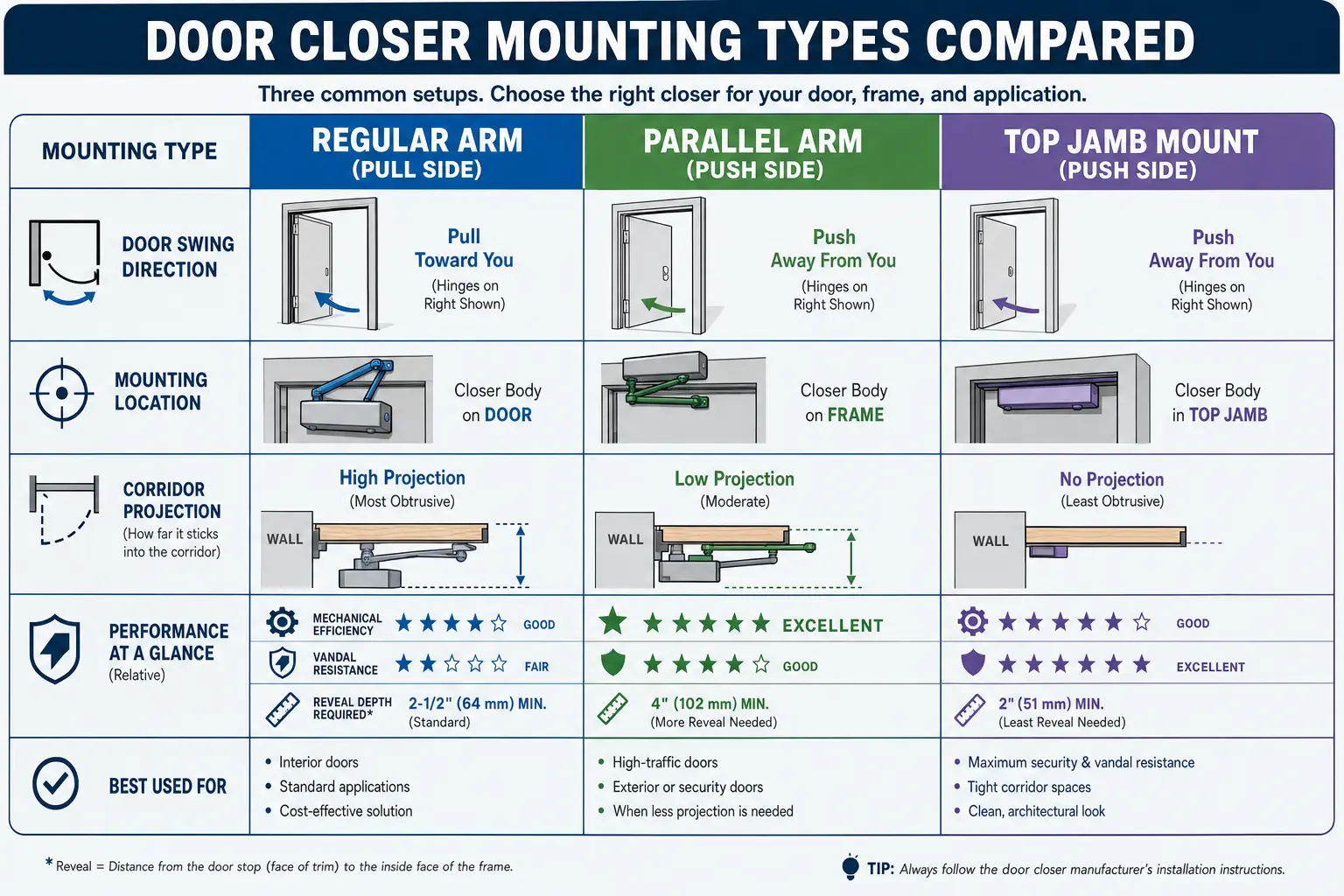
Side-by-side comparison of Regular Arm, Parallel Arm, and Top Jamb Mount door closers highlighting their mounting location, mechanical efficiency, corridor projection, and best use cases to clarify selection criteria.

Feature / Metric Regular Arm (Pull Side) Parallel Arm (Push Side) Top Jamb Mount (Push Side)
Mounting Location Body on Door / Arm on Frame Body on Door / Arm on Soffit Body on Frame / Arm on Door
Door Swing Side Pull Side (Hinge Side) Push Side (Stop Side) Push Side (Stop Side)
Mechanical Efficiency Highest (100% Baseline) Lower (15–20% Loss) High (90–95% Efficiency)
Corridor Projection High Projection Low Profile (Tucked) Moderate Projection
Top Rail Requirement Standard (2.5″–3″) Requires 4″+ (or drop plate) Narrow Rails (<2″)
Max Reveal Depth Flush (0″) Flush / Shallow Up to 8″ (Long Arm)

Need a Quick Fix?

Tell us what’s wrong with your door — we’ll get it sorted.

Regular Arm Mount (Pull Side): Maximum Mechanical Advantage


Regular Arm mounting positions the closer body on the pull side of the door leaf, with the main arm attached perpendicular to the frame face.

Engineering Dynamics

Because the main arm operates perpendicular to the frame, it achieves 100% baseline mechanical power transfer. This provides optimal closing torque and latching control on heavy timber or hollow metal openings. However, the arm projects directly into the room or corridor space, leaving hardware exposed. It requires a minimum top rail clearance of 2.5 to 3 inches on the door leaf.

Parallel Arm Mount (Push Side): Corridor Safety and Durability


In a parallel arm setup, the closer body mounts to the push side of the door leaf, while the arm folds parallel to the frame face via a soffit plate bracket.

The Mechanical Efficiency Penalty

Parallel arm geometry alters mechanical leverage, creating an intrinsic 15% to 20% efficiency loss. To maintain reliable closing and latching force, specifiers must scale spring power up by +1 size (for example, adjusting a multi-size spring from Size 3 to Size 4).

High-Traffic Protection

Despite efficiency trade-offs, parallel arm mounts are preferred in school corridors and healthcare facilities. Folding the arm flat beneath the frame soffit protects components from abusive contact and equipment collisions. If physical impacts fracture internal hydraulic seals over time, quick intervention prevents issues associated with a door closer leaking oil on surrounding flooring. Specialized Heavy-Duty (EDA) or Cushion-Stop (CUSH) arms add integrated dead-stop buffers for severe usage.

Top Jamb Mount (Push Side): Solving Narrow Top Rails and Deep Reveals


Top Jamb mounting places the closer body directly on the head frame face on the push side, while the shoe attaches to the door leaf.

Frame Reveal Depth Thresholds

This configuration suits storefront doors requiring commercial storefront door repair, where narrow glass top rails (<2 inches) cannot accommodate a closer body. Hardware selection relies on frame reveal dimensions:

  • 0″ to 2″ Reveal: Standard top jamb arm assembly.
  • 2″ to 4″ Reveal: Extended arm foot paired with frame drop plates.
  • 4″ to 8″ Reveal: Long main arm required to clear deep exterior soffits while maintaining resistance against wind stack pressures.

Code Compliance: Accessibility and Life Safety


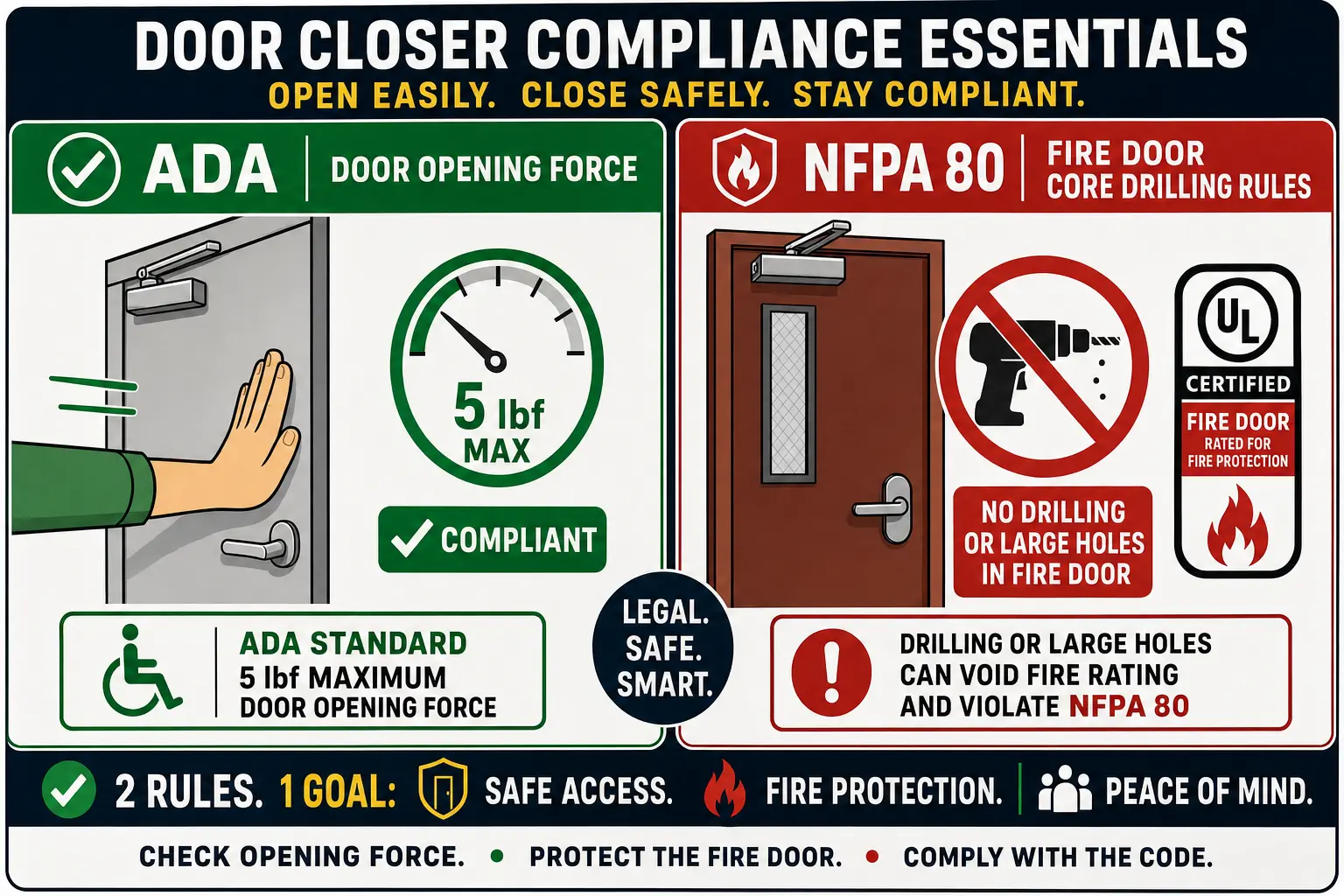
Visual memory aid highlighting the ADA maximum 5 lbf interior door opening force requirement and NFPA 80 core drilling prohibitions on fire-rated doors to ensure code-compliant installations.

ADA Standards for Accessible Design

Per ADA Section 404.2.9, interior non-fire-rated commercial doors must not exceed a maximum opening force of 5 lbf (22.2 N). Hydraulic sweep speed must also allow the door to close from 90 degrees to 12 degrees in no less than 5 seconds. Fine-tuning these rates relies on precise commercial door closer adjustment. When exterior drafts make manual compliance difficult, facility managers should evaluate an ada door operator installation.

NFPA 80 Fire Door Mandates

Fire-rated openings require Grade 1 closers certified for 2,000,000 cycles under ANSI/BHMA A156.4 (Grade 2 closers, rated at 1,000,000 cycles, are prohibited on fire assemblies). Fastening hardware to hollow metal or mineral-core fire doors requires through-bolts or sex-nuts. Field-drilling unauthorized mounting holes or installing unapproved hold-open arms voids UL fire labels during an nfpa 80 fire door inspection. Any latching hardware on fire doors must satisfy mandatory commercial door panic bar code requirements.

Decision Framework: Selecting Your Configuration


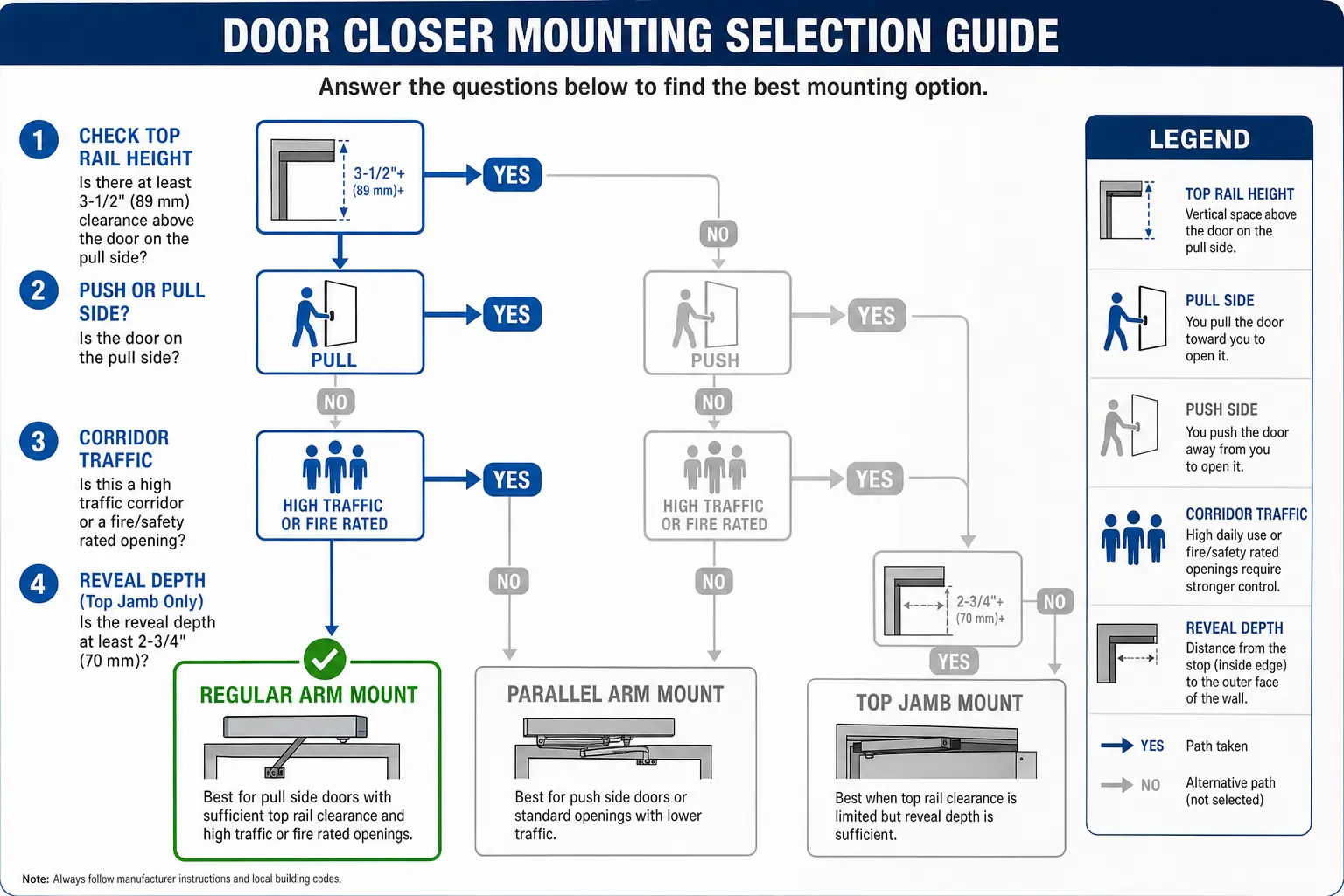
Step-by-step decision flowchart simplifying the selection process among Regular Arm, Parallel Arm, and Top Jamb mount door closers based on architectural and usage factors.

Evaluate hardware layout choices using this evaluation sequence:

  1. Top Rail Profile: If the top rail height is under 3 inches, select Top Jamb Mount.
  2. Corridor Protection: If mounting on the push side in high-traffic hallways, specify Parallel Arm Mount.
  3. Mechanical Leverage: For standard interior pull-side doors needing maximum efficiency, choose Regular Arm Mount.
  4. Exterior Reveal Depth: For exterior doors with reveals between 4 and 8 inches, install Top Jamb Mount with a Long Arm.

For specialized retrofits or comprehensive opening upgrades, professional commercial door installation ensures long-term operational integrity and code alignment.

Frequently Asked Questions


Why does a parallel arm door closer require higher spring power than a regular arm mount?

Parallel arm geometry reduces mechanical leverage by 15% to 20%. To offset this power loss and ensure positive latching against draft pressures, technicians must increase the spring size setting by one level compared to a regular arm layout.

Can hold-open door closers be installed on fire-rated doors?

Manual mechanical hold-open arms are prohibited on NFPA 80 fire doors, which must remain self-closing and positive-latching. Automatic hold-open units are allowed only if electronically connected to the building’s fire alarm system to release upon smoke detection.

What frame reveal depth requires an extended top jamb arm?

Standard top jamb arms accommodate reveals up to 2 inches. Frame reveals between 2 and 4 inches require extended arm feet or drop plates, while deep reveals from 4 to 8 inches require specialized long top jamb main arm assemblies.