(855) 676-0881

Stop Your Screen Door From Falling Off Its Track: Calibrating Roller Height and Retainers


Published: Nov 18, 2026

When a sliding screen door repeatedly derailments every time you move it, it is easy to assume the frame is ruined or the track is permanently damaged. However, diagnostic field data shows that over 80% of sliding screen door derailments are caused by improper roller height calibration or collapsed internal tension springs rather than structural track distortion.

Before committing to buying a brand-new setup, evaluating whether your issue stems from simple height miscalibration, failing retainer clips, or structural frame fatigue helps you choose the most reliable, cost-effective solution.
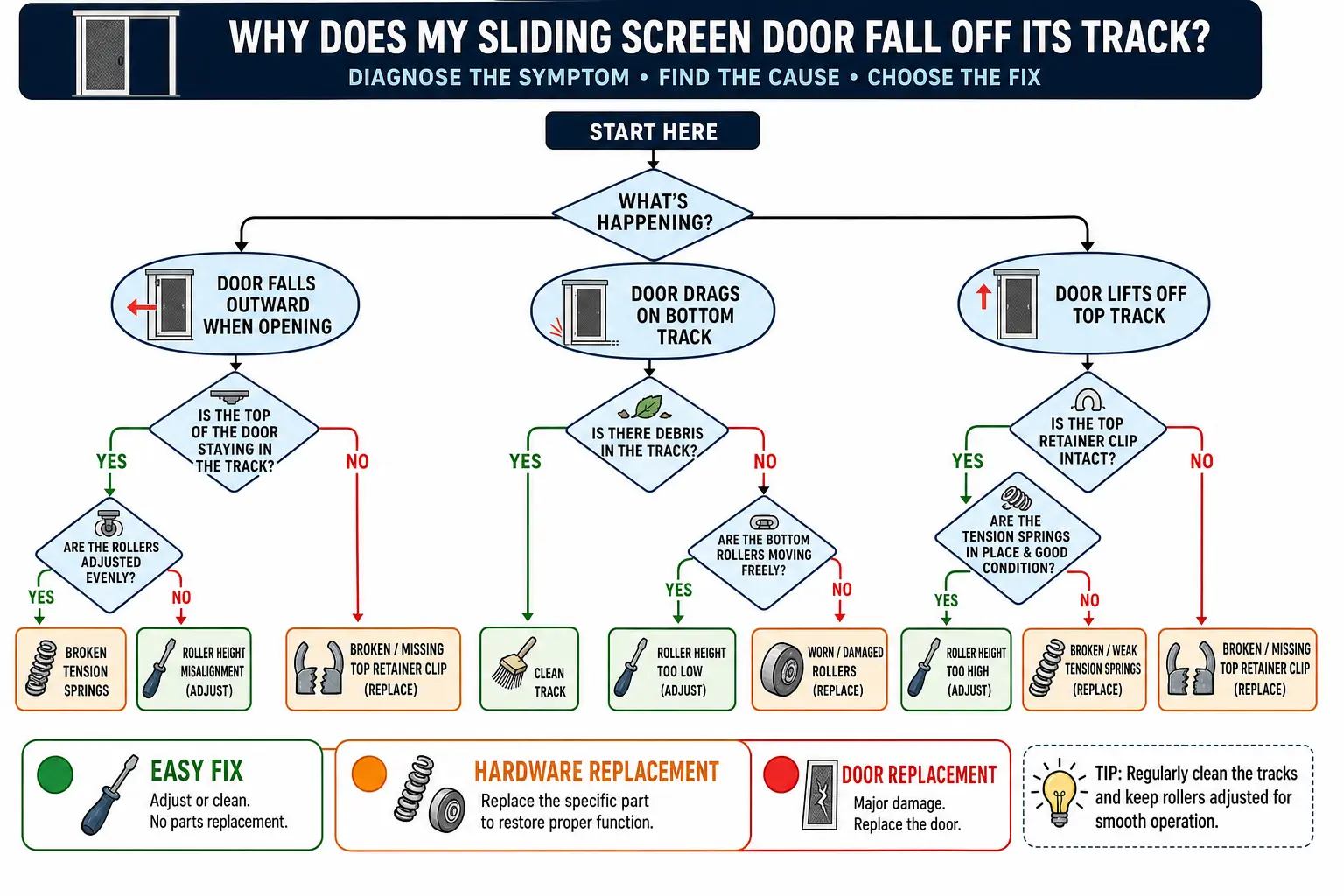
Executive Diagnostic Flowchart: Why Is Your Screen Door Falling Off?


Step-by-step diagnostic guide to identify why a sliding screen door falls off its track, helping users quickly target the exact fix needed.

Identifying the specific physical behavior of your screen door reveals the underlying mechanical defect:

  • Symptom 1: Door drags along the bottom sill and hops out.
  • Root Cause: Bottom rollers are fully retracted or flat-spotted; lack of height elevation lets the aluminum frame rub directly on the sill.
  • Symptom 2: Door swings outward from the top track when operated.
  • Root Cause: Missing, broken, or disengaged top retainer clips combined with excessive top channel clearance.
  • Symptom 3: Door sticks midway and lifts off the bottom track.
  • Root Cause: Debris accumulation in track channels or uneven tension between left and right roller assemblies causing frame rack twist.

Targeting the root cause prevents unnecessary spending during home maintenance or sliding door track repair.

Need a Quick Fix?

Tell us what’s wrong with your door — we’ll get it sorted.

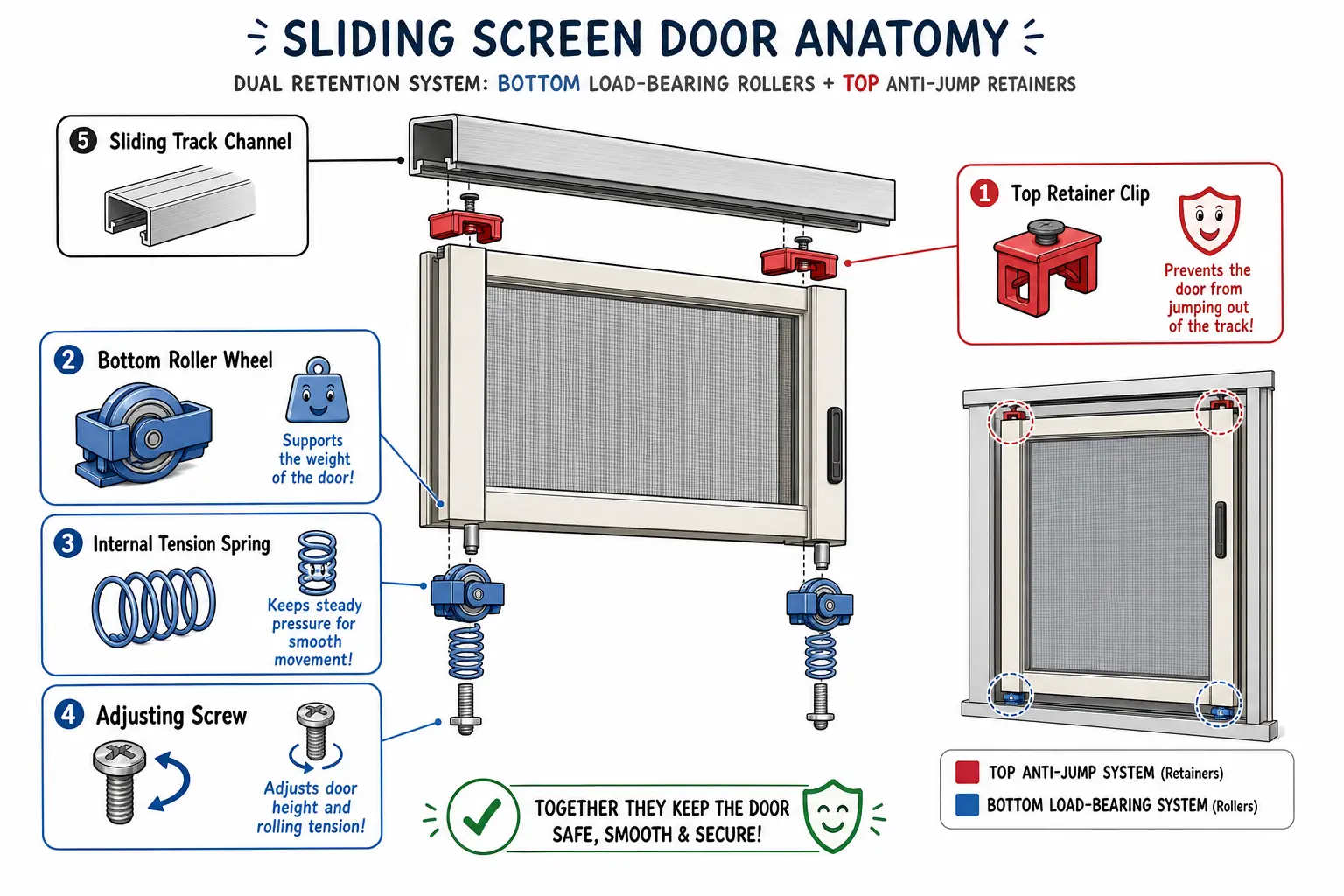
Anatomy of a Sliding Screen Door: Rollers, Springs, and Retainer Clips


Visual breakdown of how sliding screen door rollers and top retainer clips work together to keep the door aligned and prevent it from falling off its track.

Sliding screen doors depend on a dynamic dual-axis retention system to remain captive in their tracks:

  1. Bottom Load-Bearing Rollers: Positioned inside the lower corners, these wheels support the physical weight of the panel while riding along a raised track bead.
  2. Top Retainer Clips & Tension Guides: Fitted into the upper frame corners, nylon anti-jump retainers or spring-loaded guides fit into the deep upper channel to stabilize the door against lateral force and wind.
  3. Internal Tension Springs: High-tension spring steel housings hold the rollers against the track, absorbing minor variances in threshold elevation.

Step-by-Step Calibration: Adjusting Roller Height & Resetting Retainers


Calibrating your screen door height requires minimal tools, typically just a #2 Phillips screwdriver, but demands attention to alignment tolerances.

  1. Locate the Adjustment Screws: Look near the inner face or side edge of the frame corners for the roller adjustment access holes.
  2. Understand Screw Mechanics:
  • Clockwise Rotation: Lowers the internal roller housing, pushing the wheel outward and raising the screen door panel.
  • Counterclockwise Rotation: Retracts the wheel higher into the frame, lowering the screen door panel.
  1. Calibrate Top Target Gap: Adjust bottom rollers until the panel sits level with an exact 1/8-inch clearance gap inside the upper track channel.
  2. Engage Anti-Jump Retainers: Adjust top retainer clips upwards so they extend into the top channel guide, keeping the door captive without binding.

Pro Tip: Avoid using petroleum-based lubricants (like standard WD-40 or heavy grease) on screen door tracks. Petroleum attracts dust and grit, forming a destructive grinding paste that ruins nylon wheel bushings. Use a clean cloth and dry silicone spray instead.

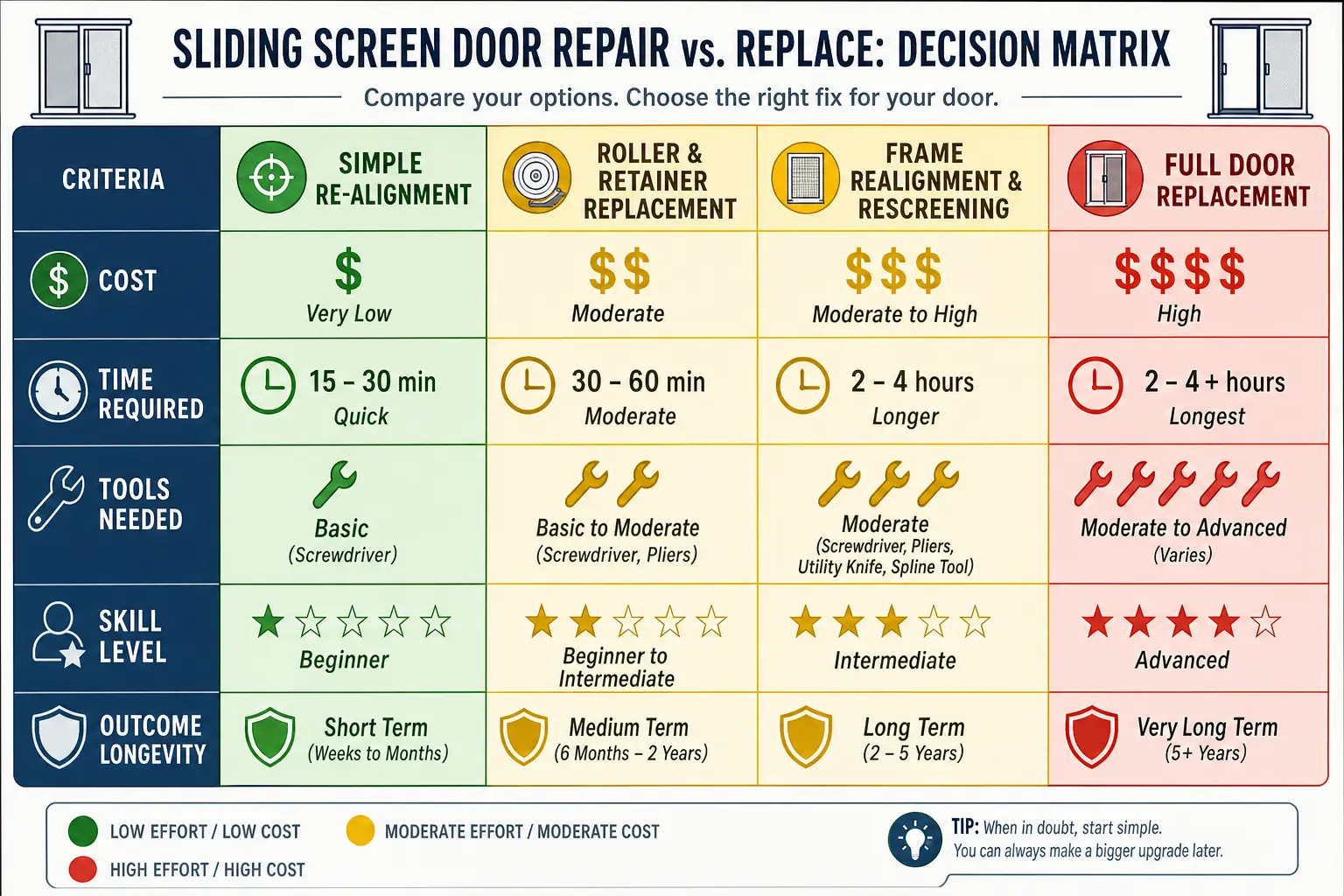
Evaluation Matrix: Adjust, Repair Hardware, or Replace the Door?


Comprehensive evaluation table helping users choose whether to adjust rollers, replace hardware, or invest in full screen door replacement based on key criteria.

When deciding how to resolve track derailments, evaluate hardware condition against frame integrity:

  • Option A: Re-Alignment & Calibration (~10 mins)
  • Best for: Intact rollers where screws simply loosened over time.
  • Option B: Hardware Refresh Kit (~45 mins)
  • Best for: Broken springs, flattened nylon wheels, or worn top clips on a straight, unbent aluminum frame.
  • Option C: Professional Service (Pro Install)
  • Best for: Complex door frame alignment, custom fitting, or when combined with professional screen door repair & replacement.
  • Option D: Full Screen Door Replacement
  • Best for: Severely bowed, bent, or twisted frames where extruded corners have separated.

Hardware Selector: Matching Wheels and Retainer Styles


If replacing hardware, matching component specifications ensures smooth operation:

  • Nylon vs. Steel Ball-Bearing Wheels: Nylon wheels offer quiet sliding and complete rust resistance. Steel ball-bearing assemblies provide enhanced weight capacity and long-term durability for high-traffic patio entrances.
  • Wheel Profiles: Concave wheels feature a grooved center designed to ride on raised rail beads, while convex wheels feature a rounded profile meant for flat or recessed channels.
  • Frame Matching: Selecting proper materials and matching different types of screen doors guarantees long-term durability suited to your local environmental conditions.

Frequently Asked Questions


Why does my screen door keep jumping off the top track?

Top track derailment occurs when top retainer clips are broken, unengaged, or when bottom rollers are set too low. If the door panel drops below its intended height, excess clearance in the top channel allows the door to tilt and pop off the frame during normal use.

Should I use WD-40 to make my screen door slide smoother?

No. Standard WD-40 and petroleum lubricants leave a sticky film that attracts dirt, hair, and grit. This creates an abrasive compound that destroys nylon roller bushings. Use a dry silicone lubricant after thoroughly clearing track channels.

How do I know if I need to adjust the rollers or replace the entire door?

If turning the adjustment screws successfully lifts the frame and establishes a consistent 1/8-inch top clearance, calibration is all you need. However, if adjustment screws spin loosely without moving the wheels, or if the metal frame itself is warped out of square, full door replacement is recommended.