

Automatic Door Repair
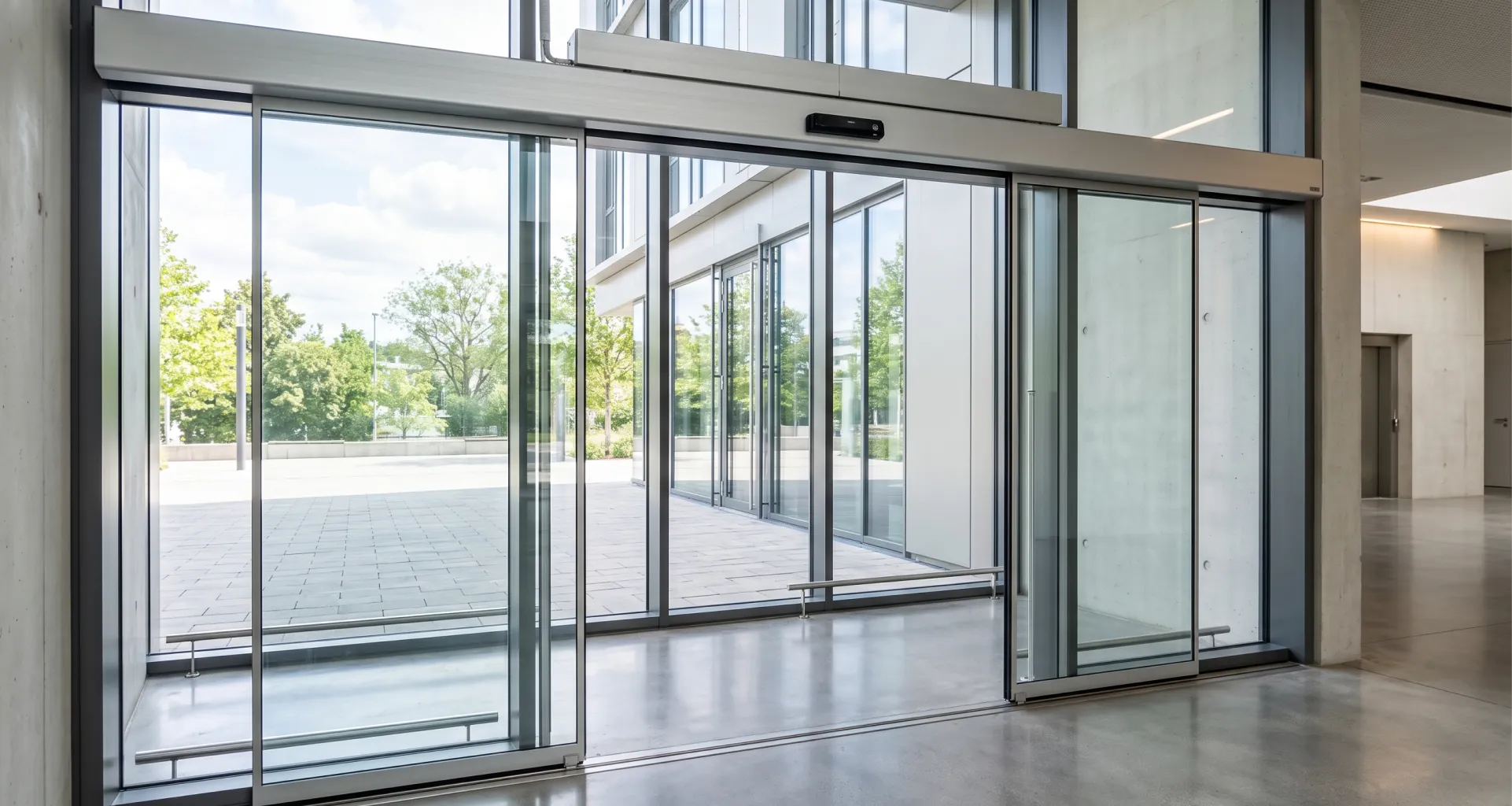
A1 Door Services repairs commercial automatic entrances of every type and make across Texas, Connecticut and Alabama — sliding, swing, folding, revolving, ICU, specialty and security doors, whoever built them and whoever installed them. Repairs start with a diagnosis rather than a parts swap. A door that drags, stalls, slams or refuses to complete a cycle can be the drive, the running gear, the control board or the frame it hangs in, and replacing the wrong one only produces a second visit.
 (855) 676-0881
Get in touch with us
Call us 24/7: (855) 676-0881
Or Let Us Call You
How the Diagnosis Works
The technician runs the door through a full cycle in both automatic and manual modes before anything is opened up. How the door behaves through that cycle narrows the fault to one of four groups: the drive and running gear, the sensing and activation package, the controls and power, or the frame and structure the door sits in.
From there it is a matter of confirming rather than guessing — belt tension and carrier condition checked by hand, board and power supply checked at the terminals, detection zones walked and observed, and the opening measured for square where the symptoms point to the frame.
We tell you what failed and what caused it. A carrier set that has worn out in eight months is a symptom of a bent track, and replacing only the carriers puts you back in the same position by the end of the year.
Operator and Drive Repair
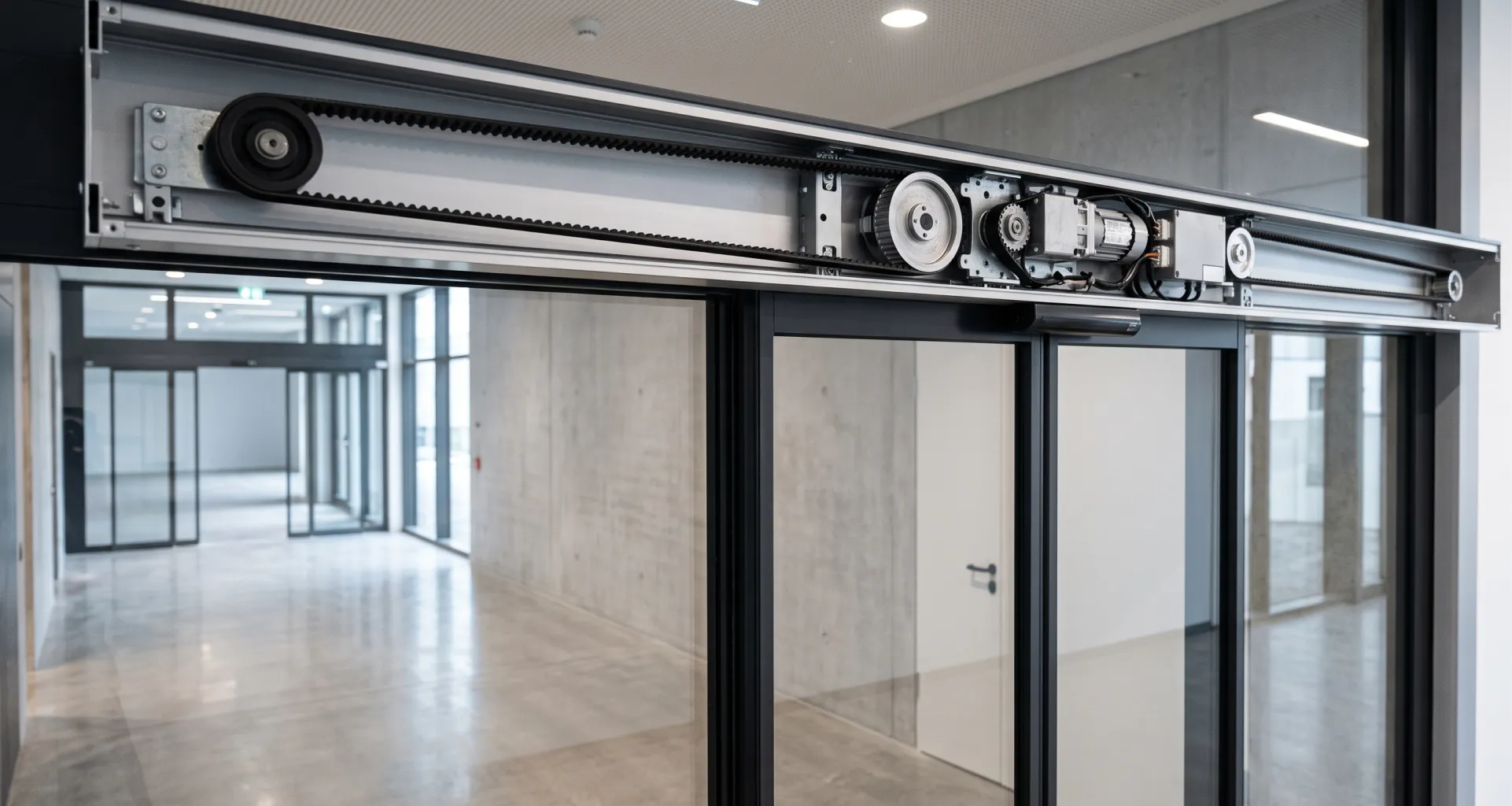
Inside the header the wear items are the motor and gearbox, the drive belt and pulleys, and the encoder and limits that tell the operator where the door is. A stretched or slipping belt makes a door slow, jerky or unable to finish its cycle. A failing motor or gearbox makes it noisy, weak or intermittent, and often only under load.
On swing systems we repair and replace arms, linkage, spindles and the operator body. On revolving doors we service canopy and ring drives, speed control and the night lock. On folding doors we repair hinge and pivot assemblies and the panel hardware.
Where an operator has been undersized for the door from the outset, we say so rather than repairing it a third time.
Track, Carrier and Roller Repair
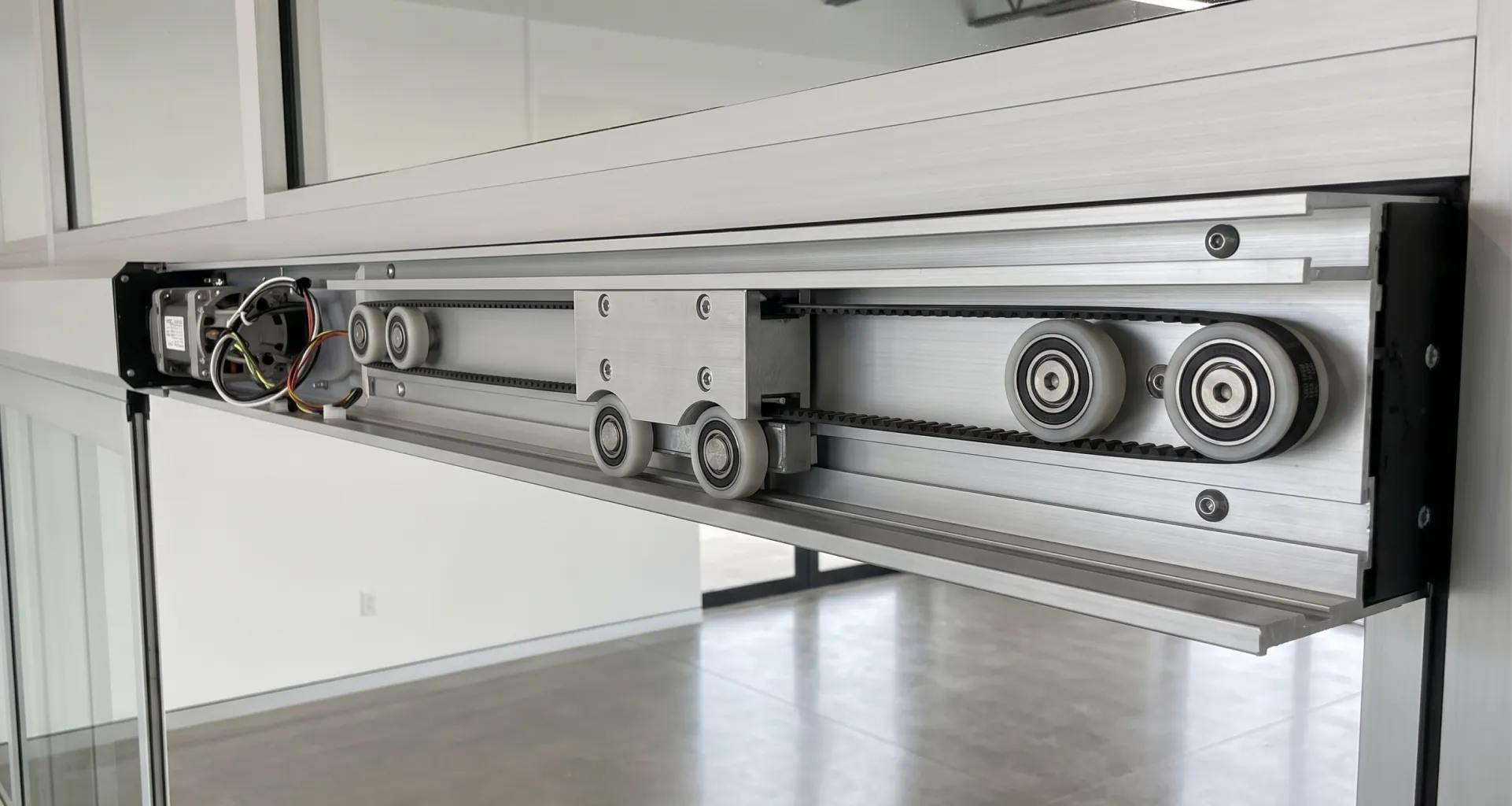
Worn carriers and hanger rollers make a sliding door drag, bind or come off its track, and a bent or contaminated track will destroy a new set of rollers within weeks.
We replace carriers, hanger and anti-riser rollers, bottom guides and damaged track sections, clean and realign the track and square the opening. Where a panel has derailed, we correct the alignment rather than forcing the panel back on — forcing it is what turns a running-gear repair into a panel replacement.
Floor tracks in high-cycle buildings are cleared of grit and debris as part of the repair, because that is what is grinding the guides down in the first place.
Control Board and Electrical Repair
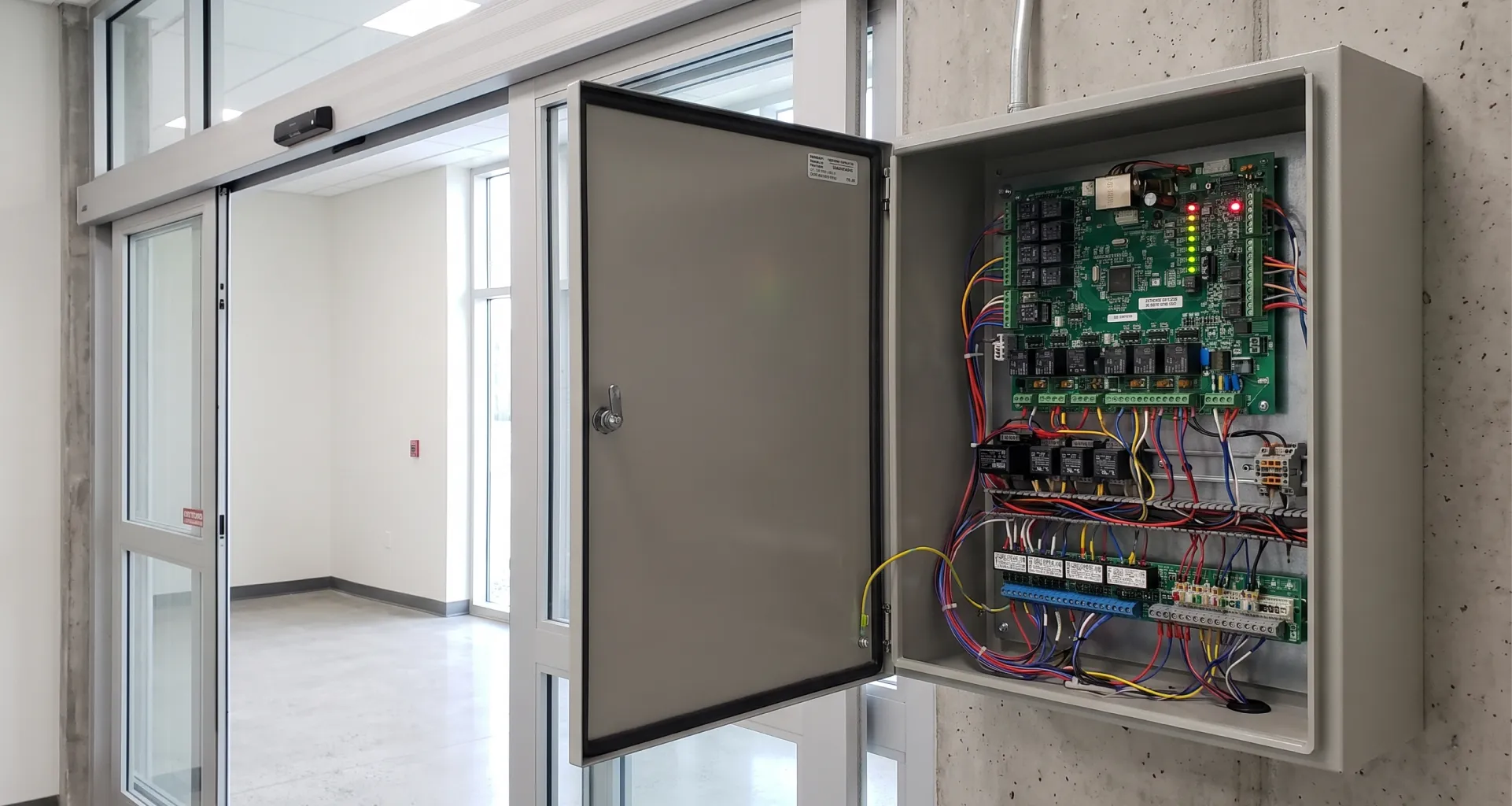
Intermittent faults, doors that reset at random and entrances that are simply dead are traced through the power supply, transformer, control board, encoder and limits, relay board and low-voltage wiring — including the fire alarm interface and the access control connections that can hold a door open or keep it locked.
We repair and replace control boards and logic modules across current and obsolete platforms, and cross-reference discontinued boards to a current equivalent where the original is no longer made.
Where an entrance keeps tripping or resetting, we check the supply and the earth before replacing anything, since a board that fails twice in a year is usually telling you about the circuit rather than about itself.
Panel, Glass and Weather Seal Repair
We replace broken and cracked glass in entrance panels, sidelites and transoms, along with damaged stiles and rails, glazing gaskets and beads. Tempered, laminated and insulated units are measured on site and fitted when they arrive, with the opening secured in the meantime.
Worn weather stripping, brush seals, meeting-stile seals, sweeps and thresholds are replaced in the same visit — these are the parts that let water, air, dust and pests through an entrance that otherwise looks fine, and they are the cheapest thing on the door to put right.
Frame, Header and Threshold Repair
A surprising share of automatic door faults are structural rather than mechanical. A racked or dropped frame makes a swing operator fight the door on every cycle. A header that has sagged puts the panels out of plumb and wears the carriers unevenly. A threshold that has lifted catches the bottom guide.
We square frames, correct header support, repair and replace thresholds and jambs, and reset the hardware before touching the operator settings — because an operator tuned to compensate for a bent opening is never right for long.
Repairs by Door Type
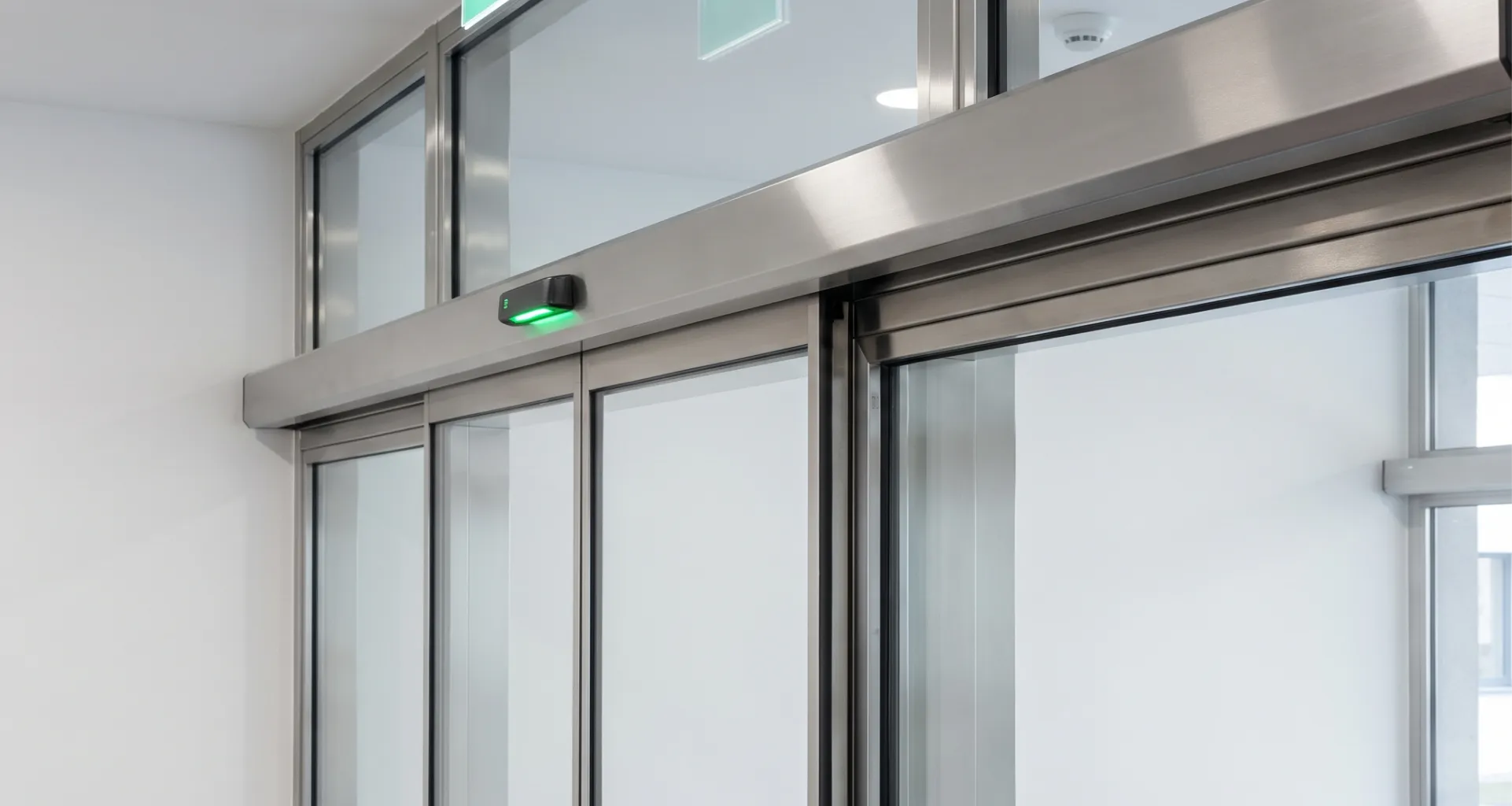
Sliding entrances
Belt, carrier, roller, bottom guide and track repair, breakout switch and panel service, meeting-stile seal replacement and header realignment.
Swing doors and operators
Arm, linkage and spindle repair, operator replacement, closer and latch alignment, guide rail and safety sensor service, timing and force reset.
Folding entrances
Hinge, pivot and panel hardware repair, drive service, breakout operation and speed setting.
Revolving doors
Canopy and ring drive service, speed control, breakout force correction, wing seal and glass replacement, night lock repair.
ICU and hermetic doors
Seal and gasket replacement, breakaway leaf service, quiet-running drive repair, all carried out inside occupied units.
Faults We See Most Often
- Door drags, binds or comes off track.
- Door opens or closes too slowly, or stalls part way through the cycle.
- Door slams, bounces or fails to latch.
- Door will not respond to the push plate or key switch.
- Operator runs but the panel does not move.
- Door resets, cycles at random or is completely dead.
- Entrance leaks air and water through worn seals and thresholds.
- Glass, panel or threshold damaged by impact.
Emergency and Scheduled Repairs
Not every automatic door repair is urgent, and treating them all the same way wastes money. A door that is noisy, slower than it was, or leaking air through worn seals is a scheduled repair. A door that will not close, will not open, is off track or is closing on people is an emergency.
We take both, and the difference is how they are handled: an emergency is attended around the clock and made safe before anything else; a scheduled repair is planned into a window that suits the building and carried out with the right parts already on the van.
Where a scheduled repair reveals something urgent — a failing presence sensor, a cracked header, a breakout that will not release — we say so on the spot rather than adding it to a report.
Service Areas
Texas — Austin, Cedar Park, Cypress, Richardson, McKinney, Sherman, Paris. Connecticut — Hartford, New Haven, Danbury, Greenwich. Alabama — Birmingham.
Tell us the door type and what it is doing, and we will send a technician with the parts that fault usually needs.
Our Services
Frequently Asked Questions
Do you repair brands you do not sell?
Yes. We repair every major automatic door brand in the North American market, including systems that are no longer manufactured, and cross-reference discontinued parts to current equivalents.
My door came off its track — can it be repaired?
In most cases yes. Doors derail because carriers or rollers have worn or the track has been knocked out of line. We replace the running gear and correct the alignment instead of forcing the panel back into the track.
Why does my automatic door open slowly or stall?
Usually a stretched drive belt, worn carriers, a dirty or bent track, or an operator losing torque under load. A technician can narrow it down within a few minutes at the door.
Can an obsolete automatic door be repaired?
Often yes. Many legacy systems can be kept running with cross-referenced parts. Where nothing current fits, we say so plainly instead of stringing out repairs.
Do you carry parts on the truck?
Yes. Trucks are stocked with the components that fail most often — belts, carriers, rollers, boards, actuators and seals — so many calls are finished on the first visit.
The door was repaired recently and has failed again — why?
Usually because the underlying cause was not addressed. Carriers that wear out quickly point to a bent track; boards that fail repeatedly point to the supply; an operator that keeps failing is often undersized for the door.
Do you repair the frame as well as the door?
Yes. Racked frames, dropped headers and lifted thresholds are corrected as part of the repair, because an operator tuned around a bent opening will not hold its settings.