When an overhead garage door malfunctions or ages, homeowners face a high-stakes decision: execute a minor DIY repair, hire a professional, or invest in a modern replacement. With total installation costs averaging a national median of $996 ($700 to $1,500 overall), choosing the right path requires clear diagnostic steps, hardware pricing transparency, and safety standard compliance.
Residential Overhead Garage Doors: Installation, Repair and Upgrade Guide
Published: Oct 15, 2026
Diagnostic Quick-Find: System Failure Symptoms
Identifying the exact failure point prevents unnecessary hardware replacements. Key symptoms include:
- Motor Hums, Door Doesn’t Move: Typically indicates a stripped main drive gear or broken trolley connection.
- Door Reverses Instantly: Often caused by misaligned photo-eye safety sensors or object obstruction.
- Jerky or Uneven Travel: Points to worn rollers, snapped cables, or unbalanced spring tension.
- Remote Fails, Wall Console Works: Signals depleted battery, lost rolling code memory, or faulty logic board receivers.
The Door Balance Test: Safety and Mechanical Mechanics
Before servicing or replacing an opener, test the door’s mechanical balance. A common misconception is that garage door openers lift heavy doors; in reality, high-tension torsion springs perform 95% of the heavy lifting. Openers merely guide movement.
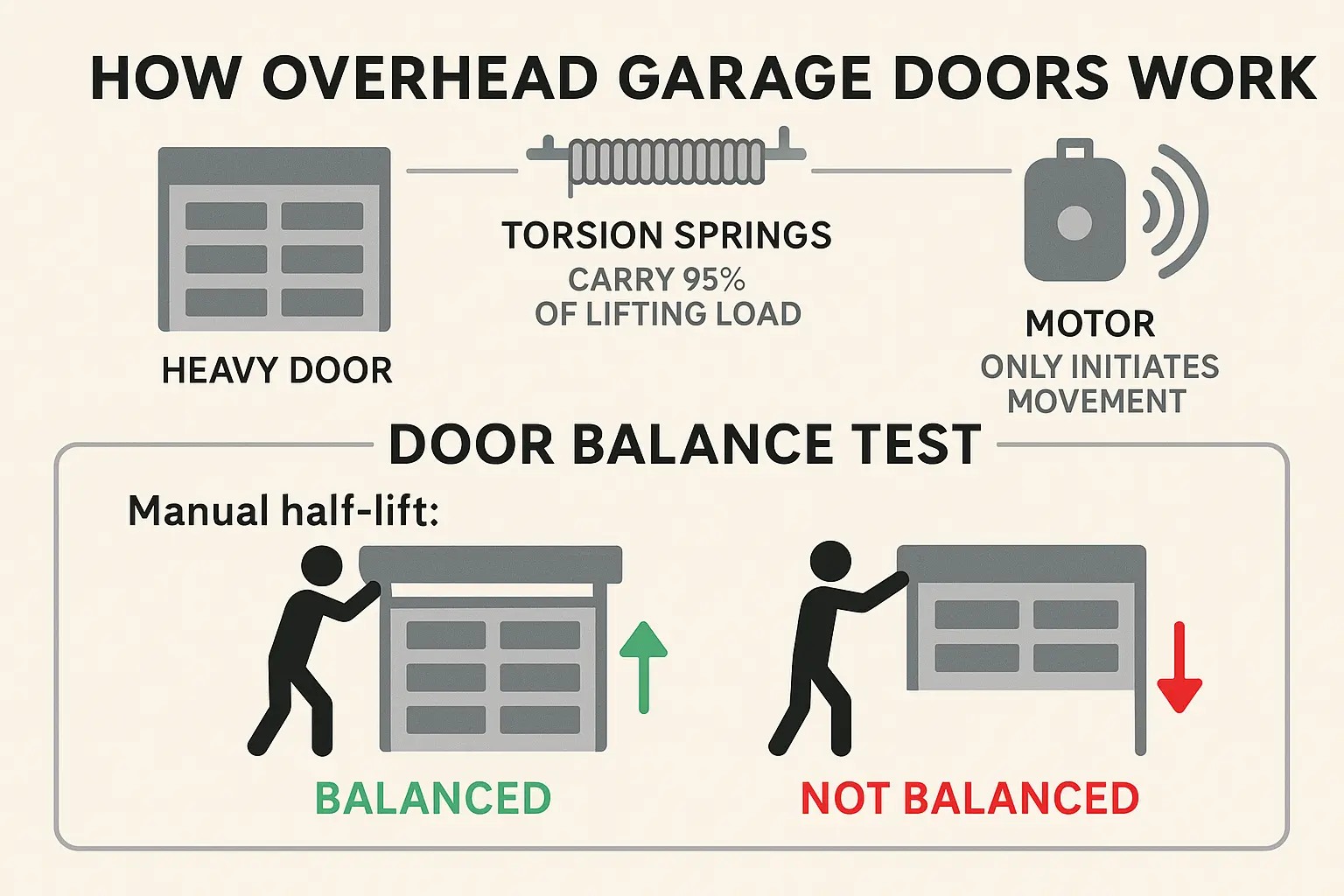
How to Perform the 30-Second Balance Test:
- Disconnect the opener by pulling the emergency release cord.
- Manually lift the door smoothly to waist height (about 3–4 feet off the ground) and let go.
- Result: If the door stays in place, springs are balanced. If it crashes down or shoots upward, the springs are out of balance. Installing a new opener on an unbalanced door destroys the drive gear within months.
Repair vs. Replace Matrix: Making the Right Investment
Evaluating whether to fix an existing system or fund a full replacement comes down to three concrete factors: system age, safety standards, and repair costs.
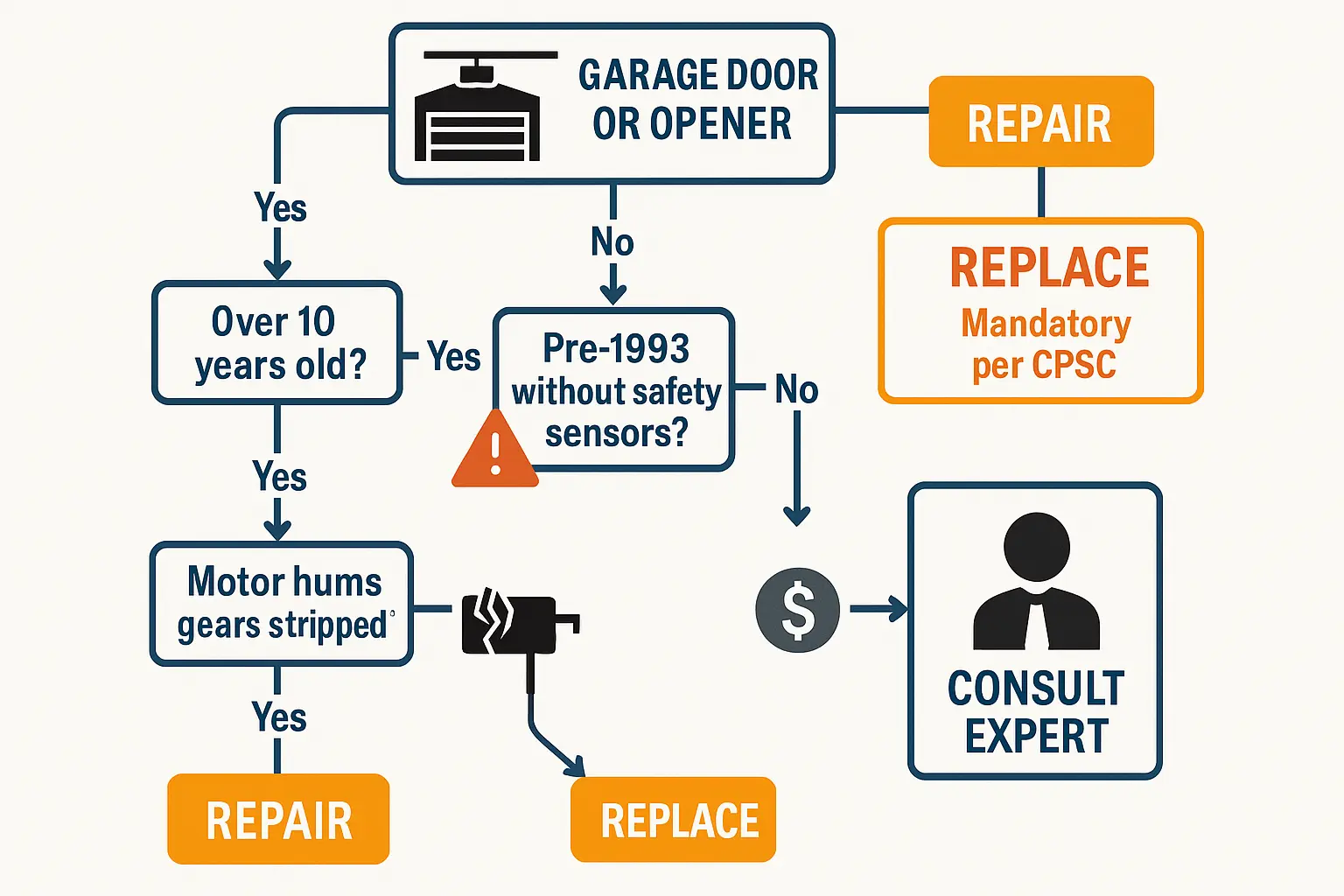
- 10-Year Rule: Systems under 10 years old with minor issues (accessory re-pairing, sensor realignment, gear kits) should be repaired—median professional accessory tickets cost $140–$150.
- Pre-1993 Safety Compliance: Federal CPSC regulations and UL 325 mandates require automatic non-contact safety reversal sensors. Openers built before 1993 lack photo-eyes, cannot legally be serviced, and require complete replacement.
- 50% Cost Threshold: If a quote for logic board replacement, motor swap, or extensive wooden garage door repair exceeds 50% of a full system replacement, upgrade to a modern system.
Modern Upgrades: Smart Ecosystems & Safety Compliance
Upgrading your overhead system adds convenience, security, and climate efficiency:
- Smart Connectivity: Systems utilizing myQ, Aladdin Connect, or Apple HomeKit enable remote monitoring, live video feeds, and timed automatic closure.
- Battery Backups: Legally mandated in states like California (SB-969), battery backup units ensure continuous operation during grid power outages.
- Panel Insulation: Replacing uninsulated steel panels with polyurethane (R-12 to R-18) or polystyrene insulated panels improves thermal efficiency and noise reduction.
Contractor Vetting: Avoiding Hidden Fees
When scheduling service through a reliable local provider for garage door repair near me, ask these six questions to avoid hidden quote bloat:
- Is old hardware haul-away included in the estimate?
- Does the price include testing and balancing existing torsion springs?
- Are new photo-eye sensors and wall consoles included?
- Is ceiling electrical framing or outlet relocation required?
- What warranty covers parts versus labor?
- Are your technicians fully licensed, bonded, and insured?
Frequently Asked Questions
How do I know if my garage door issue is the opener or the spring?
Disconnect the opener by pulling the red emergency release cord and manually lift the door. If the door feels extremely heavy or won’t stay open at mid-travel, the spring is worn or broken. If the door moves easily by hand but the motor hums without moving, the issue lies within the opener.
Can I replace a garage door opener myself?
While DIY installation is possible for simple overhead rail units, professional installation ensures proper ceiling mounting, limit switch programming, force calibration, and compliance with UL 325 safety reversal standards. Torsion spring adjustments during installation should always be handled by trained experts due to high mechanical tension.
Why are openers made before 1993 mandatory to replace?
Federal regulations established by the CPSC in 1993 require all residential openers to feature external non-contact safety reversal sensors (photo-eyes). Units manufactured prior to 1993 lack these critical entrapment prevention features and cannot legally be serviced or repaired by professional technicians.