(855) 676-0881

How to Stop a Commercial Door From Slamming: The Definitive Calibration Guide


Published: Sep 30, 2026

A slamming commercial door is more than an annoyance—it is a significant liability. Constant high-impact slamming damages door frames, loosens hinges, and compromises building security. More importantly, poorly adjusted door closers can result in costly ADA compliance penalties or violate local fire safety codes.

For facility managers and property owners, maintaining a safe, quiet entryway is a continuous balancing act. Correctly adjusting a commercial door closer requires understanding the physics of hydraulic valves, managing environmental pressure, and navigating strict accessibility standards.


The Stop-Sign Diagnostic: Is Your Closer Actually Fixable?


Before pulling out your ladder and tools, you must determine if your door closer can be adjusted, or if it requires professional replacement.

  1. Check for Oil Leaks: Hydraulic door closers rely on internal oil pressure to control the door’s speed. If you see oil dripping down the arm, pooling on top of the cover, or staining the door face, the internal seals are blown. No amount of valve turning will fix this. The closer has lost its hydraulic resistance and must be replaced.
  2. Inspect for Structural Damage: Look for bent arms, cracked brackets, or loose mounting screws. If the door’s pivot hinges are sagging, the closer cannot compensate for a misaligned frame.
  3. The Safety Blowout Warning: When adjusting closer valves, never back any screw out past the flush face of the closer body. Doing so can fully release the highly pressurized hydraulic fluid, instantly destroying the unit, creating an immediate safety hazard, and leaving your entry entirely unsecured. If the door continues to fail, you likely need professional door closer services to safely install a new unit.

The Universal Hydraulic Law (Correcting Competitor Errors)


There is a widespread misconception online regarding which way to turn adjustment screws. Several high-ranking guides state that turning screws counter-clockwise slows the door down. This is physically incorrect and highly dangerous.

To adjust any commercial hydraulic closer, you must follow the absolute law of fluid dynamics:

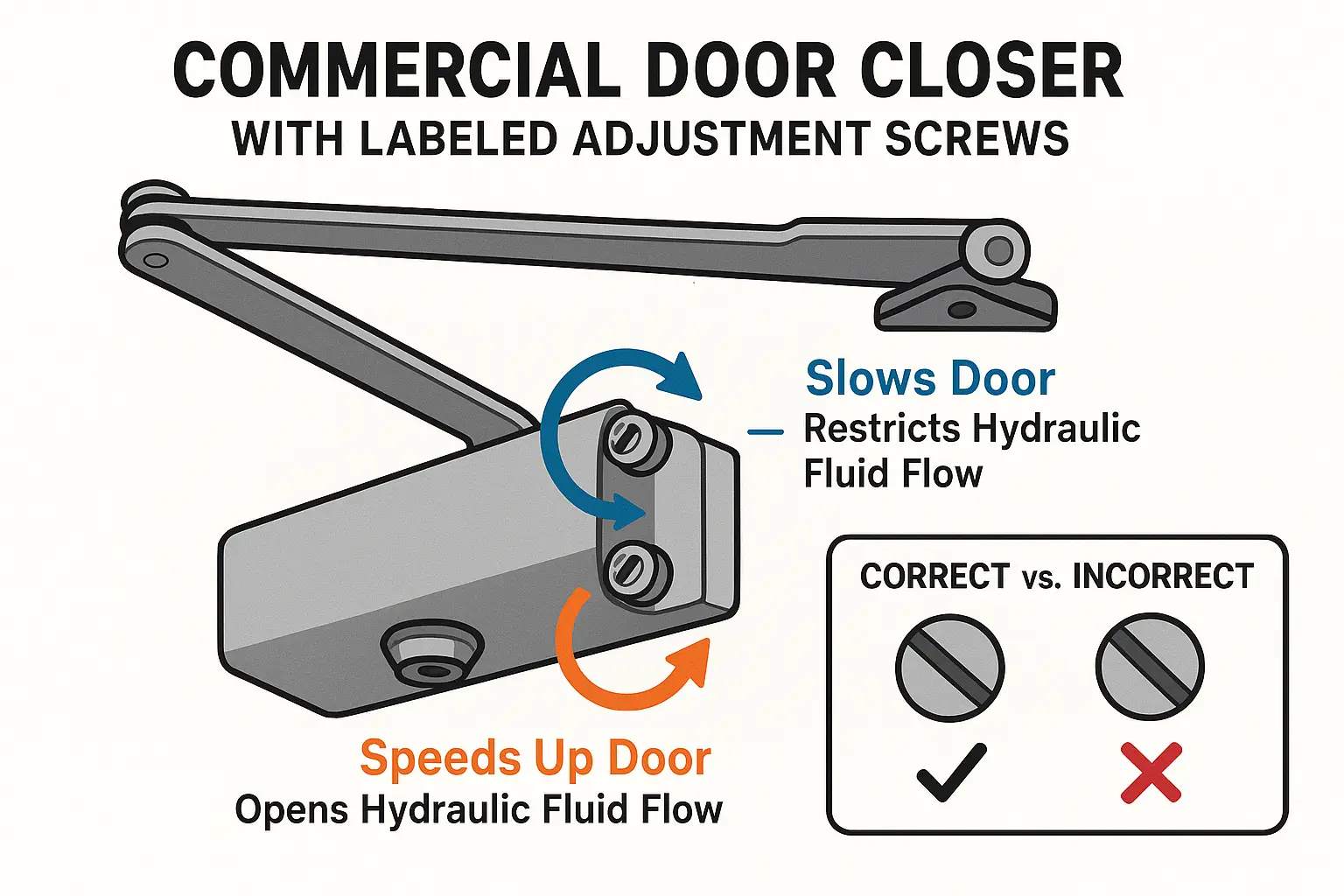
  • Clockwise (CW) Turn = Slows the door. Turning the screw clockwise restricts the hydraulic fluid port. This increases internal resistance, slowing down the swing speed of the door.
  • Counter-Clockwise (CCW) Turn = Speeds up the door. Turning the screw counter-clockwise opens the port, allowing fluid to flow faster and accelerating the swing speed.

Always adjust in tiny increments. Hydraulic valves are incredibly sensitive—never turn a screw more than 1/8 to 1/4 of a turn at a time before testing the door’s swing.

Understanding Hydraulic Valve Adjustment: Turning the adjustment screw clockwise slows door closing by restricting fluid flow; turning counter-clockwise speeds it up. This clears up common industry mistakes for safer, more effective adjustments.


The Four Zones of Hydraulic Control


Standard commercial closers feature up to four distinct control valves. Understanding these zones prevents you from adjusting the wrong screw and worsening a slamming issue.

  • Sweep Speed (S or C): Controls the closing speed from a fully open position (90 degrees) down to approximately 12 to 15 degrees from the frame.
  • Latch Speed (L): Controls the final 12 to 15 degrees of the closing cycle. This valve ensures the door closes quietly but has enough force to securely engage the latch. This is the valve that resolves a commercial door not closing all the way.
  • Backcheck (BC): Provides resistance during the opening cycle starting around 70 degrees. This prevents heavy winds or forceful openings from slamming the door against exterior walls or straining the hinges.
  • Delayed Action (DA): An optional feature that keeps the door open for an extended period (usually 20 seconds or more) before starting the sweep phase, allowing wheelchair users or cart traffic to pass safely.

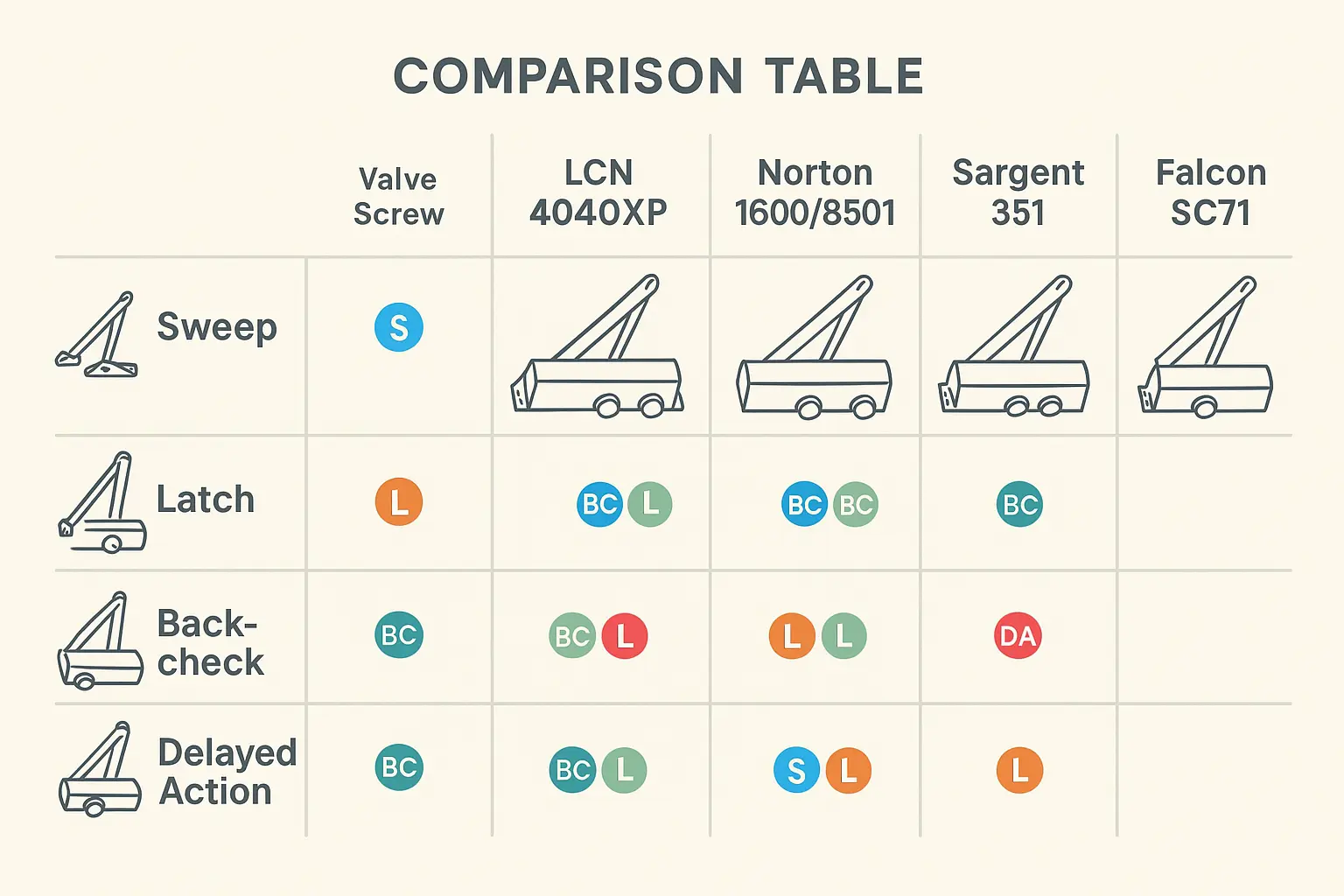
Cross-Brand Valve Translation Table


Different manufacturers use unique labels and locations for their adjustment valves. Refer to this quick reference map to locate the correct screws on your specific hardware.

Closer Brand & Model Sweep Valve Latch Valve Backcheck Valve Delayed Action (If Equipped)
LCN 4040XP Labeled “MAIN SPEED” (Face of body) Labeled “LATCH SPEED” (Face of body) Labeled “BACKCHECK” (Face of body) Labeled “DELAY” (Face of body)
Norton 1600 / 8501 Labeled “S” (End of body) Labeled “L” (End of body) Labeled “BC” (Top corner/Opposite end) Labeled “DA” (Side of body)
Sargent 351 Labeled “S” (Side of closer) Labeled “L” (Side of closer) Labeled “BC” (Side of closer) Labeled “D” (Side of closer)
Falcon SC71 Labeled “S” (End of body) Labeled “L” (End of body) Labeled “BC” (End of body) Labeled “DA” (End of body)

Valve Translation Table: Know exactly where each valve adjustment screw is located on popular commercial door closers. This visual map removes guesswork and speeds up accurate adjustments for facility professionals.


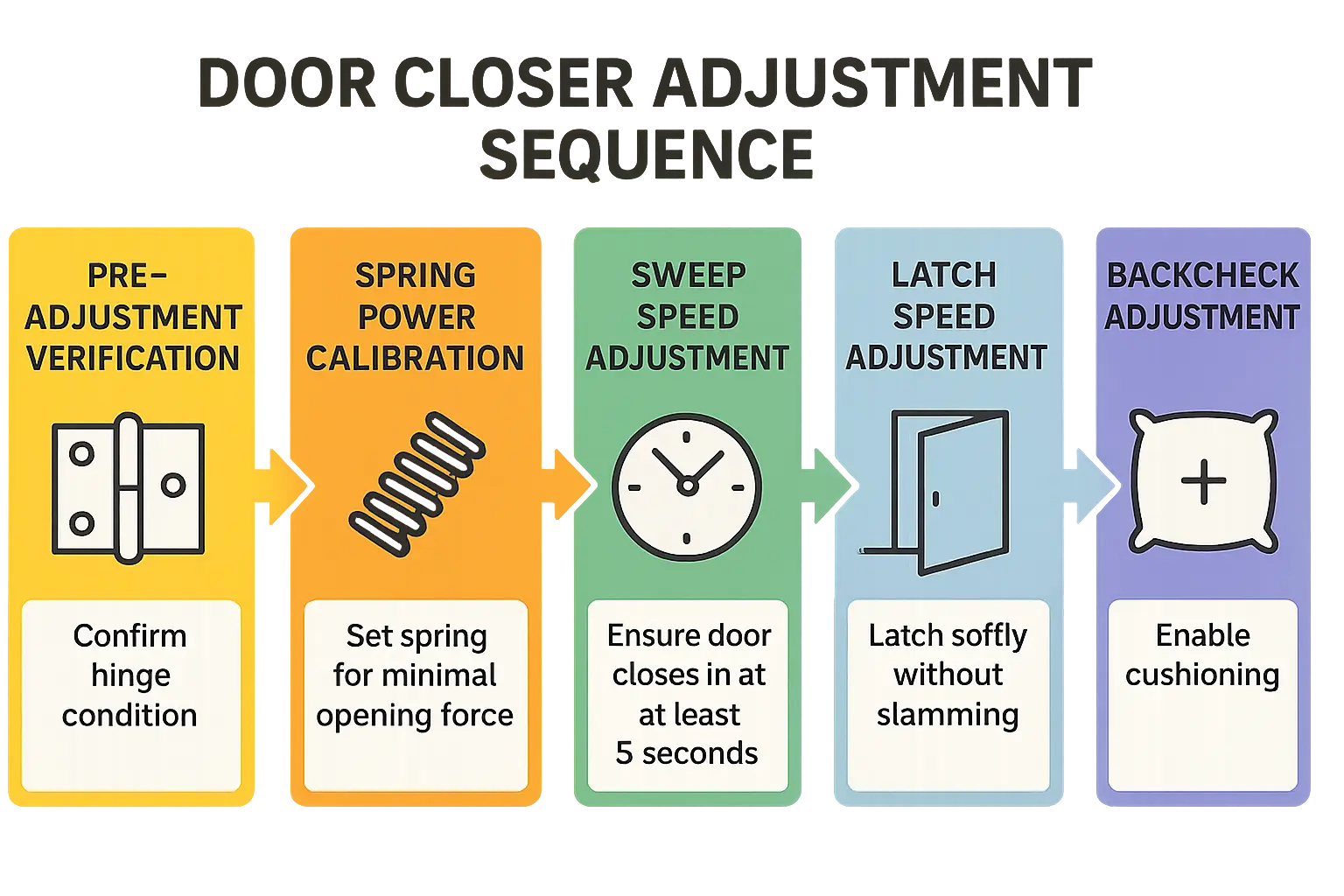
Step-by-Step Calibration Sequence


To adjust your door closer accurately, follow this systematic approach. Doing so guarantees compliance with ADA Section 404 and local fire safety codes.

  1. Test the Opening Force: Use a force gauge to check the opening resistance. ADA Section 404.2.9 mandates that non-fire-rated interior doors must not require more than 5 pounds of opening force (lbf). Adjust the spring tension nut at the end of the closer body if the door is too heavy to push open.
  2. Time the Sweep Speed: Open the door to 90 degrees and release it. Time how long it takes to reach the 12-degree mark. ADA Section 404.2.8 (The 5-Second Sweep Rule) requires that this transition take a minimum of 5 seconds. Turn the S valve clockwise to slow down the sweep if the door is closing too quickly.
  3. Calibrate the Latch Speed: Observe the last 12 degrees of the closing path. The door should transition smoothly into the latch without a loud bang. Turn the L valve clockwise to eliminate slamming or counter-clockwise if the door lacks the momentum to latch securely.
  4. Fine-Tune the Backcheck: If your exterior doors are prone to catching the wind, turn the BC screw slightly clockwise to increase cushioning as the door reaches its fully open angle.

Master the Adjustment Process: Follow this clear, stepwise guide to adjust commercial door closers safely and compliantly, ensuring smooth operation and ADA/NFPA compliance.


Troubleshooting Environmental Issues


Often, door behavior changes without anyone touching the valves. Two main environmental factors cause these “ghost” issues:

The Temperature Viscosity Trap

Standard hydraulic fluid reacts to temperature shifts. In winter, cold weather thickens the fluid, causing the door to close sluggishly or stay open. In summer, warm weather thins the fluid, resulting in a sudden, violent slam.

To combat this, perform proactive seasonal adjustments during spring and autumn. This should be a standard part of your commercial facility door maintenance schedule. Alternatively, upgrading to high-end, Grade 1 closers with all-weather fluid ensures consistent operation across extreme temperature swings (-30°F to 120°F).

HVAC Stack Pressure

High-velocity HVAC systems create interior air pressure differences. When fans kick on, stack pressure can create a vacuum that either holds a door open or pulls it shut with aggressive force.

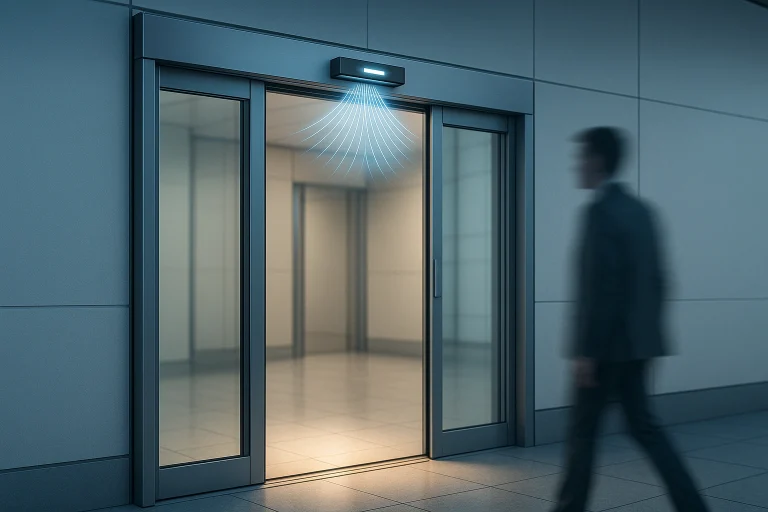
Do not try to solve stack pressure by over-tightening closer spring tension, as this will easily violate the ADA 5 lb opening force restriction. Instead, consider installing an ada automatic door opener installation to handle the physical pressure difference while keeping your entry accessible to all visitors.


Commercial Decision Matrix


If adjusting the valves doesn’t stop your door from slamming or failing to latch, you must weigh your replacement options:

  • Standard Openings: If a standard commercial entry is failing, upgrading to a heavy-duty Grade 1 closer (such as the LCN 4040XP or Sargent 351) with all-weather fluid will eliminate regular maintenance headaches.
  • Fire-Rated Openings: Fire doors must close and latch fully on every cycle under NFPA 80. If your fire door fails to positively latch, it poses a direct life-safety threat and will fail a certified nfpa 80 fire door inspection. Professional inspection and calibration are highly recommended.
  • High-Traffic or Wind-Prone Entries: In vestibules experiencing high winds or severe stack pressure, manual closers often fail to meet both ADA and latching codes simultaneously. Transitioning to automatic swing operators is the most compliant, long-term solution.

When you need reliable, compliant entrance solutions, contacting professional commercial door repair technicians ensures your physical assets are secure and your facility remains up to code.


Frequently Asked Questions


Why is my commercial door slamming even after I adjusted the valves?

If you have turned the adjustment valves clockwise and the door still slams, the internal hydraulic seals are likely blown, allowing fluid to bypass the regulating ports entirely. You can verify this by checking for oily residue on the closer body or cover. A closer with blown seals cannot be repaired and must be replaced.

How do I make sure my adjusted door is ADA compliant?

To remain compliant with ADA guidelines, your door closer must meet two primary metrics: it must take at least 5 seconds to close from a 90-degree open angle down to 12 degrees, and the force required to manually open an interior door must not exceed 5 pounds. You can measure these using a standard stopwatch and a door pressure gauge.

What happens if a fire-rated door is adjusted to close too slowly?

While slowing down a door closer prevents slamming, fire-rated doors must fully close and positively latch on every single cycle to comply with NFPA 80 safety codes. If a door is adjusted to close too slowly, stack pressure or latch resistance may prevent it from securing properly, which can allow smoke and fire to migrate through the building during an emergency.