

Automatic Doors for Senior Living and Nursing Homes
Doors in senior living are set differently from every other building type. They open more slowly, stay open longer and have to be usable by someone with a walker, a wheelchair or limited grip strength, with nobody standing beside them to help. The settings are the service here as much as the hardware. A community that has automatic doors set at factory defaults has automatic doors most of its residents still cannot use comfortably.
 (855) 676-0881
Get in touch with us
Call us 24/7: (855) 676-0881
Or Let Us Call You
Where the Doors Are in a Community
- Main entrances and reception vestibules, often with visitor access control.
- Dining room, activity room and common area doors residents use several times a day.
- Courtyard, garden and patio access - usually the heaviest exterior doors on the property.
- Corridor, restroom and resident room doors where independence is won or lost.
- Memory care openings with delayed egress and wander management hardware.
- Service, kitchen, laundry and clinical support doors.
Automatic Door Installation in Senior Living
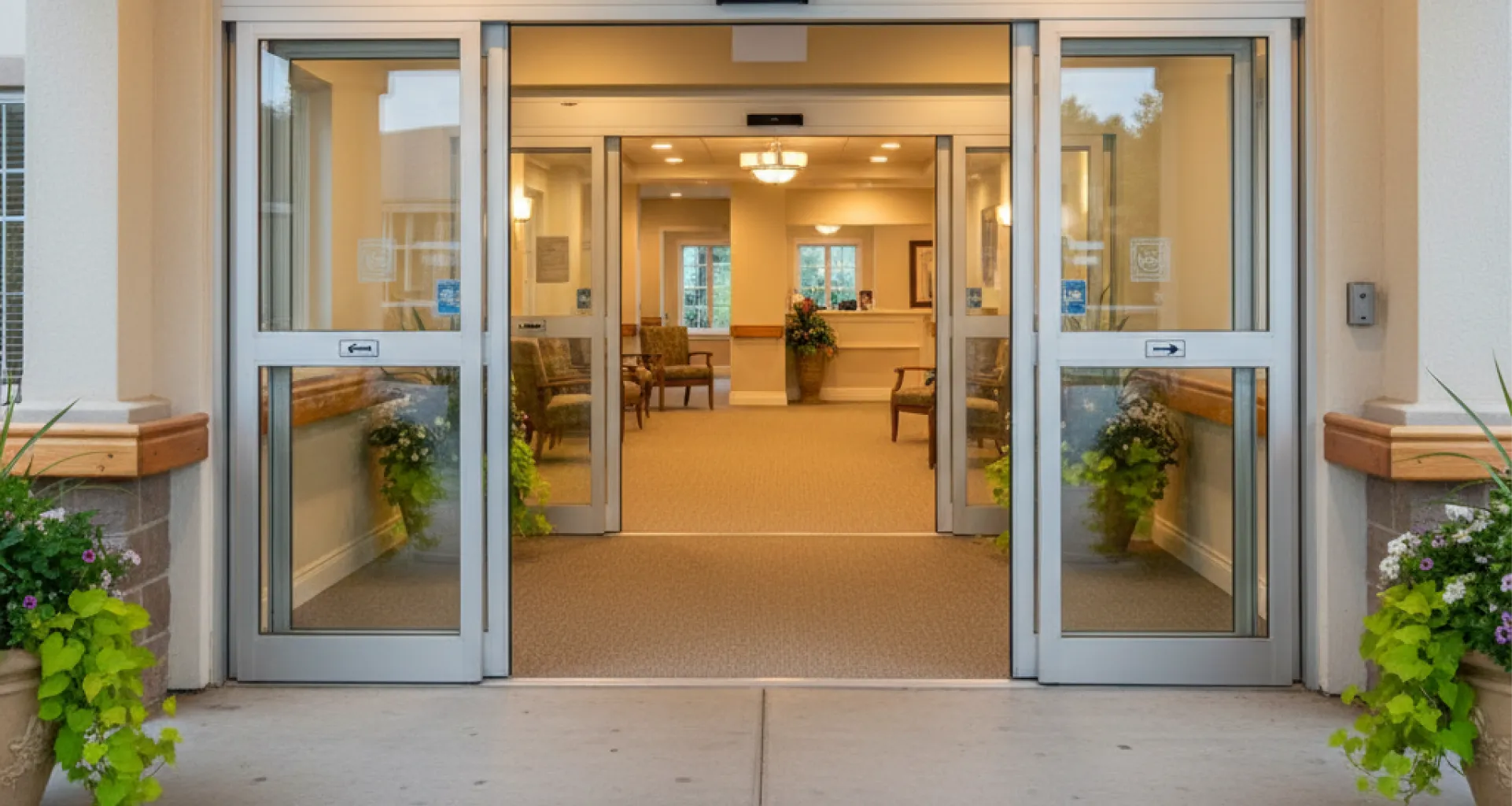
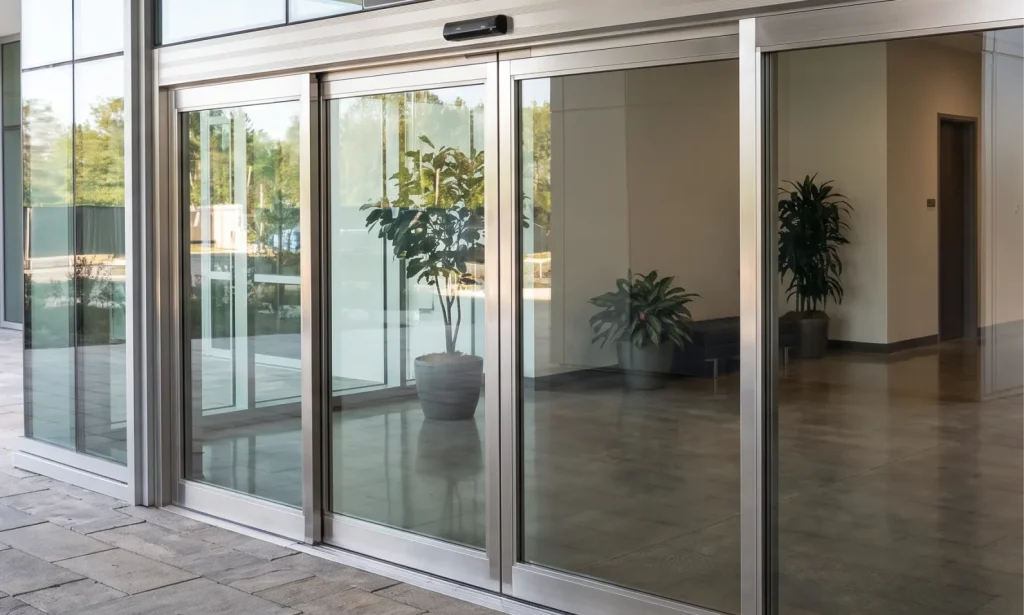
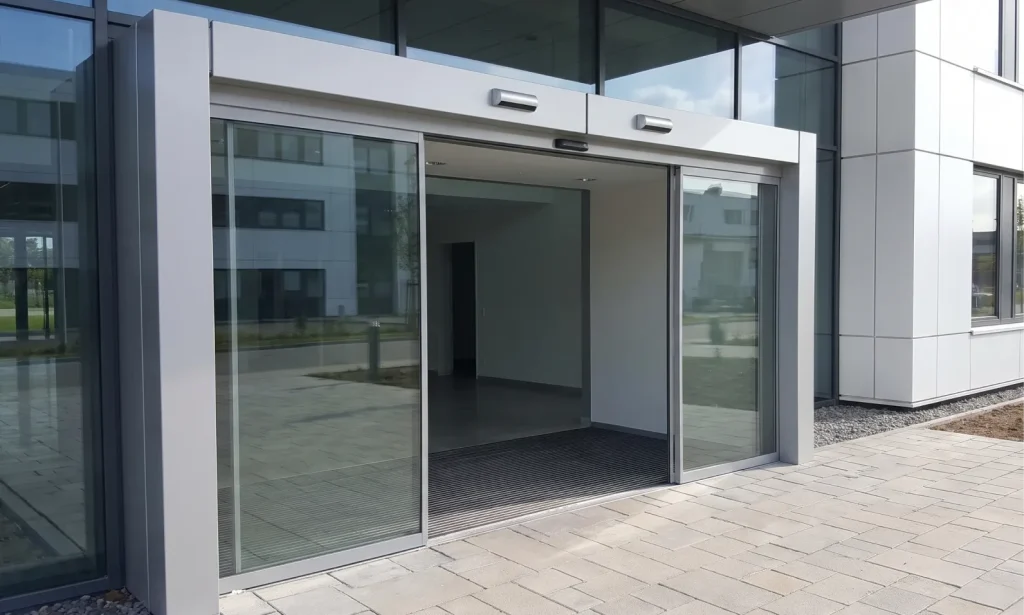
New entrances are specified for slow-moving traffic and mobility equipment: a wider clear opening than a standard commercial entrance, longer hold-open times, and detection that reliably picks up a resident approaching slowly with a walker.
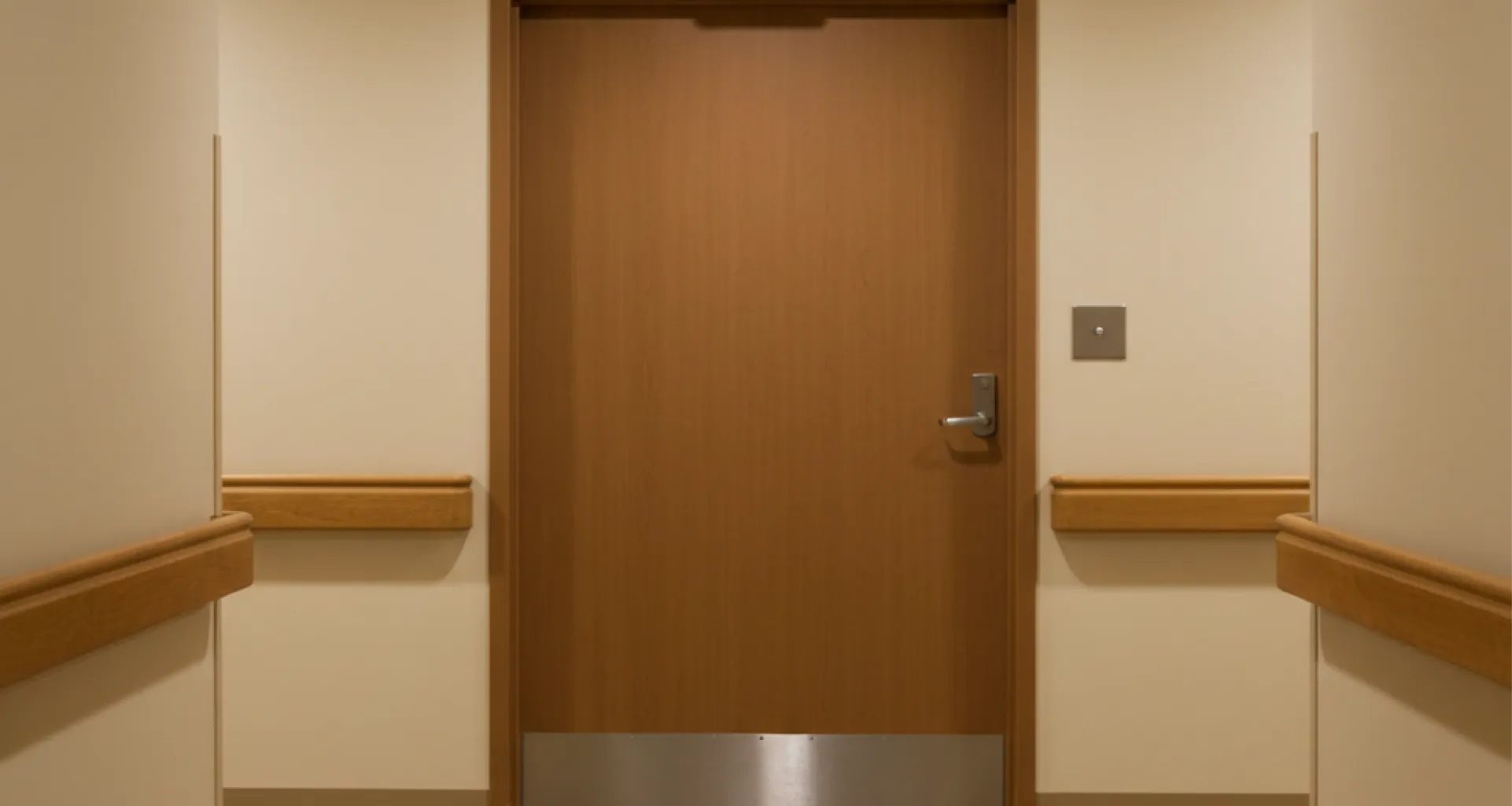
Interior openings are usually low-energy swing operators. They are the highest-value retrofit in this sector because they are cheap to add relative to their effect and they are exactly where residents lose independence.
Actuator height and position are decided on site by approaching the door the way a resident would, in a wheelchair as well as standing. Installation is planned around meals, activities and rest periods so routes residents rely on are never blocked.
Setting the Doors for Residents
A door set at factory defaults moves too fast for most residents. We set opening speed, closing speed and hold-open for the people actually using the opening, and re-check those values at every visit because they drift as an operator ages.
Manual opening force with the power off is checked too — a power outage should not leave a community with doors residents cannot open at all.
Where a door has been set fast to keep a lobby warm or reduce draughts, we solve that with seals and vestibule sequencing rather than by leaving the door moving faster than the residents can manage.
Automatic Door Repair in Communities
The common faults here are worn operator arms and linkage, actuators knocked out of alignment by wheelchairs and walkers, sensors that no longer detect slow movement, doors that have drifted out of their timing, and frames racked by equipment traffic.
We repair operators, arms, linkage, boards, sensors and actuators, square frames, and reset timing and force afterwards. Work is scheduled around residents’ routines and an alternative route is arranged before an opening is taken out of use.
Doors on courtyard and garden access get particular attention, because they are heavy, exposed and used unaccompanied.
Memory Care and Controlled Openings
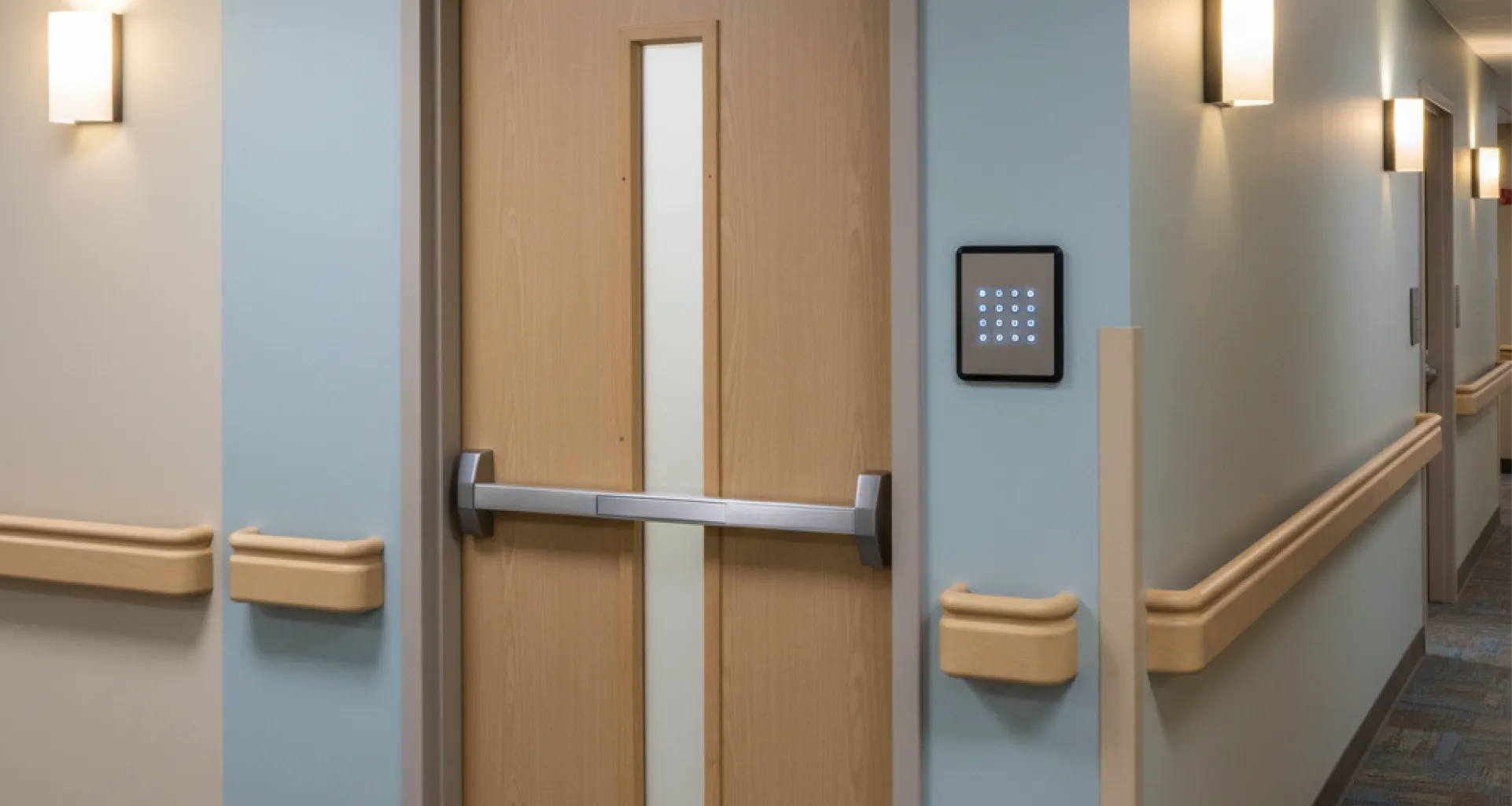
Memory care units use delayed egress and controlled openings so residents are safe without the unit being locked. That hardware has to keep behaving exactly as configured, every day, and it is tested as part of every service visit.
Where an opening ties into a wander management system, the door, the hardware, the alarm and the release behaviour are function-tested together rather than separately — which is how a fault gets found before it matters.
Scheduled Maintenance and Annual Inspection
Communities are best served on a fixed interval, usually quarterly on entrances and semi-annually on interior openings, because settings drift and residents will rarely report a door that has become slightly harder to use.
Each visit covers cycle testing, timing and force re-measurement, actuator function and position, sensor re-aiming for slow movement, arm and linkage wear, frame and threshold condition, and the delayed egress and wander management interfaces. The annual safety inspection is folded into one visit a year.
Fire and Smoke Doors on the Same Schedule
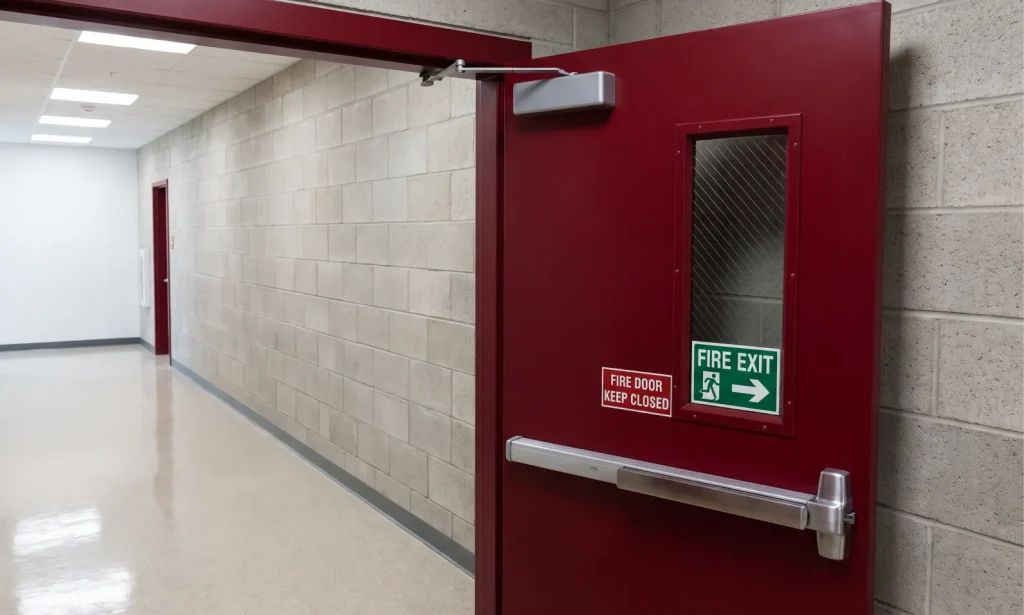
Skilled nursing and assisted living buildings carry a large number of fire and smoke door assemblies alongside their automatic entrances, often in the same corridors. We service them on the same visit so one contractor covers the whole opening schedule.
Entrance Replacement and Upgrades in Occupied Communities
Replacing an entrance in a senior living community is planned around residents rather than around the contractor. Work is staged so the main route in and out is never closed, an alternative is signed and staffed where needed, and the opening is secure and weathertight at the end of every shift.
Where the existing frame is sound, the new header, operator and panels go into it and the work stays inside a short window. Where a community is upgrading several openings, they are done one at a time rather than as a single disruptive project.
Actuators Residents Can Actually Use
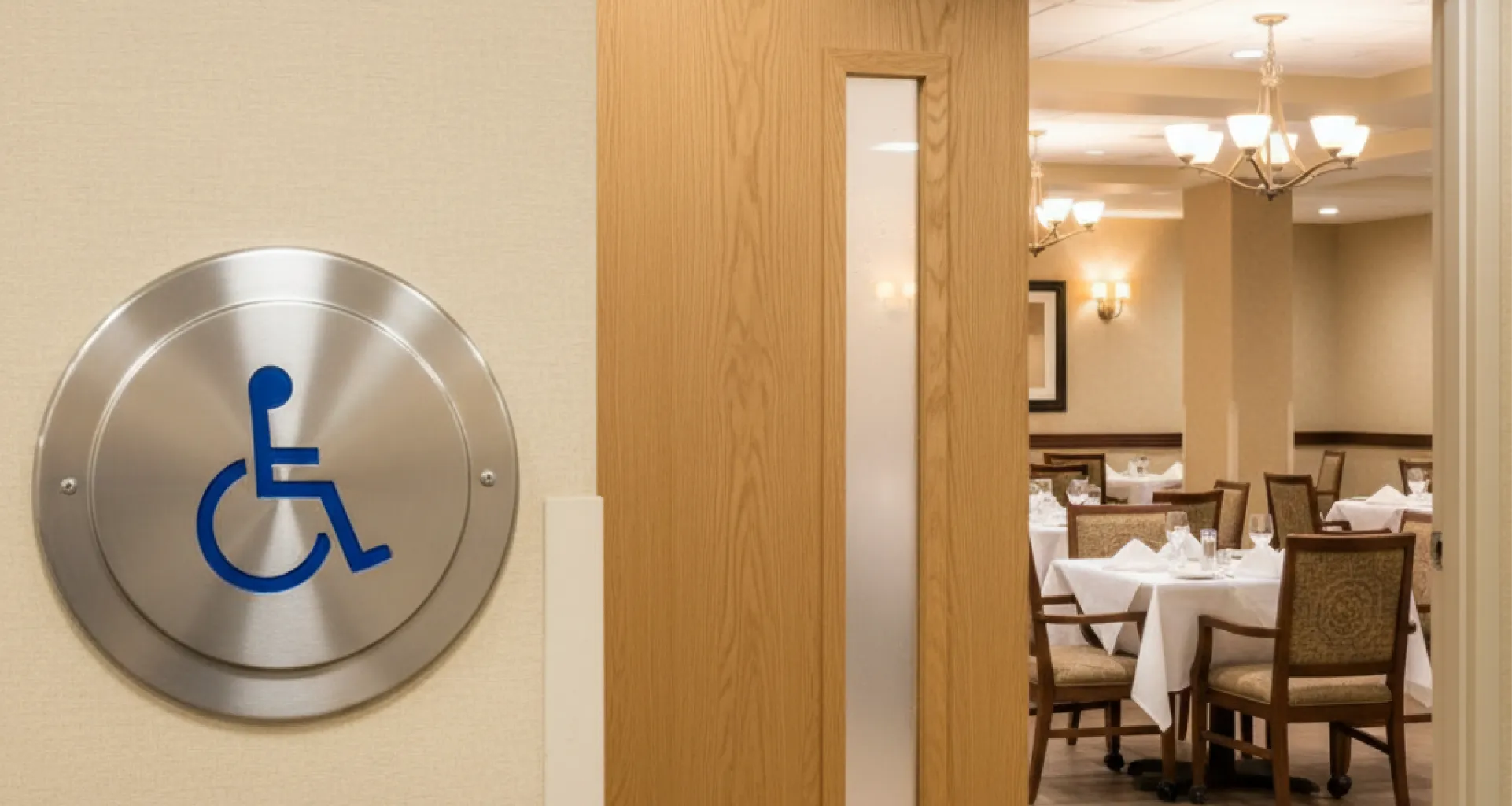
The actuator is where most accessible openings fail in practice. A plate mounted too high, too far from the door, or requiring a firm press is unusable for a resident with limited grip strength, however well the operator behind it is set.
We position actuators by approaching the door the way a resident does — in a wheelchair, with a walker, with one hand occupied — and specify wave or touchless actuators where pressing is the barrier. Where an existing plate is in the wrong place, relocating it is usually a short visit and it changes who can use the door.
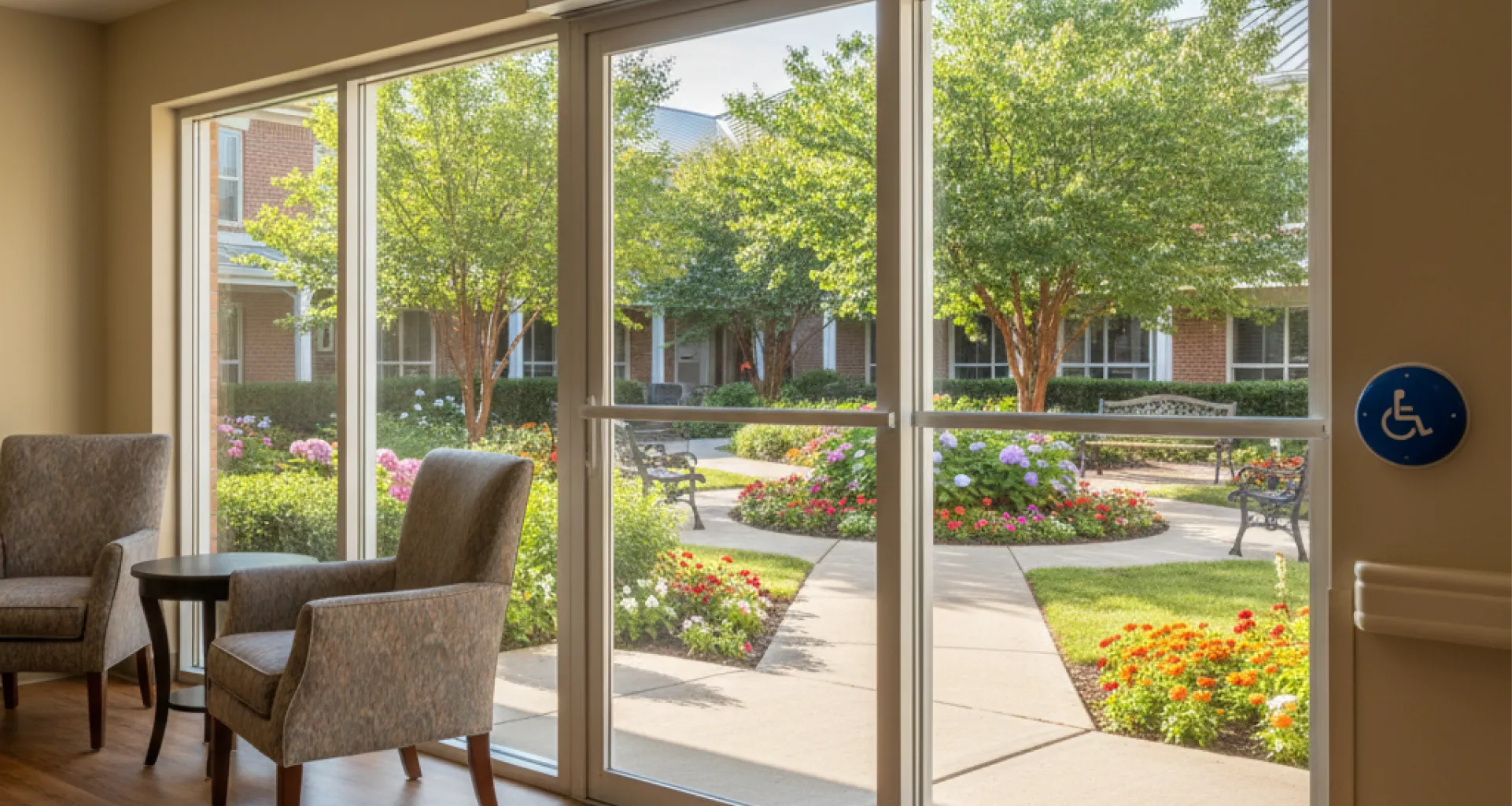
Courtyard, Patio and Garden Access
Exterior amenity doors are the heaviest doors most residents will meet, and they are the ones used unaccompanied. They face wind and weather, they usually have a closer set firm to keep them shut, and they are frequently the reason a courtyard goes unused.
These openings respond well to a low-energy operator combined with seal and threshold work, and they are among the highest-value upgrades in a community for what they take to fit.
Common Faults in Senior Living Buildings
The calls we take most often here are actuators knocked out of alignment or position by wheelchairs and walkers, operators that have drifted faster than residents can manage, sensors that no longer detect slow movement, and courtyard doors that have become too heavy after a closer was tightened.
None of them present as a broken door. They present as residents quietly using a different route, or staff propping an opening that should be working. That is why these buildings benefit from a fixed interval rather than a call-out arrangement.
Sensors Set for Slow Movement
Standard sensor settings assume someone walking at normal pace. A resident approaching with a walker, or pausing in the doorway, can fall outside a detection pattern that would be perfectly adequate in an office.
We set detection zones deeper on the approach, extend hold-open times, and use presence detection that keeps holding while someone is still crossing the threshold. Those settings are re-checked at every visit, because a door that closes too early on a resident is the fault most likely to go unreported and most likely to cause harm.
Service Areas
Texas — Austin, Cedar Park, Cypress, Richardson, McKinney, Sherman, Paris. Connecticut — Hartford, New Haven, Danbury, Greenwich. Alabama — Birmingham.
Tell us the community and the openings, and we will plan the work around residents’ routines.
Our Services
Frequently Asked Questions
Can automatic doors be set to open more slowly?
Yes, and in senior living they should be. Opening speed, closing speed and hold-open are set for residents rather than left at factory defaults, and re-checked at every visit.
What is delayed egress and where is it used?
It is a controlled opening arrangement used in memory care so residents are safe without locking the unit. It is configured and function-tested together with the alarm system.
Which openings should be automated first?
The main entrance, dining and activity room doors, courtyard access and the restrooms residents use unaccompanied.
Can you work without disrupting residents?
Yes. Work is scheduled around meals, activities and rest periods, and routes residents depend on stay open or are replaced with a signed alternative.
Do you service fire and smoke doors too?
Yes, on the same visit as the automatic entrances, so the whole opening schedule sits with one contractor.
Our push plate is too high for wheelchair users — can it be moved?
Yes, and it is a common correction. Actuator height and position are decided by approaching the door the way a resident actually does.
How often should a community's doors be serviced?
Usually quarterly on entrances and semi-annually on interior openings, because the settings drift and residents rarely report a door that has slowly become harder to use.