Preparing a commercial door for a rim or surface vertical rod (SVR) exit device requires absolute dimensional precision.
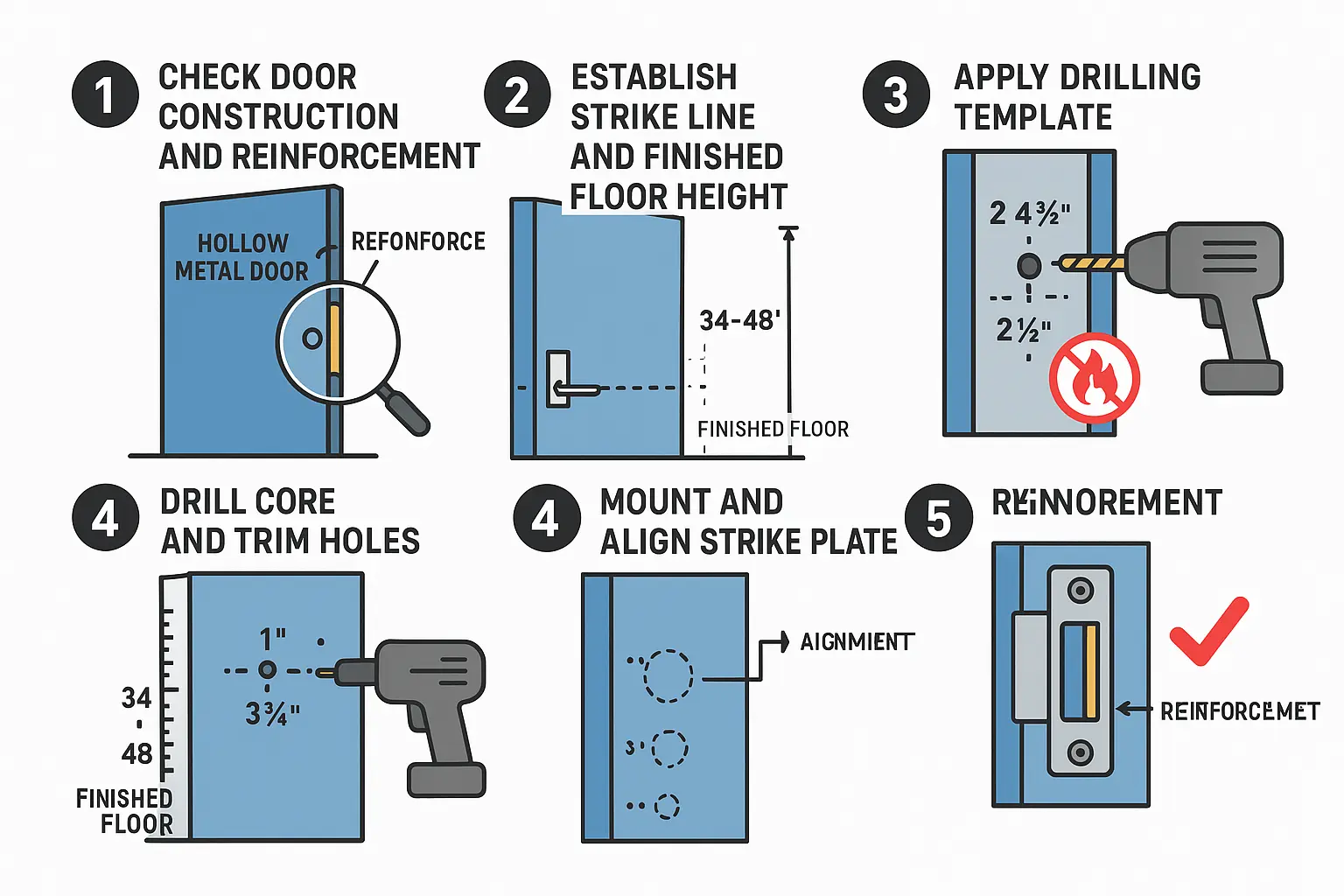
Verify Door Construction & Reinforcement
Wood doors require thru-bolts (sex bolts) to prevent mounting screws from pulling through. Hollow metal doors require internal 16-gauge steel reinforcing plates. Attempting to mount exit hardware to unreinforced sheet metal will eventually cause the screws to strip and the device to fail.
Establish the Strike Line and Finished Floor Heights
Egress codes mandate that the center of the panic bar touchpad must be positioned between 34 inches and 48 inches above the finished floor. The standard industry target height is 40-5/16 inches.
Apply the Drilling Template
Position the manufacturer’s template on the door face, referencing the correct backset. The standard commercial backset is 2-3/4 inches. Secure the template and mark all pilot holes. Precise alignment is crucial; even a 1/16-inch variance can cause latch binding. Correct alignment is a major focus during panic bar installation and repair to ensure smooth mechanical operation.
Prepare the Core and Trim Holes
Drill pilot holes straight through the door using a leveling guide. If your configuration includes an exterior key cylinder or pull trim, cut the main cylinder hole with a high-quality hole saw (commonly 1-1/4 inches or 2-1/8 inches depending on the lock chassis).
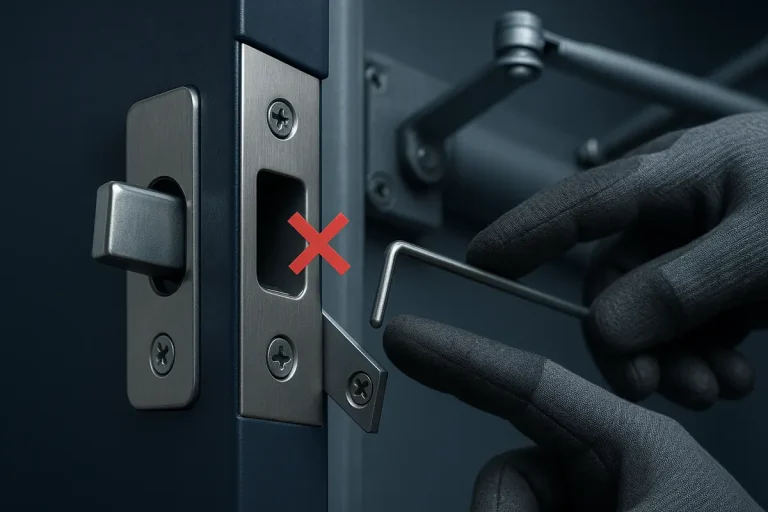
Mount and Align the Strike Plate
Secure the panic bar body to the door and install the strike plate on the door frame. Ensure the latch fully projects and deadlatches smoothly. At this stage, verify that your door closer service is properly adjusted, ensuring the door closes and latches completely on its own.