(855) 676-0881

ADA Automatic Door Openers: Push Plates, Opening Force and Timing Explained


Published: Oct 1, 2026

Navigating the landscape of commercial door compliance can feel like a moving target. For facility managers, general contractors, and property owners, the stakes are remarkably high. Failing an occupancy inspection or encountering a Title III ADA lawsuit due to an improperly configured entrance can derail operations and incur massive costs.

To mitigate these risks, maintaining strict automated door safety compliance is essential. Achieving true accessibility requires a clear understanding of three core technical pillars: activation mechanics, physical operating forces, and precise timing sequences.


The "Knowing Act" Principle: Why Your Activation Method Matters


In automatic door engineering, the method used to trigger a door dictates its entire regulatory framework. The industry divides activation into two categories:

  • Knowing Act Activation: This occurs when a user performs a conscious, physical action to open the door—such as pressing a wall-mounted push plate, waving a hand in front of a touchless sensor, or presenting an access card.
  • Unknowing Act Activation: This occurs when a door opens automatically without user initiative, typically triggered by overhead motion sensors or pressure mats.

The distinction is critical for your bottom line. Under ANSI/BHMA A156.19, “knowing act” doors are classified as low-energy operators. Because they rely on a deliberate user action, they do not require expensive safety guide rails, presence-sensing carpets, or overhead safety sensors. Opting for a low-energy operator under standard push-plate activation during your next ada door operator installation can save thousands of dollars per opening while maintaining absolute regulatory compliance.


Push-Plate Placement Rules (Standard vs. California Title 24)


Proper actuator placement ensures that individuals with limited mobility can easily access the activation switch. Standard ADA requirements (referencing Paragraph 309.4) dictate that manual controls must be operable with one hand, without tight grasping or pinching, and mounted between 34 and 48 inches above the finished floor. Furthermore, actuators should be placed within 1 to 5 feet of the door for optimal usability, with a maximum allowable distance of 12 feet.

However, national guidelines are only part of the equation. If your facility is located in California, California Building Code (CBC) Title 24, Section 11B-404 introduces a strict dual-actuator requirement. To accommodate both hand and wheelchair footrest activation, you must install either a 36-inch tall vertical actuation bar or two independent push-plates: a lower plate mounted between 7 and 8 inches from the floor, and an upper plate mounted between 30 and 44 inches.
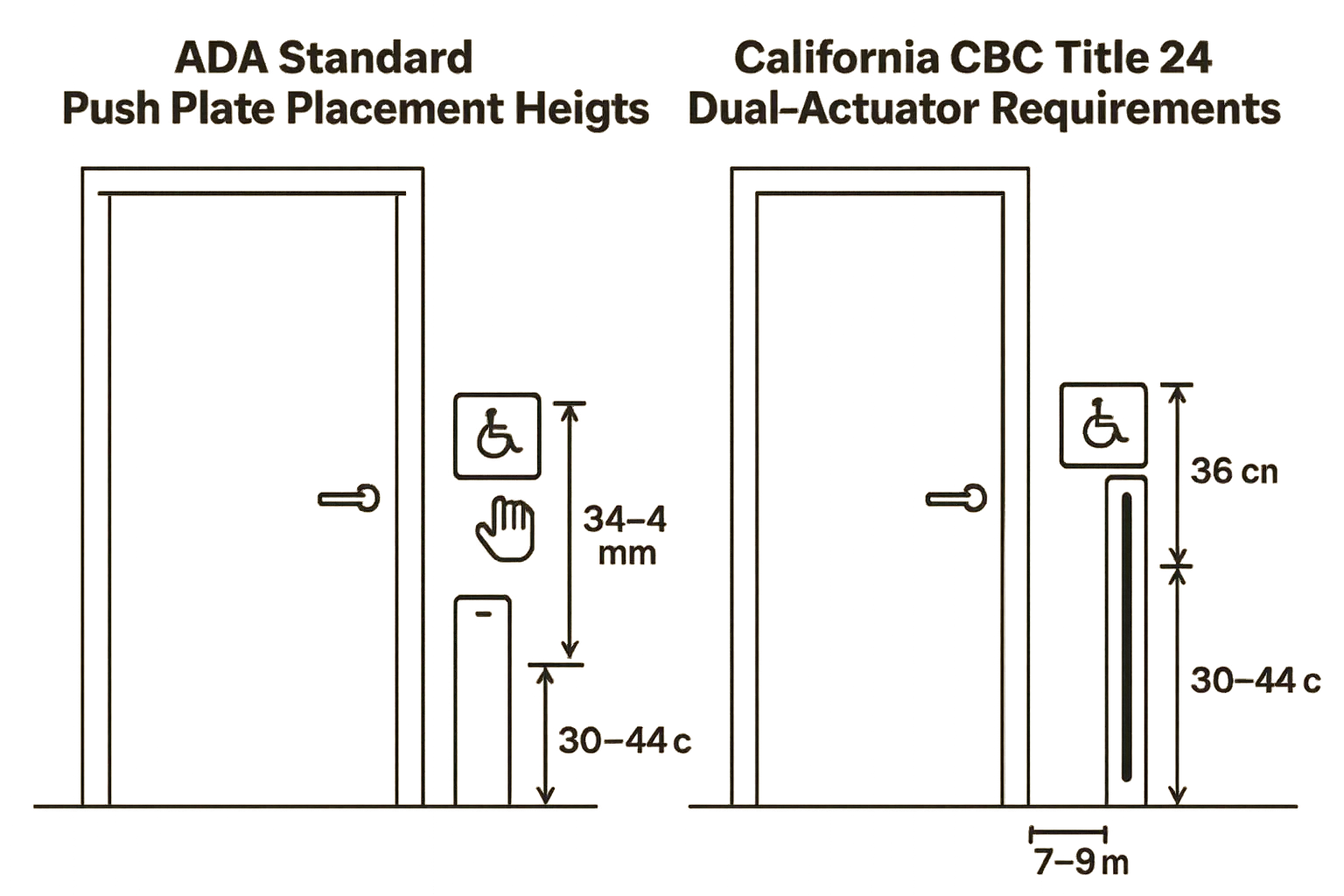
Standard vs California Title 24 push plate placement comparison

Side-by-side comparison of ADA standard and California Title 24 push plate placement rules, revealing the critical dual-actuator and vertical bar requirements unique to California. Understand correct installation heights visually to ensure compliance.

Whether you are managing a complex retrofit or a new handicap door installation, aligning your physical hardware layout with regional codes is non-negotiable.


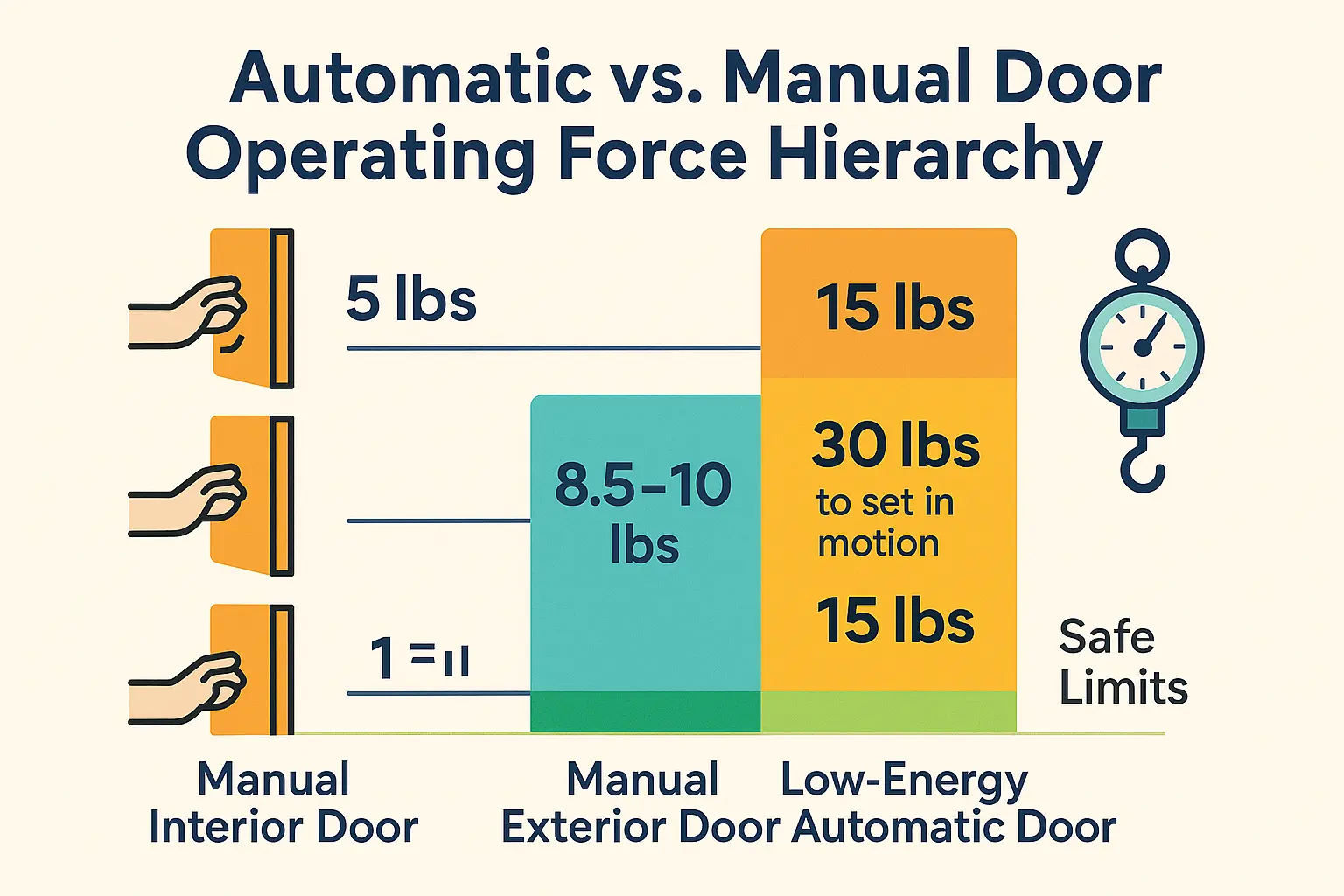
The Force Equation: Opening and Closing Force Decoded


Before a motor ever engages, a door must be fundamentally safe to operate. If power fails, the door must still function manually without posing a hazard.

  • Manual Interior Doors: Under ADA Standards, manual interior doors must require a maximum of 5 lbs (22.2 N) of force to set in motion.
  • Low-Energy Automatic Doors (ANSI/BHMA A156.19): To prevent injury to pedestrians, low-energy operators are restricted in the kinetic energy they can generate. They must require no more than 15 lbs (66 N) of force to release the latch, 30 lbs (133 N) of force to set the door in motion, and 15 lbs (66 N) to open the door fully.

Visual hierarchy of door operating forces comparing low-energy and manual doors

Visual hierarchy of door operating forces highlighting how low-energy automatic doors provide easier access compared to manual doors, with step-by-step measurement pointers for DIY compliance checks.

If your manual door closer is too stiff, a professional door closer service can recalibrate the hydraulic valves. If the system is worn beyond adjustment, a targeted door operator replacement will restore safety and bring your entryway back into legal compliance.


Timing and Speed Calculations: Keeping Pedestrians Safe


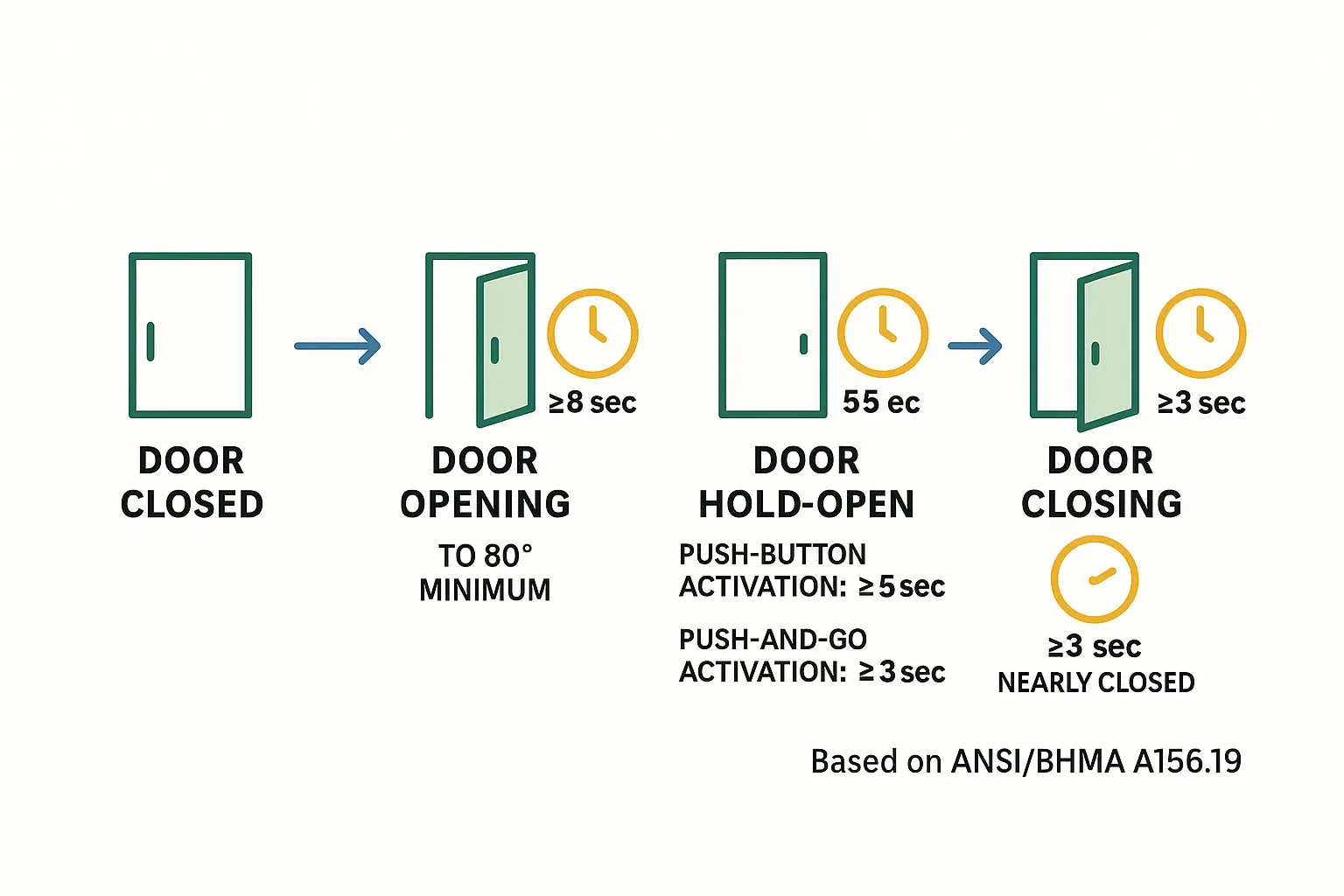
The speed at which an automatic door cycles is strictly regulated to prevent impact injuries. ANSI/BHMA A156.19 outlines clear timing parameters based on the physical dimensions and weight of the door:

  1. Opening Speed: The door must take a minimum of 3 seconds to travel from a closed position to an open angle of 80 degrees. If the door is wider or heavier, this minimum time increases (e.g., a 3-foot door weighing 125 lbs requires at least 3.5 seconds).
  2. Hold-Open Time: Once fully open, the door must remain stationary for at least 5 seconds when activated by a push-plate. If triggered by a manual push-and-go system (where a physical push prompts the motor to take over), the minimum hold-open is 3 seconds.
  3. The 12-Foot Rule: If an actuator is installed further than 12 feet from the door, you must add 1 additional second of hold-open time for every extra foot of travel distance to ensure the user can reach the threshold.
  4. Closing Speed: The door must take a minimum of 3 seconds to close from 90 degrees to 10 degrees.

Stepwise visualization of the ADA automatic door timing cycle

Stepwise visualization of the ADA automatic door timing cycle, clarifying opening speeds, hold-open durations, and closing times required to ensure safe pedestrian passage.


Access Control, Vestibules, and Fire-Door Fail-Safes


Integrating automatic operators with security infrastructure introduces complex fire code and egress challenges. In vestibule layouts (airlock systems), operators must be wired sequentially to prevent users from being trapped between doors.

Additionally, operators installed on fire-rated doors must be integrated with the building’s fire alarm system to immediately deactivate automatic operation during an alarm. When manual maneuvering clearance is insufficient, battery backup systems are legally required to guarantee continuous emergency egress. Working with licensed, trained experts ensures that these security integrations strictly adhere to commercial door inspection requirements.


Frequently Asked Questions


What is the difference between low-energy and full-energy automatic doors?

Low-energy doors (governed by ANSI/BHMA A156.19) are activated by a deliberate action, like pushing a button, and move slowly with limited force. They do not require complex safety sensors. Full-energy doors (governed by ANSI/BHMA A156.10) open automatically via motion sensors and require safety mats, guide rails, and presence sensors to prevent pedestrian impact.

Can an existing commercial door be retrofitted with an automatic opener?

Yes. Most commercial wood, hollow metal, and aluminum storefront doors can be retrofitted with low-energy automatic operators. The installation requires verifying that the existing frame can support the operator’s weight and that there is an accessible 120V power source nearby.

How often should ADA automatic door operators be inspected?

According to the American Association of Automatic Door Manufacturers (AAADM), automatic doors should undergo safety inspections daily by facility personnel and at least once a year by an AAADM-certified technician. This ensures all force, timing, and sensor thresholds remain in compliance with national and local building codes.