(855) 676-0881

Door Won’t Latch After Temperature Swings: Strike or Hinge Problem?


Published: Nov 10, 2026

When seasonal temperature snaps or sudden humidity shifts occur, exterior and interior doors often refuse to latch smoothly. You pull the handle, but the latch bolt catches on the faceplate or fails to drop into the pocket entirely.

At this stage, home and building owners face a critical diagnostic crossroad: Is the misalignment caused by hinge-side structural sag, or is it a strike-side jamb movement?

Acting without diagnosing the true culprit leads to the seasonal reversal trap. Permanently chiseling mortises or filing brass strike plates during a cold winter dry spell often results in a loose, drafty door that rattles or refuses to close when summer humidity returns.


Diagnostic Decision Tree: Hinge vs. Strike


Before retrieving files or chisels, conduct a simple 30-second inspection to isolate the mechanical root cause.

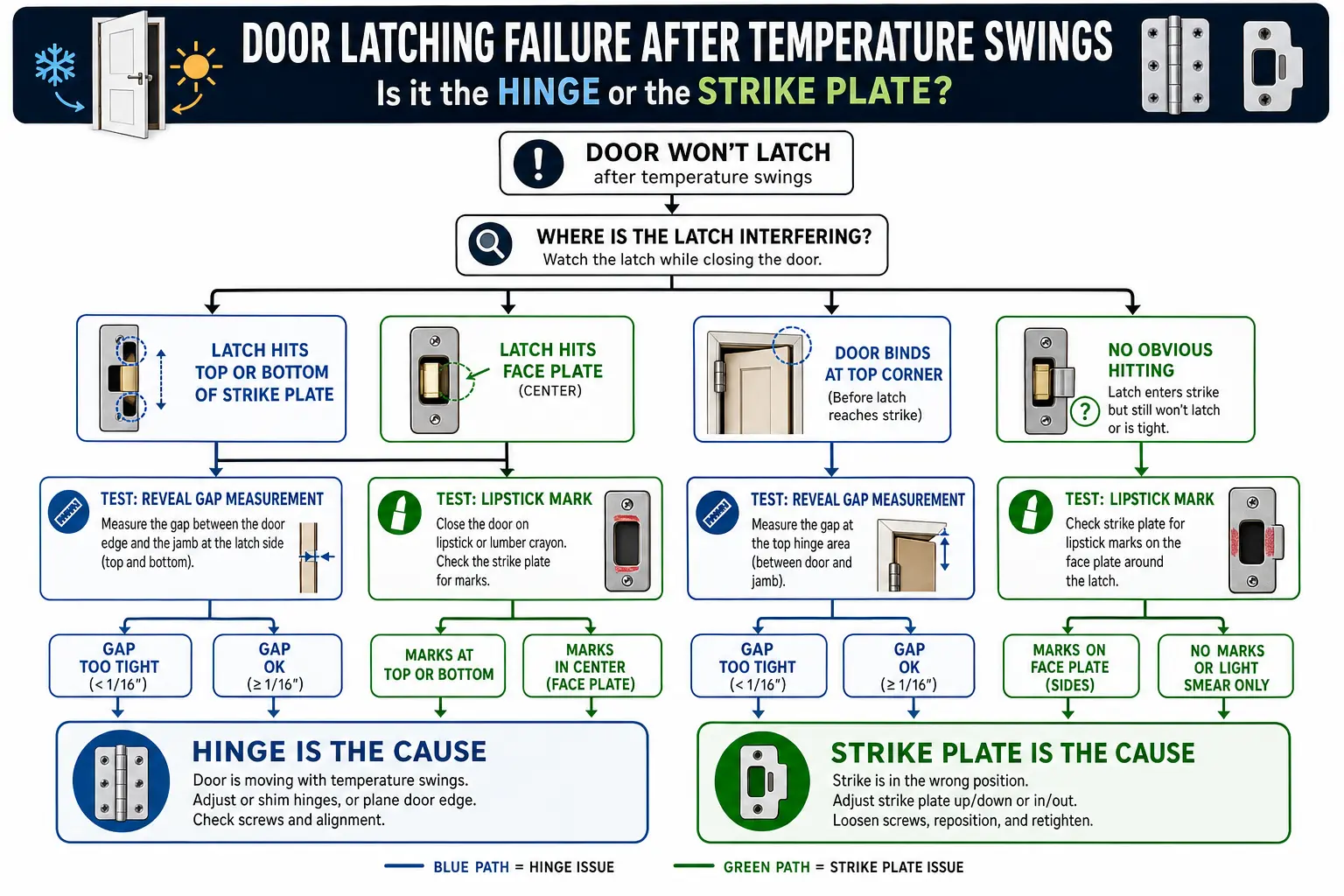
This decision tree helps quickly identify if a door latch issue after temperature changes is due to hinge sag or strike plate misalignment, preventing unnecessary permanent fixes.

The 30-Second Diagnostic Routine

  1. The Reveal Gap Test: Stand inside and look at the margin between the door leaf and the frame. A uniform 1/8-inch margin along the top and sides indicates frame stability. If the top latch-side corner gap is tighter than the hinge-side gap, the door leaf has sagged downward toward the strike.
  2. The Lipstick Mark Test: Apply a dab of lipstick or washable marker to the tapered edge of the latch bolt. Close the door normally. The residue left on the strike plate reveals exact contact alignment:
  • Mark above or below the throat: Vertical misalignment caused by hinge tension loss or frame twist.
  • Mark on the flat faceplate: Horizontal misalignment caused by jamb swelling, frame movement, or compressional weatherstrip resistance.

If you suspect underlying frame movement beyond minor alignment issues, performing thorough hardware repair and diagnostics will protect your wall framing from long-term stress.


Resolving Hinge-Side Mechanics and Strike Misalignment


Differentiating between structural pivot failure and strike plate misalignment preserves your hardware’s integrity over multi-season cycles.
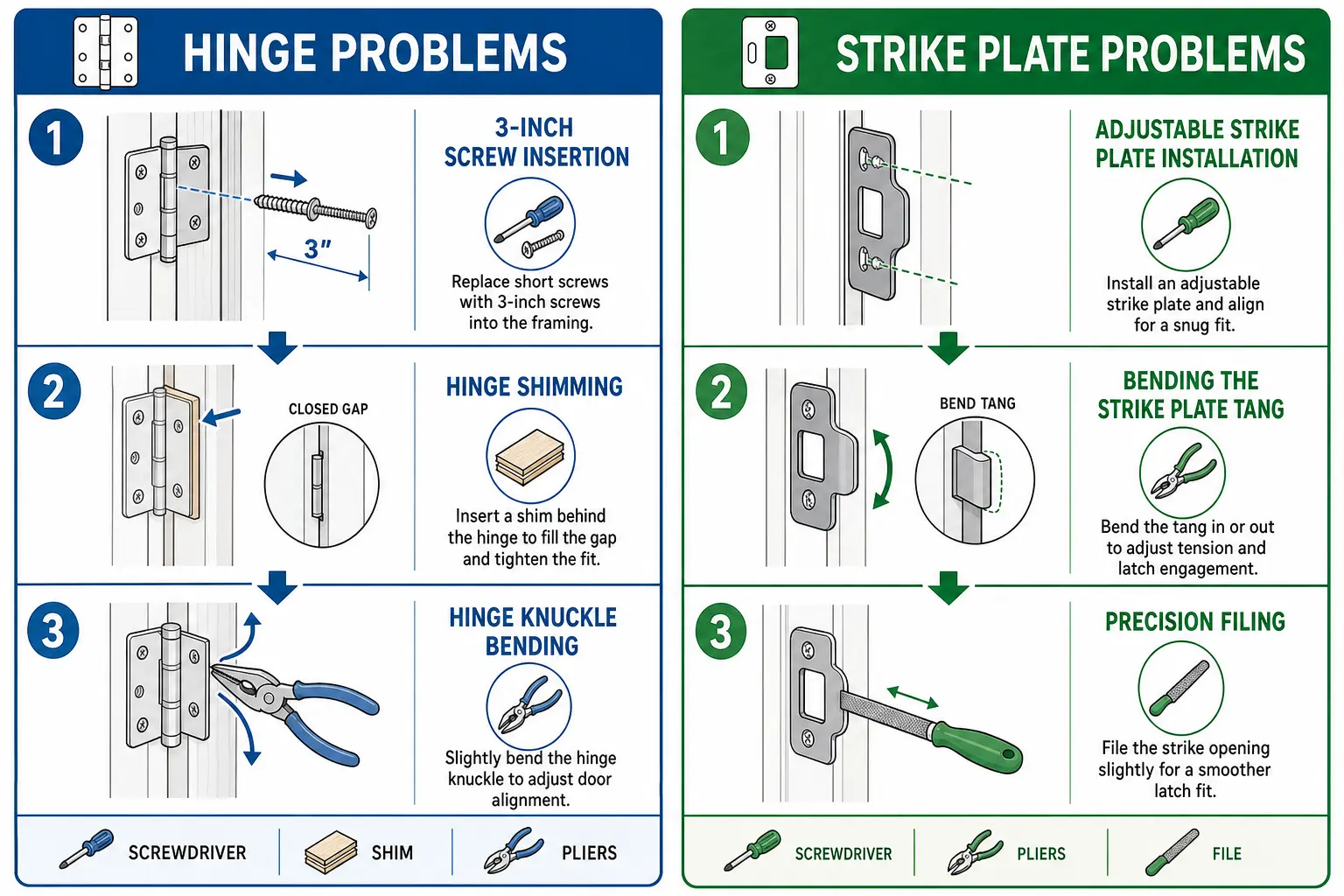
Stepwise guide to reversible fixes for door latch problems caused by either hinge sag or strike plate misalignment, emphasizing non-destructive adjustments.

Analyzing Hinge Sag Dynamics

A standard 36-inch exterior door weighing 75 lbs exerts over 110 lbs of rotational tension force directly on the top hinge screws. During cold snaps, ambient humidity drops, causing wooden wall studs and jambs to contract. This contraction loosens short factory screws in the top hinge leaf, allowing the door to drop by as little as 1/16″ to 1/8″—sufficient to prevent the latch bolt from entering the strike throat.

Reversible Hinge Solutions:

  • The 3-Inch Framing Screw Strategy: Remove the center screw from the top hinge leaf on the jamb side. Drive a 3-inch #9 wood screw through the jamb directly into the rough wall framing. This pulls the top of the door back toward the hinge jamb, lifting the latch side back into alignment.
  • Hinge Shims: Insert solid plastic hinge shims behind the bottom hinge leaf to tip the top latch corner upward without permanently altering the frame.

Correcting Strike-Side Misalignment

While hinges govern vertical trajectory, strike plate issues usually stem from transverse wall movements or material expansion. Understanding door latch failure mechanisms prevents misdiagnosing normal frame shifts as hardware defects.

When temperature drops, exterior jambs shrink while indoor heating creates differential air pressure, forcing the door leaf hard against the weatherstripping. If the latch cannot extend fully into the plate, inspect your latch assembly for common tubular latch problems explained before modifying any metal plates.

Reversible Strike Solutions:

  • Adjustable Strike Plates: Install a dual-piece adjustable strike plate that permits 1/8-inch lateral tuning between winter and summer.
  • Bending the Strike Tang: Insert a flathead screwdriver into the strike plate’s center tab (tang) and bend it slightly forward to catch the latch earlier without removing wood.
  • Weatherstrip Optimization: Inspect installed types of kerf weatherstripping to confirm seasonal compression isn’t preventing the door leaf from flush seating.

Material Response to Seasonal Swings


Different door constructions react uniquely to thermal shifts and ambient relative humidity.

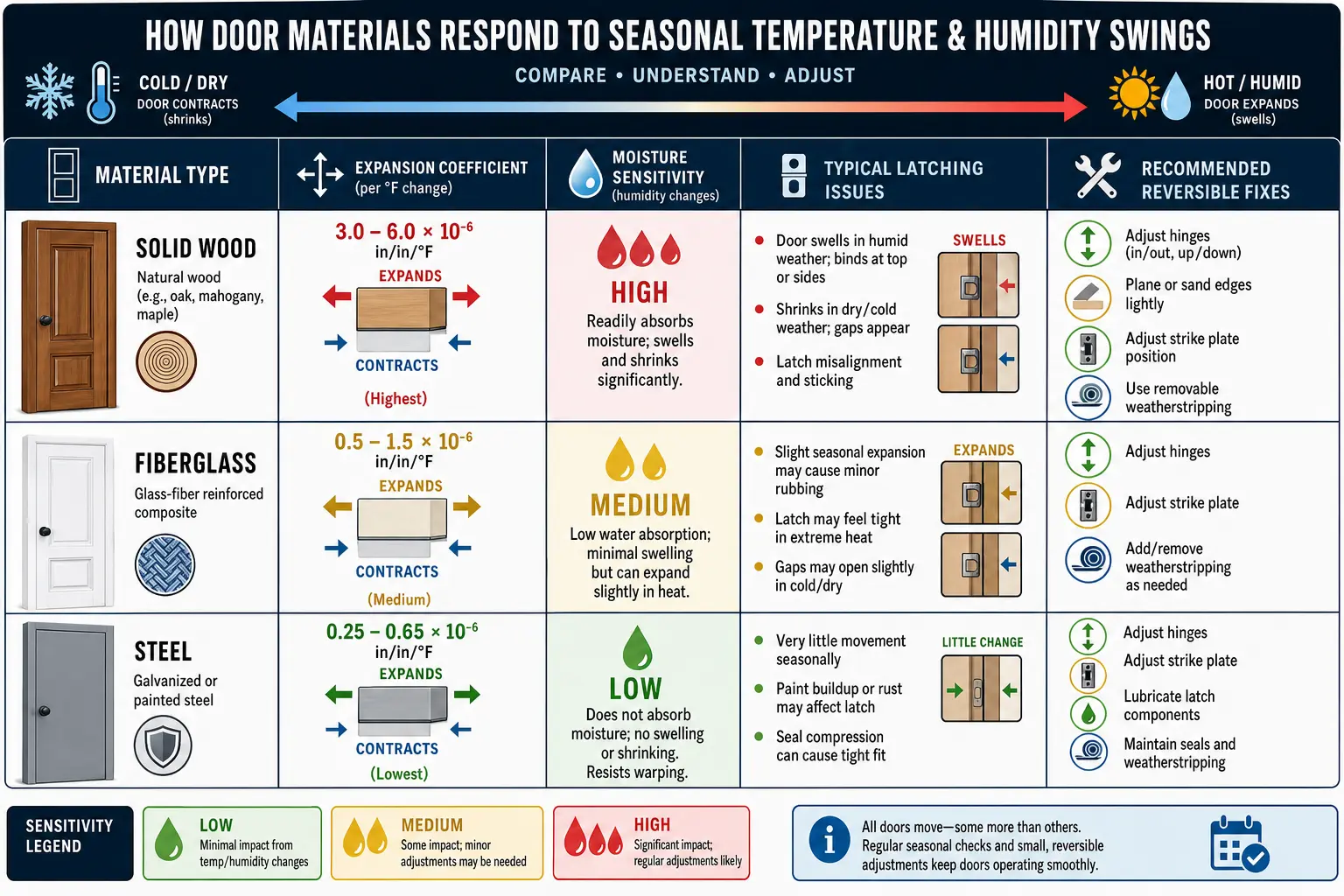
Material-specific door behavior under seasonal climate swings helps users remember why different doors need different latch care and repair approaches.

Understanding the thermal expansion coefficient ($alpha$) and hygroscopic swell rates of your specific door material guides proper non-destructive corrections:

  • Solid Wood Doors: Natural timber exhibits tangential expansion rates between 6% and 10% across relative humidity shifts (from 30% winter dry up to 85% summer humid), while longitudinal expansion remains under 0.1%. Widthwise binding or latch push-out is almost entirely moisture-driven. If you notice your door sticking in winter, evaluate internal indoor moisture balance alongside frame stability.
  • Fiberglass Composite Doors: Highly stable under humidity shifts, but core insulation layers can experience thermal bowing when exterior surfaces drop below freezing while interior surfaces remain heated to 70°F.
  • Steel Insulated Doors: Steel expands at approximately $approx 12 times 10^{-6} /^circtext{C}$. Extreme cold contracts the metal skin slightly, while the surrounding wooden jamb structure shifts, altering deadbolt and latch alignments.

When evaluating durable upgrades, selecting proper exterior door materials tailored to northern climate swings prevents annual latch failures. Furthermore, home entry points benefit significantly when homeowners reinforce door frame anchors to withstand both force and thermal stresses.

For internal interior transitions, matching appropriate internal door hardware ensures reliable operation across changing household zones. When frames exhibit structural deterioration beyond simple shim repairs, a complete door jamb replacement restores permanent alignment.


Professional Consultation and Next Steps


Persistent latch issues that resist non-destructive adjustments often point to complex interactions between structural wall settling, foundation movement, or frame fatigue. If you need assistance evaluating or executing a permanent repair, professional technicians can diagnose frame tolerances and perform precise adjustments.

To restore effortless latching, draft protection, and home security, contact a licensed technician to evaluate your entryway alignment today.

Frequently Asked Questions


Why does my door get stuck when it's cold outside?

Cold ambient air drops relative indoor and outdoor humidity, causing wooden framing studs and jambs to dry and contract. This contraction loosens top hinge screws under rotational tension, letting the door leaf sag downward against the lower latch edge or frame threshold.

Should I file my strike plate if the door stops latching in winter?

Filing down brass or steel strike plates should be treated as a last resort. Because seasonal shifts are cyclical, filing metal in winter creates an oversized opening that leads to loose, rattling doors and air leakage once summer humidity swells the jamb back into its warm-weather position.

How do I know if my door frame needs structural repair or just hardware adjustments?

If driving a 3-inch framing screw into the top hinge and adjusting the strike tab fails to align the latch, or if the reveal margin along the top head jamb is severely slanted, the wall framing or jack studs may have settled. In such cases, professional jamb realignment or structural frame testing is recommended to restore proper operation.