(855) 676-0881

After a Garage Door Falls: The Post-Failure Hardware Inspection


Published: Nov 9, 2026

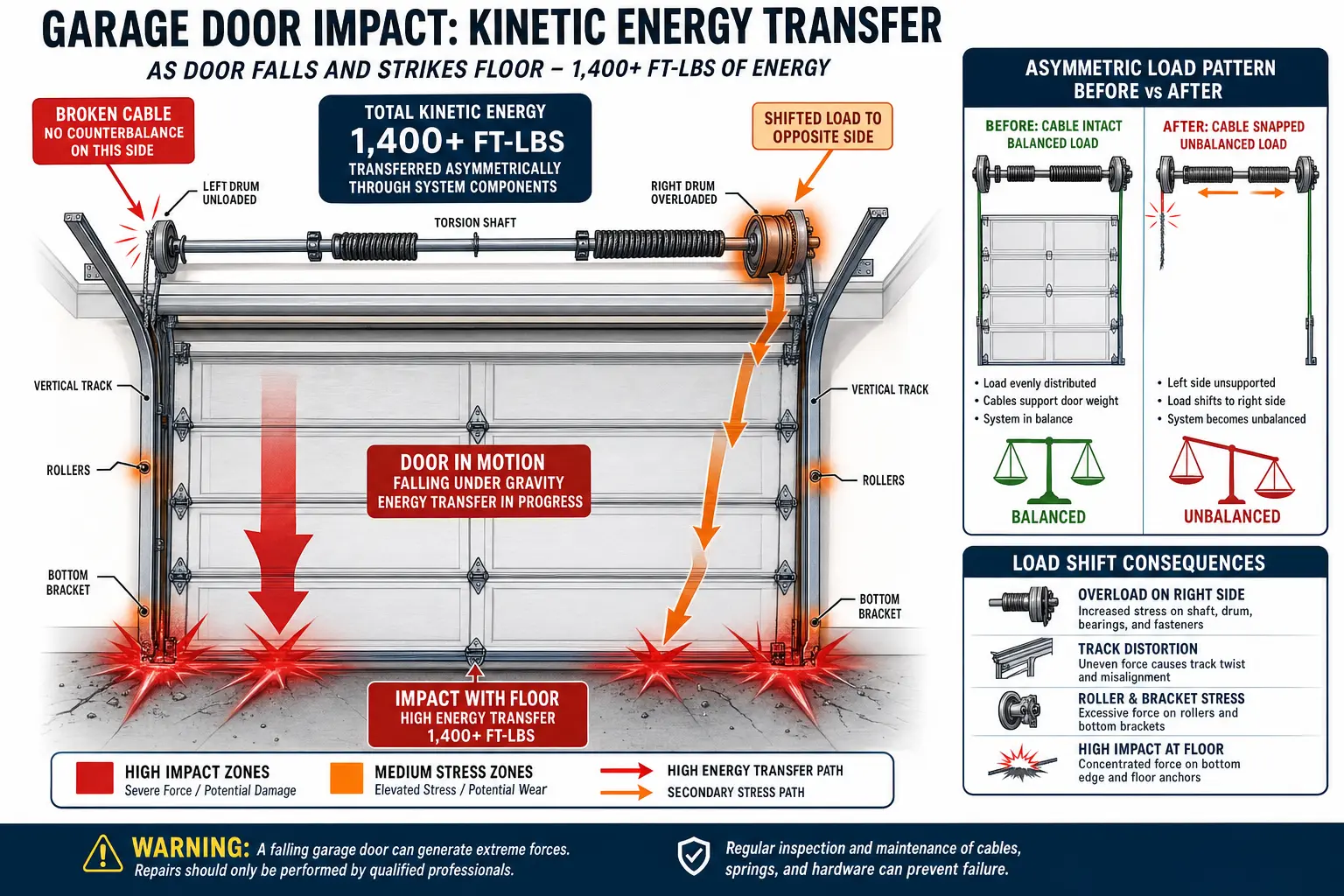
When a 150 to 400 lb garage door free-falls due to component failure, it strikes the floor with over 1,400 ft-lbs of kinetic energy. Beyond the immediate shock, this violent drop creates severe structural trauma throughout the assembly.

Evaluating the system after a failure requires a systematic inspection framework to identify hidden damage, establish safety boundaries, and make an informed repair-versus-replacement decision.

Immediate Safety Triage: Establishing the "Do Not Touch" Zone


Before conducting any visual assessment, you must establish strict safety boundaries. According to the National Electronic Injury Surveillance System (NEISS), over 2,000 emergency room visits occur annually from DIY garage door repairs. The vast majority of severe injuries involve sudden spring releases and bottom bracket detachments.

Even when the door rests flat on the concrete floor post-fall, high-tension hardware retains lethal energy:

  • Bottom Corner Brackets: As outlined in DASMA Technical Data Sheet #102, bottom fixtures remain under extreme rotational torque (up to 300+ lbs). Never unbolt or adjust bottom brackets while cables are under tension or wedged under load.
  • Torsion Shaft & Springs: Under DASMA TDS #103 guidelines, torsion springs, center support brackets, and winding cones must be treated as active hazard zones.
  • Manual Release Cord: Do not pull the manual disconnect cord if the door is partially stuck, as this can trigger an immediate secondary drop of unsupported sections.

If the opening cannot be secured safely or the structural frame is dislodged, contact an expert in emergency commercial door repair to stabilize the structure before proceeding.

Anatomy of a Crash: How Fall Dynamics Damage Hardware


A garage door drop is rarely a balanced vertical movement. Research shows that in 87% of door falls, one lift cable or spring fails moments before the other. This creates an immediate asymmetric shock load, transferring 100% of the kinetic energy down a single side of the tracking system.

Visualizing how the high kinetic energy from a garage door fall creates asymmetric forces that damage multiple interconnected hardware components, not just the point of impact.

As the falling section impacts the floor, force travels backward up through the panel hinges, roller stems, radius tracks, and torsion shaft. This kinetic wave creates multi-point hardware distortion:

  1. Shaft Deflection: The rotational torsion bar bends or twists out of alignment.
  2. Drum Scoring: Slipping cables groove or chip aluminum cable drums.
  3. Roller Stem Shearing: Horizontal force snaps or bends steel roller stems.
  4. Track Gauge Flaring: The impact force expands track channel walls outward.

The 6-Point Post-Fall Forensic Hardware Inspection


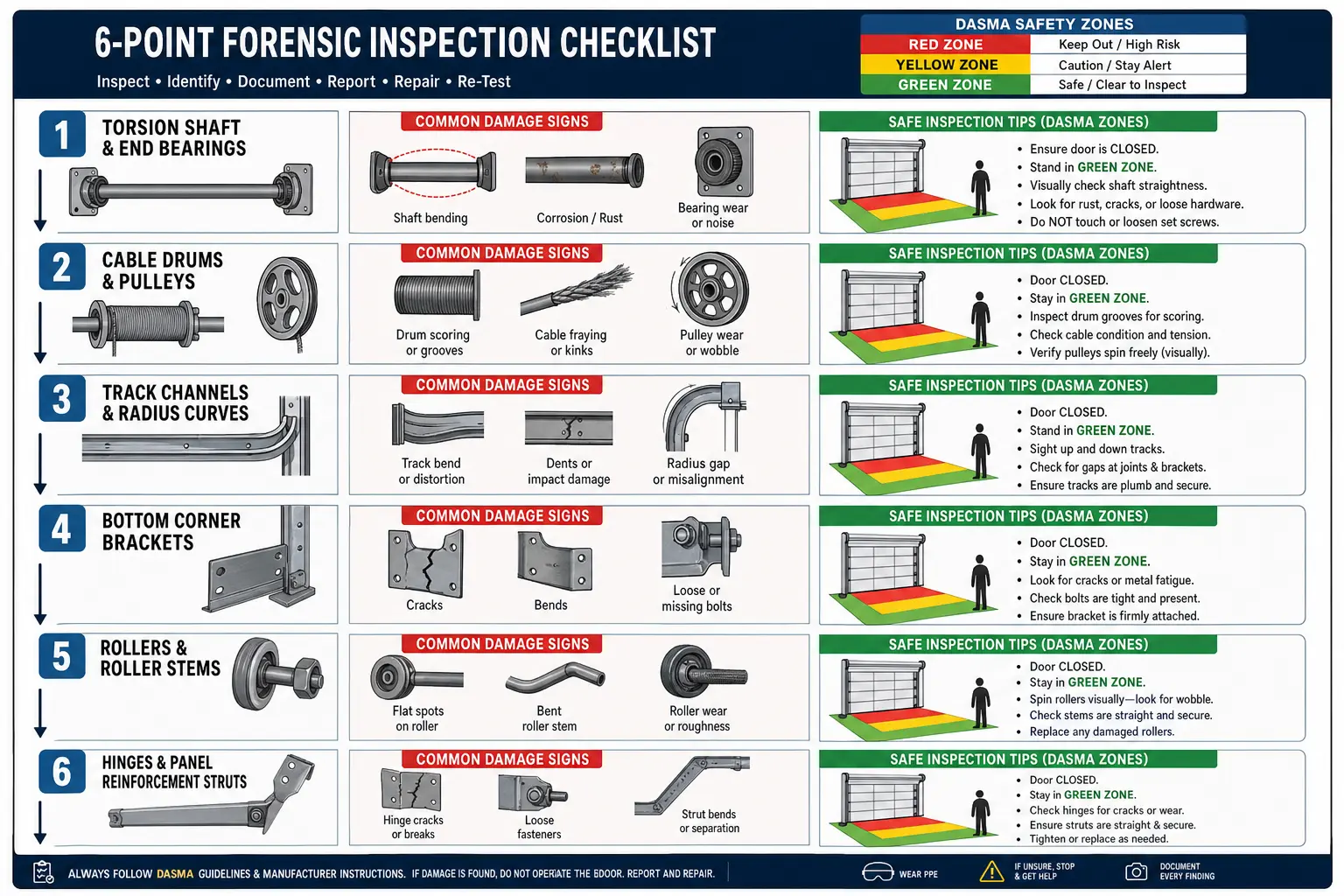
Perform a hands-off, visual 6-point check from a safe distance to document damage before attempting hardware replacement.

Stepwise visual guide for thoroughly inspecting critical garage door hardware components after a fall, emphasizing safe identification of damage before any repair attempts.

  1. Torsion Shaft & Center Bearing Plates: Check the long steel bar above the door for bowing. Inspect center plates for sheared mounting bolts or cracked bearing housings.
  2. Cable Drums & Cable Seating: Look for deep grooves on aluminum drums, chipped outer flanges, or loose set-screws indicating drum slippage.
  3. Track Channels & Radius Curves: Measure channel width using a ruler. If track wall flare exceeds 1/8 inch beyond standard width, or if radius curves show structural crimping, track integrity is compromised.
  4. Bottom Corner Brackets: Inspect visually for hairline metal fatigue cracks or bent cable attachment pins without touching the bolts.
  5. Rollers & Bearing Races: Look for bent roller stems, cracked nylon wheels, or exposed ball bearings.
  6. Hinges & Frame Jambs: Check leaf hinges between panels for stress fractures. Severe impacts can twist vertical framing, requiring door jamb replacement to restore proper squareness.

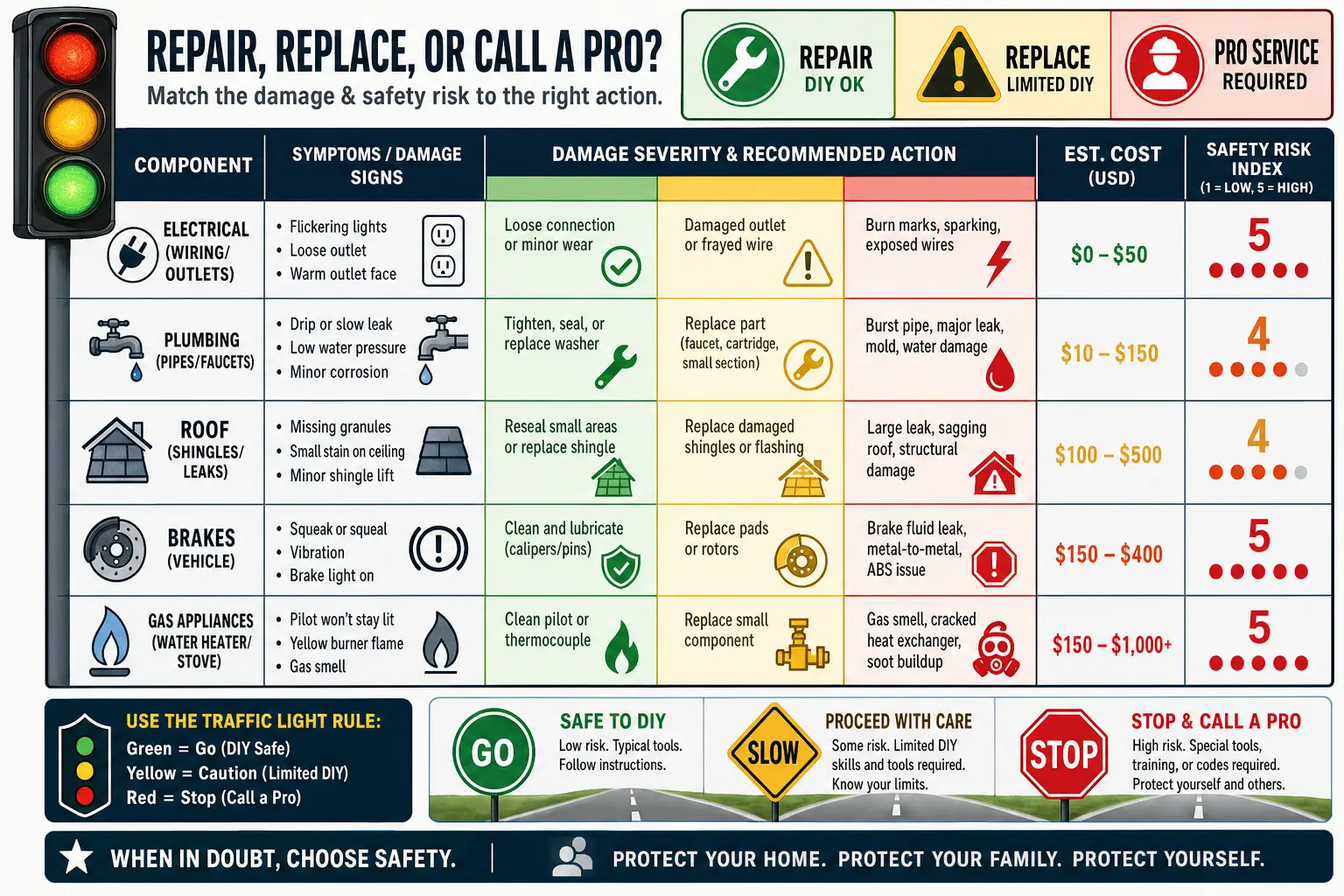
Post-Inspection Decision Matrix: Repair, Replace, or Call a Pro?


Evaluating hardware damage helps determine whether localized component replacement is viable or if full system remediation is required.

A user-friendly visual decision aid helping homeowners and technicians quickly determine the best course of action after a garage door fall, balancing safety, cost, and repair complexity.

Component Damage Signs Safety Risk Level Fixable Action Est. Repair Cost Range
Track Alignment Minor bends, wall flare < 1/8″ Moderate Realignment / Sectional Repair $125 – $250
Cables & Drums Snapped strands, drum scoring High Dual-Cable & Drum Replacement $150 – $350
Torsion Assembly Broken spring, bent tube shaft Critical Spring & Shaft Overhaul $200 – $450
Full System Multi-panel twist, severe track buckling Critical Complete Hardware Re-Kit $400 – $850+

When repairing damaged hardware, consider upgrading components to prevent future structural failure. Replacing standard 14-gauge track channels with heavy-duty 12-gauge commercial-grade tracks and upgrading to sealed 13-ball bearing nylon rollers significantly increases impact resistance. Routine professional door maintenance ensures balance, smooth tracking, and long-term operating safety.

Frequently Asked Questions


Can I manually lift the door to inspect under it after a fall?

No. Never lift a door manually after a fall. Because falling doors usually suffer asymmetric shock loads, the counter-balance springs, cables, or roller stems on one side are likely damaged. Attempting to lift the door can cause remaining cables to snap or derail rollers, leading to an uncontrolled secondary collapse.

What causes a garage door to fall asymmetrically on one side?

Asymmetric falls occur when one lift cable snaps or unspools from its drum while the opposing side remains attached. The sudden release transfers the door’s entire weight onto a single cable, destabilizing the door within the tracks and twisting the panels horizontally as it drops.

Is it worth repairing bent tracks after a high-impact door crash?

If the track exhibits light surface bending, minor adjustment is possible. However, if the track channel wall has flared out by more than 1/8 inch or if the curve radius is creased, bending the metal back compromises structural steel rigidity. In high-impact crashes, replacing the track section ensures long-term safety and operational alignment.