(855) 676-0881

Entry Door Security: Reinforcing Your Home’s Weakest Link


Published: Sep 15, 2026

When evaluating your home’s security, you might naturally focus on alarms and motion sensors. However, physical security starts at your threshold. According to the FBI’s Uniform Crime Reporting Program, 34% of burglars enter directly through the front door, and 56.7% of all burglaries involve forcible entry.

For home and business owners, the challenge is evaluating whether your entry door is a true physical barrier or merely an easy target. Securing an entry point requires looking at the door as an integrated structural system—combining the lock, the door edge, and the frame into a single protective shield.
The Quick Answer: The Anti-Kick System Blueprint


A common mistake is installing an expensive lock onto a weak wood frame. True physical protection requires an integrated approach:

  • A Grade 1 Deadbolt: To resist physical lock-picking, drilling, and blunt force.
  • An Elongated Steel Strike Plate: Upgrading the standard 2-inch strike plate to a heavy-duty, multi-screw steel plate.
  • 3.5-inch Hardened Wood Screws: Replacing the standard, shallow 1/2-inch builder screws to anchor the hardware deep into the structural 2×4 framing studs behind the door jamb.

The Physics of a Kick-In: Why Strong Locks Fail on Weak Frames


During a forced entry, burglars rarely pick locks. Instead, they apply sudden, concentrated force directly to the lock area.

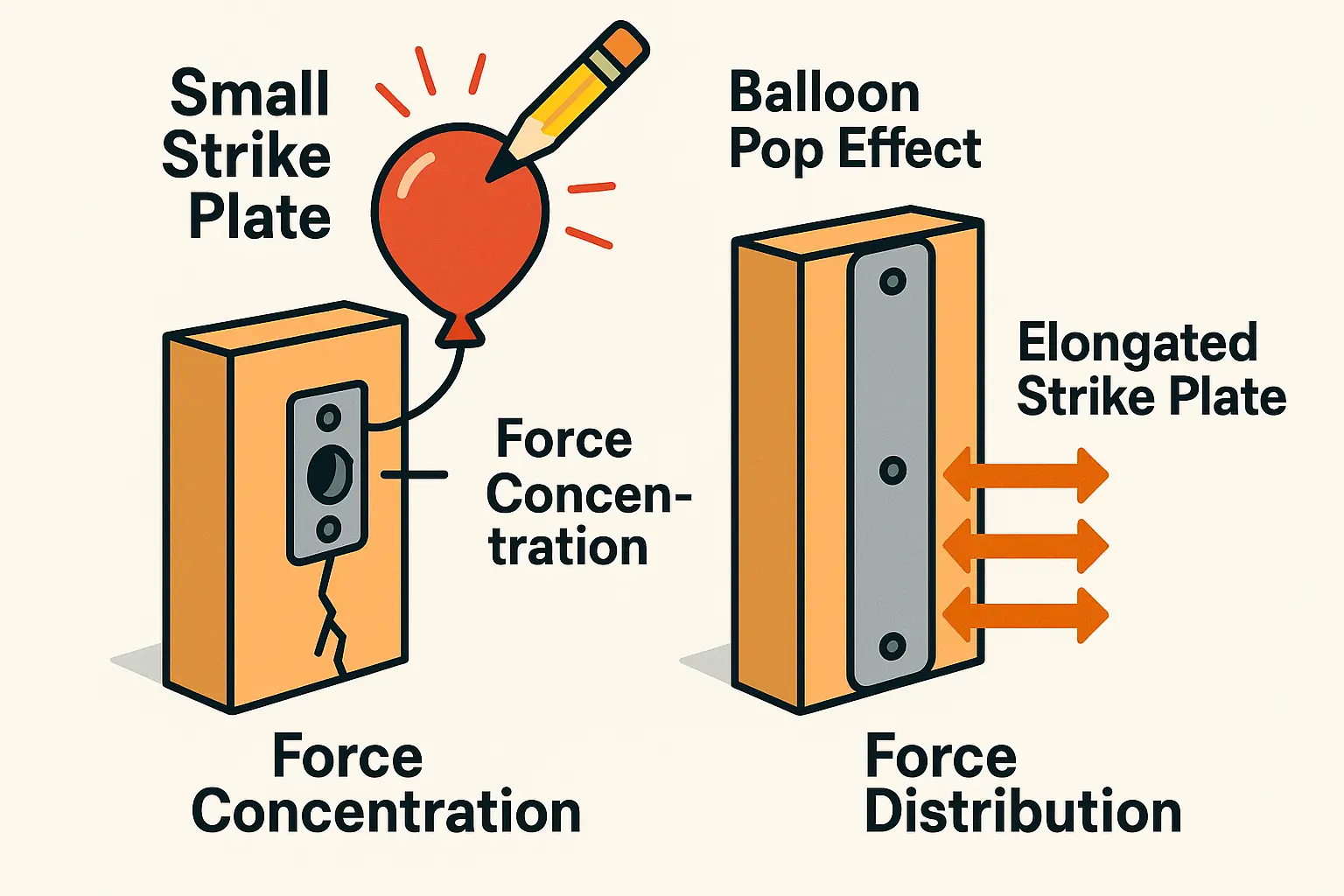
If your door is installed with standard builder-grade hardware, that strike plate is secured by thin 1/2-inch screws into a soft pine frame. This concentrates all the kick force onto a tiny, fragile block of wood, causing the door jamb to split instantly along the grain. Think of a standard strike plate like a pencil trying to pop a balloon; it focuses energy to puncture the weakest point.

An elongated steel strike plate works by distributing that impact energy across several feet of the structural framing, making the door virtually kick-proof. Without this reinforcement, homeowners often face the unexpected expense of a broken door frame repair cost.

This visual metaphor explains why strong locks fail on weak frames: a small strike plate focuses all kick-in force on a tiny soft wood area, causing failure, while an elongated steel strike plate spreads out the force to protect the door frame.


The Connecticut Climate Factor: How CT Weather Weakens Your Entry Door Frame


In Connecticut, our entry systems face a unique environmental challenge. The dramatic seasonal swings—from humid coastal summers to freezing, snow-heavy winters—cause wood frames to expand, contract, warp, and warp again.

Over time, this moisture cycle weakens the structural integrity of soft pine door frames. Moisture absorption can lead to localized rot around the lower hinges and strike plates, making the wood spongy and highly susceptible to splitting under minimal pressure.

When seeking a professional door installation hartford ct service, it is critical to evaluate materials that resist this cycle. Choosing a composite, metal-clad, or specially treated jamb that won’t rot protects against local climate degradation. Consistent door maintenance ensures that seasonal shifting doesn’t misalign your locking bolt, which can cause latch failure and compromise your physical security.


The Lock Spec Decoded: ANSI/BHMA Grade 1 vs. Grade 3


Before purchasing hardware, you must understand the industry standards established by the Builders Hardware Manufacturers Association (BHMA) and the American National Standards Institute (ANSI). Locks are graded from 1 to 3:

  • Grade 1 (Commercial High-Security): The highest level of residential and commercial security. These deadbolts must withstand 250,000 open/close cycles and 10 strikes of 150 foot-pounds of force from a heavy ram.
  • Grade 2 (Heavy Residential): Designed to handle 150,000 cycles and 5 strikes of 120 foot-pounds of force.
  • Grade 3 (Standard Builder Grade): Passes only 100,000 cycles and just 2 strikes of 90 foot-pounds of force. This is the basic hardware found in standard retail “builder packs” and often fails on the first kick.

Investing in Grade 1 locks ensures your door has commercial-grade structural resistance to physical attacks.


Smart Locks vs. Traditional Deadbolts: The Credential vs. Physical Force Debate


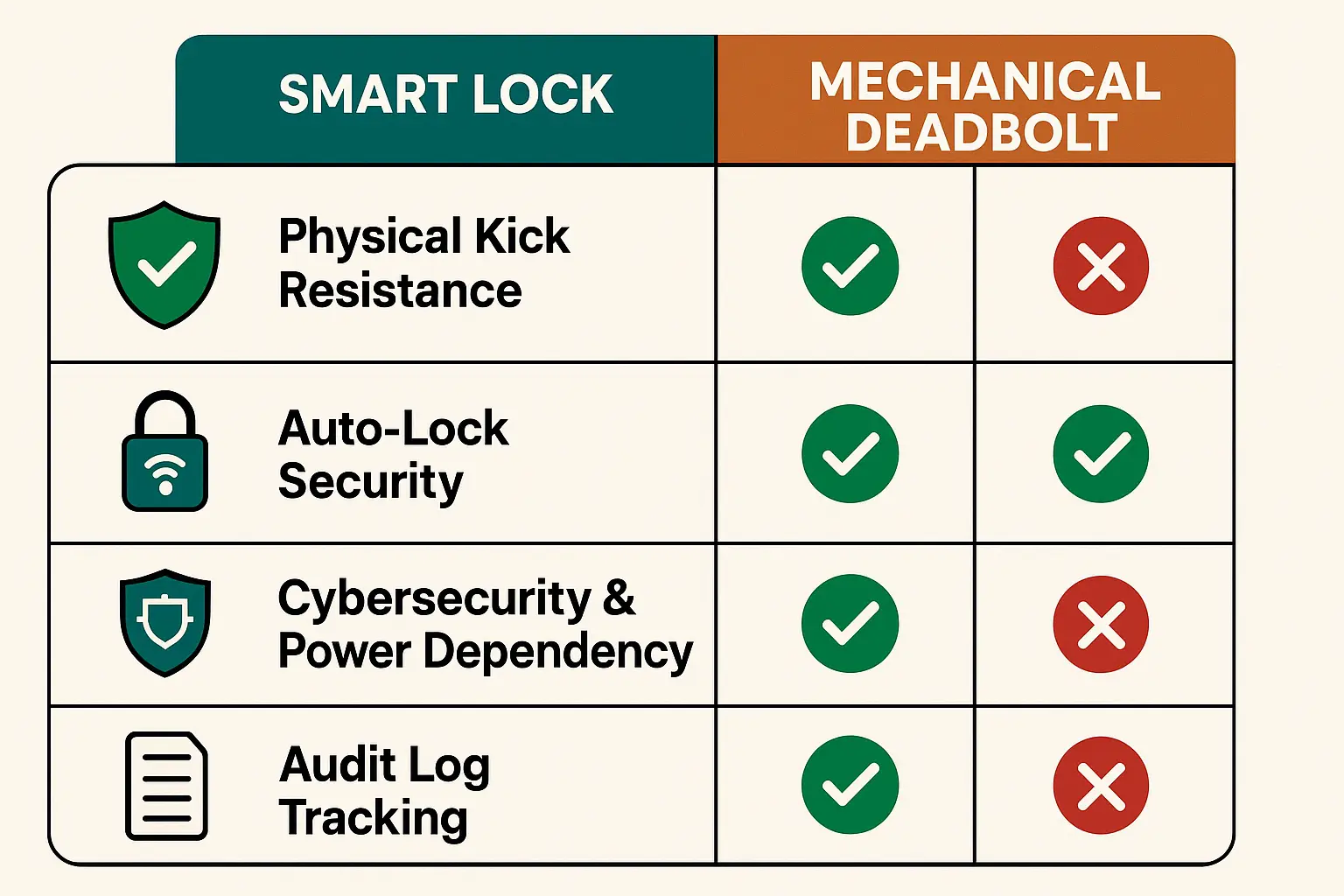
A key decision for modern entryways is choosing between traditional mechanical deadbolts and smart locking systems. Data from the Bureau of Justice Statistics shows that 30% of home burglaries occur through unlocked doors, making the auto-locking feature of smart locks a major security advantage.

This comparison chart anchors key differences between smart locks and traditional deadbolts, helping readers remember trade-offs between physical security and smart convenience features.

While smart locks offer audit trails, remote access, and automatic locking, they must be paired with physically robust structures. Installing a high-tech smart deadbolt on a flimsy door defeats its purpose. For maximum protection, pair smart credentials with heavy-duty steel entry doors to get the best of both automated convenience and physical steel-strength engineering.


Step-by-Step Structural Reinforcement (DIY Blueprint to Professional Spec)


Upgrading your entry door system can range from quick physical corrections to complete professional rebuilds.

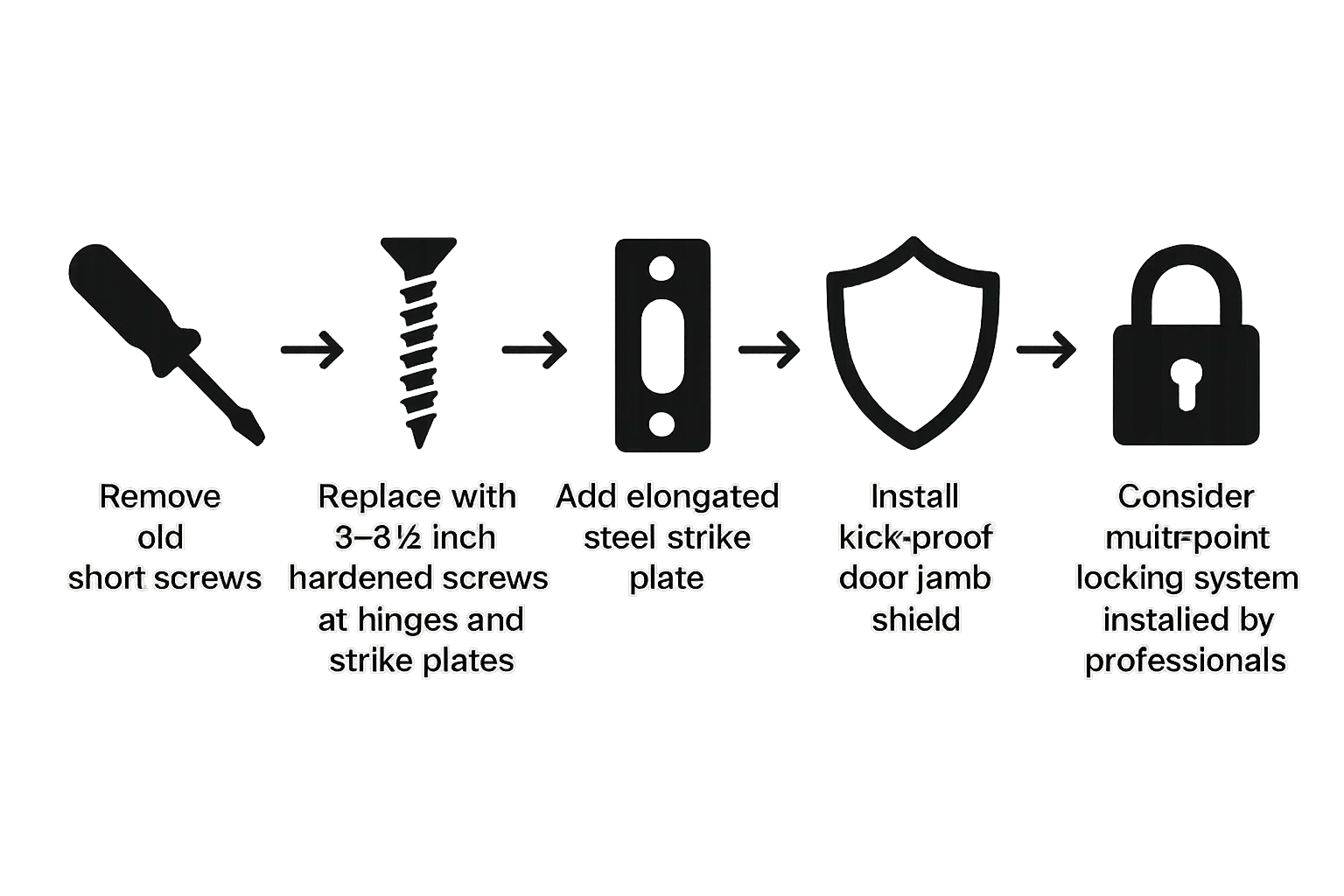
A clear process diagram guiding readers through reinforcing an entry door from simple DIY upgrades to professional multi-point locking installation for maximum security.

1. The 3-Inch Screw Rule (DIY Upgrade)

Remove the small 1/2-inch screws from your hinges and strike plates. Replace them with 3-inch or 3.5-inch hardened wood screws. This anchors the door hardware directly into the house’s wall studs, instantly increasing kick resistance by over 400%.

2. Install heavy-duty strike plates and wrap-around door edges

A brass or steel wrap-around plate reinforces the wood around the door handle itself, preventing the door from splitting down the middle under a sledgehammer or kick attack.

3. Professional Structural Reinforcement

For ultimate security, consider a complete entryway upgrade. This involves replacing weathered doors with steel-reinforced replacement front doors, installing multi-point locking systems that secure the door at three separate points along the frame, or scheduling a protective storm door replacement to add an extra physical layer of defense.


Frequently Asked Questions


How do I know if my front door frame is structurally secure?

Inspect the area around your lock’s strike plate and the hinges. If you notice soft wood, hairline cracks, or loose screws that turn without tightening, your frame is compromised. Wood that swells during humid Connecticut summers or contracts in winter indicates structural movement, making it highly vulnerable to forced entry.

What is the difference between Grade 1 and Grade 3 locks?

Grade 1 locks are commercial-grade systems certified by ANSI/BHMA to withstand 250,000 cycles and 10 high-impact physical strikes of 150 foot-pounds. Grade 3 locks are residential-grade, certified for only 100,000 cycles and 2 strikes of 90 foot-pounds. Grade 3 locks are easily bypassed with physical force.

Can I reinforce my door frame myself, or should I hire a professional?

While replacing short hinge screws with 3-inch screws is an easy DIY project, comprehensive reinforcement should be handled by a professional. Properly aligning heavy-duty strike plates, installing multi-point locking systems, and replacing rotten or warped wood frames require precise carpentry and alignment to ensure the door seals, swings, and locks correctly.