Selecting the right overhead door opener requires balancing mechanical durability, acoustic performance, smart connectivity, and safety compliance. Whether upgrading an attached home garage or specifying heavy commercial bay access, today’s automation technology bridges motor engineering with digital access networks.
Overhead Door Openers & Automation Technology
Published: Oct 23, 2026
Executive Selection Engine: Choosing the Right Drive Mechanism
Evaluating opener drive architectures depends heavily on noise tolerance, structural layout, and door weight.
Chain drives remain durable options but generate 65 to 72 decibels (dB) of noise, transferring motor vibration directly through ceiling joists via J-bar hanger straps. Belt drives powered by DC motors reduce acoustic signatures down to 50–55 dB by utilizing steel-reinforced polyurethane belts alongside soft start/stop electronic speed controls. For rooms located directly above garages, wall-mount jackshaft (direct drive) systems operate at an ultra-quiet 40–45 dB by mounting directly to the front drywall header, eliminating ceiling joist resonance entirely.
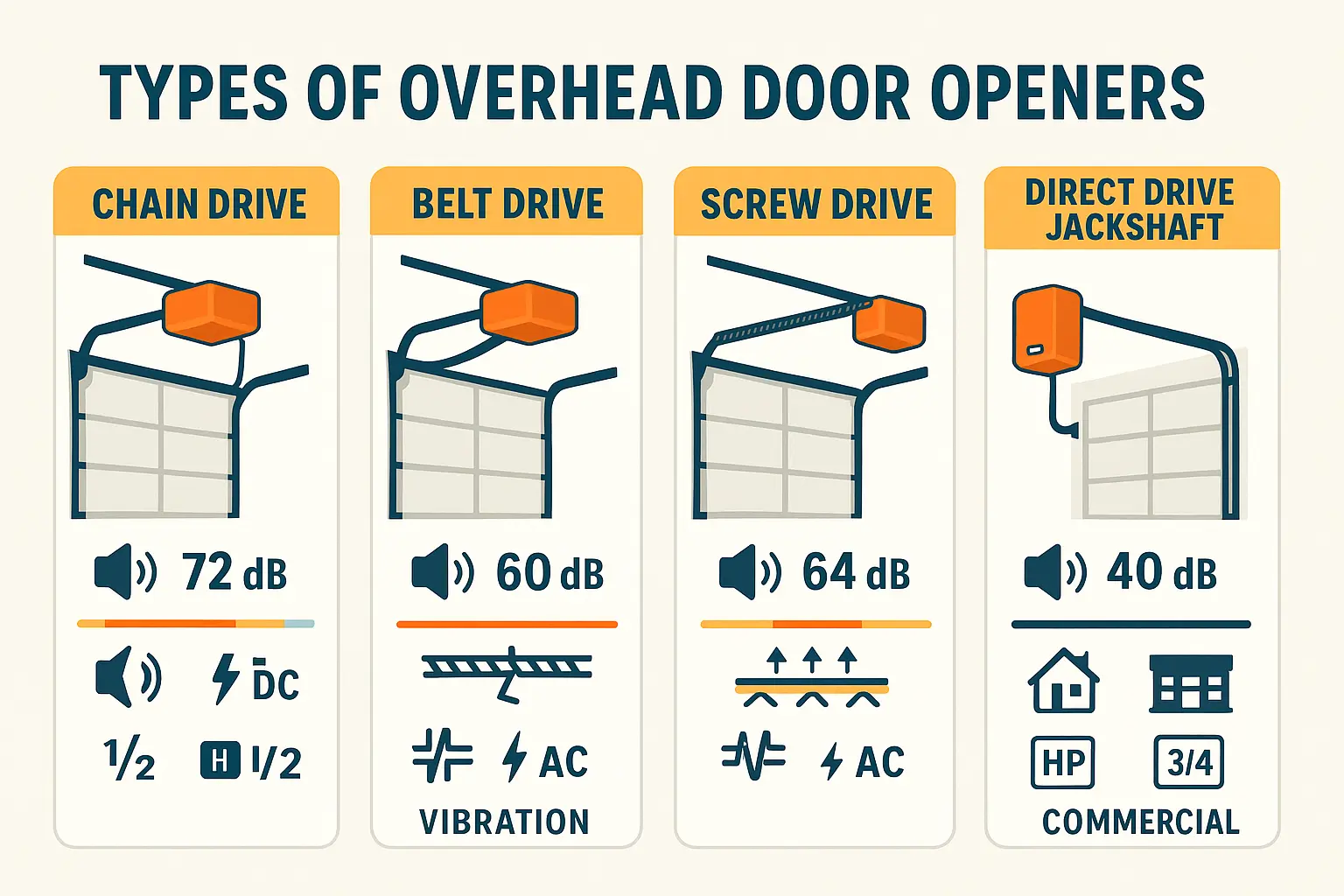
Motor output must align with door mass. Standard single and double doors run efficiently on 1/2 HP or 3/4 HPc (horsepower comparable) motors, while custom double-thick carriage doors require 1-1/4 HPc motors. When upgrading hardware, inspecting residential overhead garage doors ensures spring balance is verified; research shows 68% of premature opener failures stem from unbalanced torsion springs requiring over 10 lbs of manual lift force. System lifespan averages 10 to 15 years under proper maintenance.
Smart Home Integration & Ecosystem Matrix
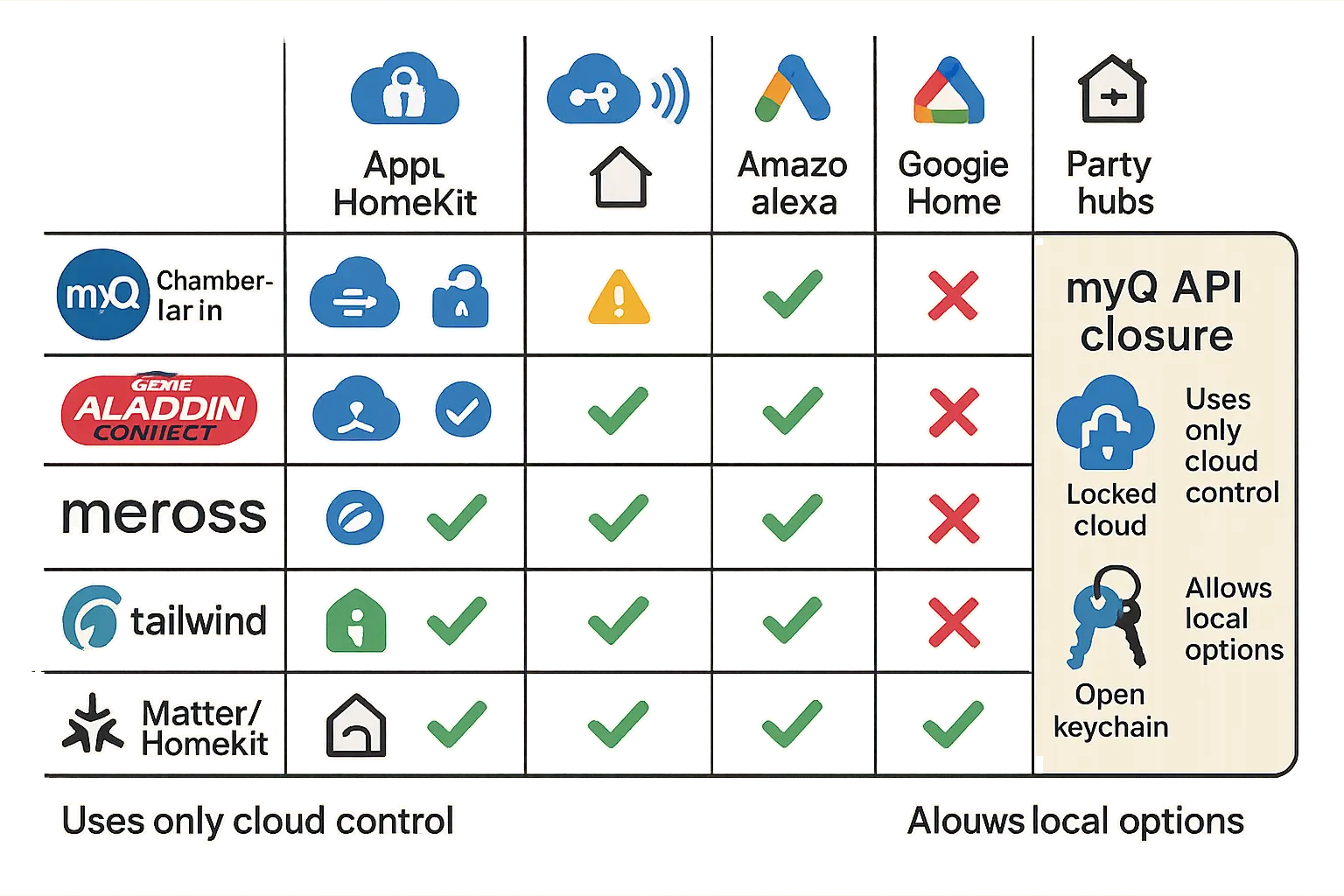
Over 42% of smart opener owners utilize remote access applications daily. Recent cloud platform policy shifts—such as proprietary ecosystem API restrictions—have accelerated adoption toward open-standard, local control solutions like Meross, Tailwind, and Ratgdo. These hardware bridges allow native integration with Apple HomeKit, Amazon Alexa, Google Home, and Matter without monthly subscription locks.
For commercial facilities, smart integration extends beyond basic app commands to include 3-button wall stations, vehicle loop detectors, RFID readers, and edge safety sensors, requiring customized office door security configurations.
Installation, Compliance, and Structural Guidelines
Before installing a replacement opener, complete a pre-installation structural audit. Standard ceiling-mount openers require a minimum of 3 inches of headroom above the highest point of door travel. Direct-drive jackshaft systems require at least 8 inches of side room clearance along the torsion bar.
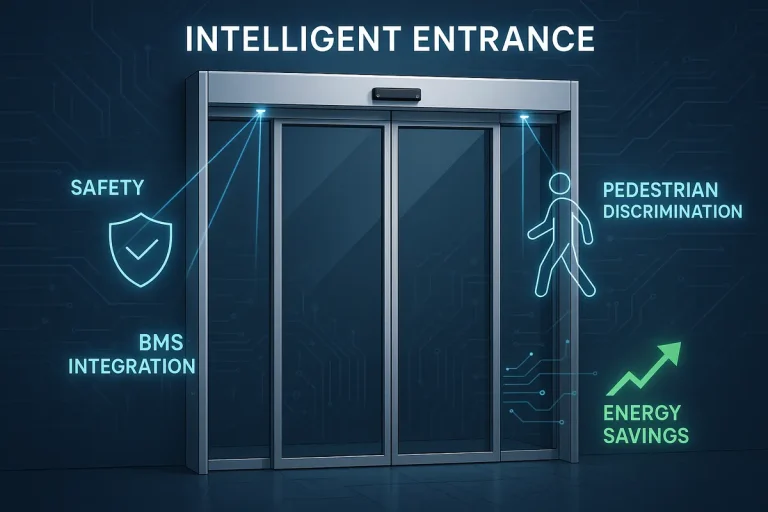
Safety compliance is strictly enforced across jurisdictions. Under UL 325 safety standards, photo-eye safety sensors must be mounted no higher than 6 inches above floor level and feature auto-reversing force tuning. Regulatory mandates like California Senate Bill 969 require operational battery backup units (BBU) on all residential installations, carrying civil penalties up to $1,000 per non-compliant setup. For commercial applications, confirming ada door operator installation standards guarantees full code accessibility compliance. High-traffic commercial systems also benefit from integrating specialized automatic door sensors for seamless perimeter movement.
The Master Diagnostic & Troubleshooting Guide
When operational issues arise, methodical isolation prevents unnecessary component replacements.
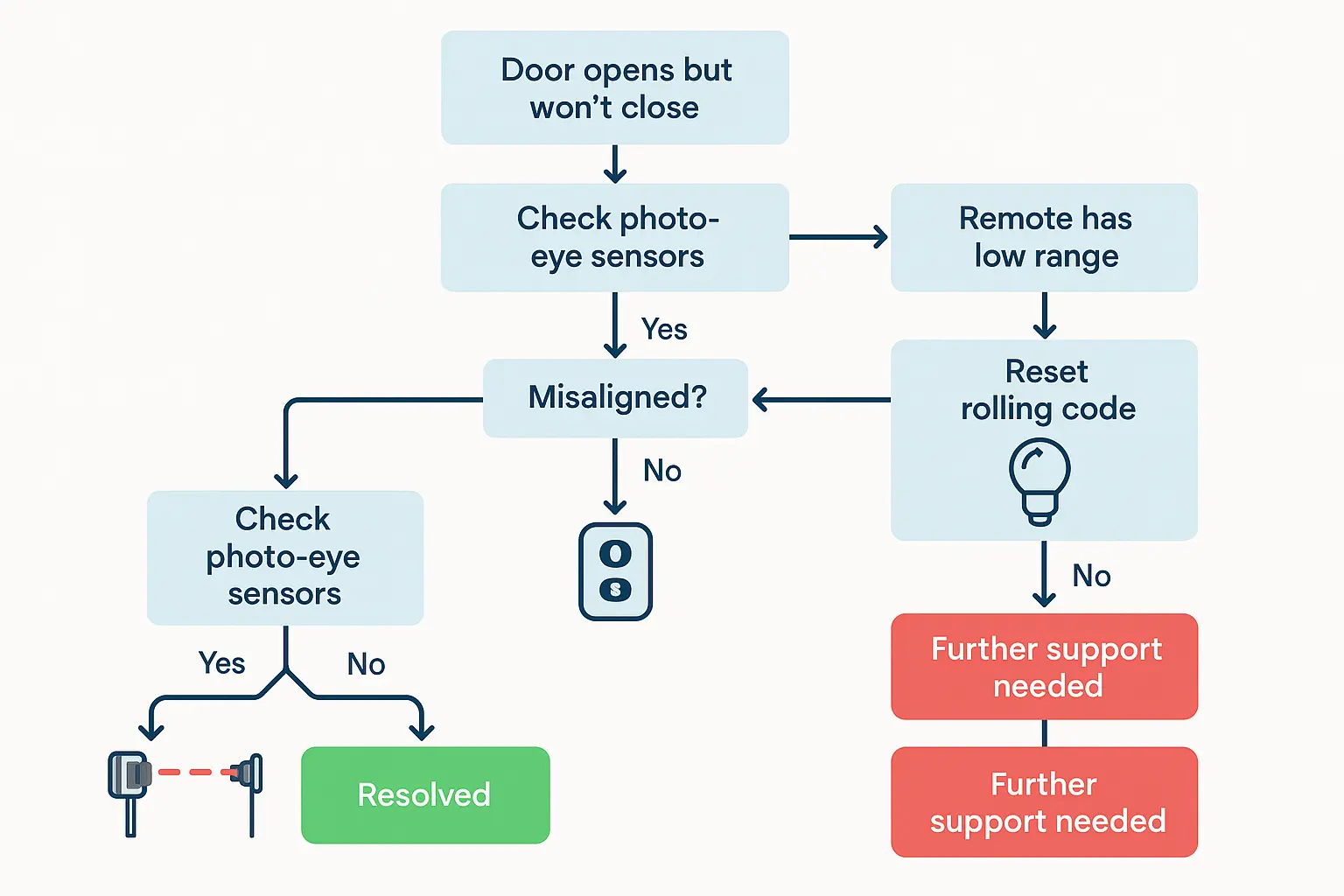
If a door opens via remote but refuses to close, executing garage door sensors troubleshooting usually highlights optical misalignments, sunlight interference on infrared receivers, or broken 5V DC logic wires. Intermittent remote range often points to radio frequency (RF) signal interference. Non-shielded LED light bulbs installed in the motor housing frequently emit electromagnetic noise across 310, 315, or 390 MHz frequencies, blocking remote signals.
When evaluating older automated entryways, calculating automatic door upgrade cost for existing building or scheduling certified automatic door installation ensures proper frequency shielding, battery backup compliance, and secure rolling-code receiver protocols.
Frequently Asked Questions
Why does my garage door remote work only when standing close to the motor?
Shortened remote range is typically caused by electromagnetic interference (EMI) generated by unshielded LED light bulbs installed in the opener socket. Replacing standard LEDs with garage-door-rated bulbs operating outside the 310–390 MHz radio frequency range restores full remote signal range.
How can I determine if my opener needs replacement or a spring adjustment?
Disconnect the opener drive arm and manually lift the door halfway. If the door drifts down rapidly or feels heavy (requiring over 10 lbs of force), the torsion springs are unbalanced. Resolving spring balance usually fixes opener strain; however, units older than 10–15 years lacking safety battery backups should be replaced.
Can I connect my garage opener to smart home systems without paying subscription fees?
Yes. Installing open-standard local controllers (such as Meross MSG100HK, Tailwind, or Ratgdo) connects your existing opener directly to Apple HomeKit, Google Home, Amazon Alexa, or Matter networks via local Wi-Fi without recurring cloud subscription fees.