(855) 676-0881

How Modern Door Sensor Upgrades Boost Safety and Lower Costs


Published: Sep 2, 2026

Ever walked into a supermarket and had the doors glide open perfectly, as if they knew you were coming? Or maybe you’ve experienced the opposite: a door that hesitates, closes too soon, or seems to have a mind of its own. That seamless, almost magical experience—or the frustrating lack of it—all comes down to a small, often overlooked piece of technology: the automatic door sensor.

These sensors are the unseen heroes of modern buildings, quietly managing access, ensuring safety, and even saving money. But when they’re outdated or malfunctioning, they can become a source of inefficiency, frustration, and significant safety risks.

This guide is your all-in-one resource for understanding these critical components. We’ll explore how they work, the signs that it’s time for an upgrade, and the surprising benefits modern sensor technology can bring to your business or home.
The Unseen Hero: Understanding Your Automatic Door Sensors


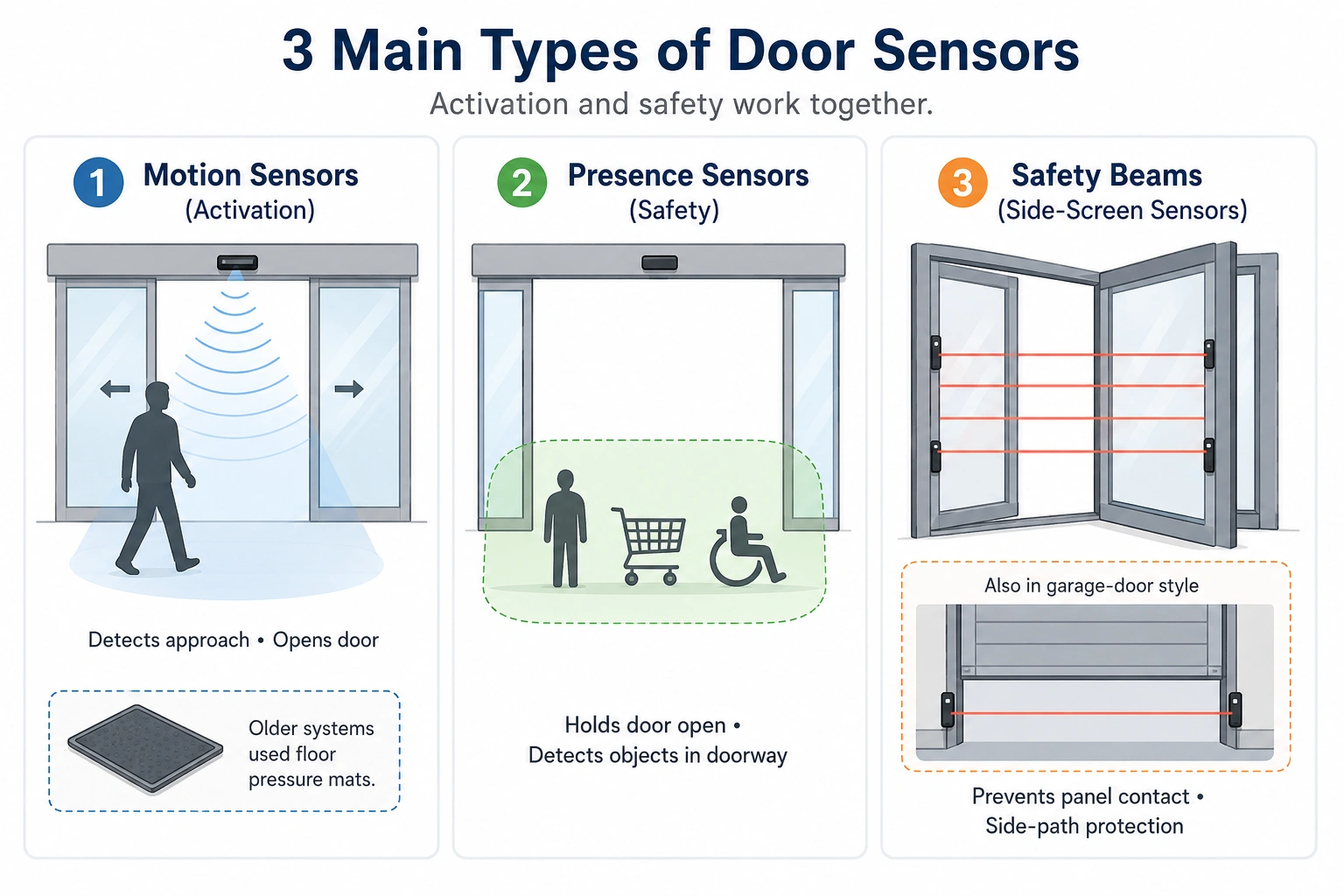
3 Main Types of Door Sensors

At its core, an automatic door sensor is the system’s set of eyes and ears. It detects when someone or something is approaching and tells the door operator to open or remain closed. While the concept sounds simple, the technology behind it is quite sophisticated and has evolved dramatically over the years.

What Are Automatic Door Sensors and How Do They Work?

Think of a sensor as a trigger. It sends out a signal—like a beam of light or a microwave field—and waits for that signal to be interrupted. When you walk into its detection zone, you break the signal, and the sensor sends a command to the door motor: “Time to open!”

The two most common technologies used are:

  • Infrared (IR): These sensors emit or detect infrared radiation (heat). Active infrared sensors shoot out beams of IR light, and when an object blocks the beam, the door is triggered. Passive infrared sensors detect the heat energy emitted by people and objects.
  • Microwave: These sensors emit microwave signals, which bounce off objects in their path. The sensor measures the “doppler shift” in the returning waves to detect motion toward or away from the door.

Modern sensors often combine both technologies (“dual-tech”) to create a smarter, more reliable system that can distinguish between approaching traffic and stationary objects.

The 3 Main Types of Door Sensors

Not all sensors do the same job. A typical automatic door uses a combination of sensors to manage activation and safety.

  1. Motion Sensors (Activation): This is the sensor that sees you coming. Usually mounted above the door, its job is to detect movement and open the door. Older systems used pressure-sensitive mats, but modern doors almost exclusively use microwave or infrared motion detectors.
  2. Presence Sensors (Safety): This is the sensor that keeps the door from closing on you. It creates a detection field in the doorway itself. If it senses an object—a person, a cart, a wheelchair—is stationary within the threshold, it will hold the door open until the path is clear. This is a critical safety feature.
  3. Safety Beams (Side-Screen Sensors): These are additional safety features, often found on swinging or folding doors. They are small, targeted infrared beams located near the door panels’ travel path to prevent them from hitting someone during the opening or closing cycle. Residential garage doors use a similar concept with beams mounted near the floor.

Is It Time for an Upgrade? 5 Signs Your Door Sensors Are Outdated


Sensors aren’t meant to last forever. Technology improves, and components wear out. Ignoring the warning signs can lead to performance issues and potential liability. Here are five clear indicators that your sensors need attention:

  1. Hesitation or Slow Response: The doors take too long to open as people approach, causing them to pause or slow down.
  2. “Ghosting” or False Activations: The door opens when nothing is there, often triggered by rain, falling leaves, or even reflections. This lets conditioned air escape and drives up your energy bills.
  3. Failure to Detect Stationary Objects: This is a major safety hazard. If a person stops in the doorway and the door begins to close, your presence sensors are failing.
  4. Decreased Detection Area: You have to get uncomfortably close to the door before it registers your presence.
  5. Visible Wear and Tear: Cracked housings, loose wiring, or foggy lenses are all physical signs that a sensor is past its prime.

If you’re noticing any of these issues, it might be time to consider a professional inspection. For persistent problems, a full commercial door repair may be necessary to ensure safety and functionality.

The Big Payoffs: Why Upgrading Your Sensors is a Smart Move


Unlocking Safer, Smarter Sensor Performance

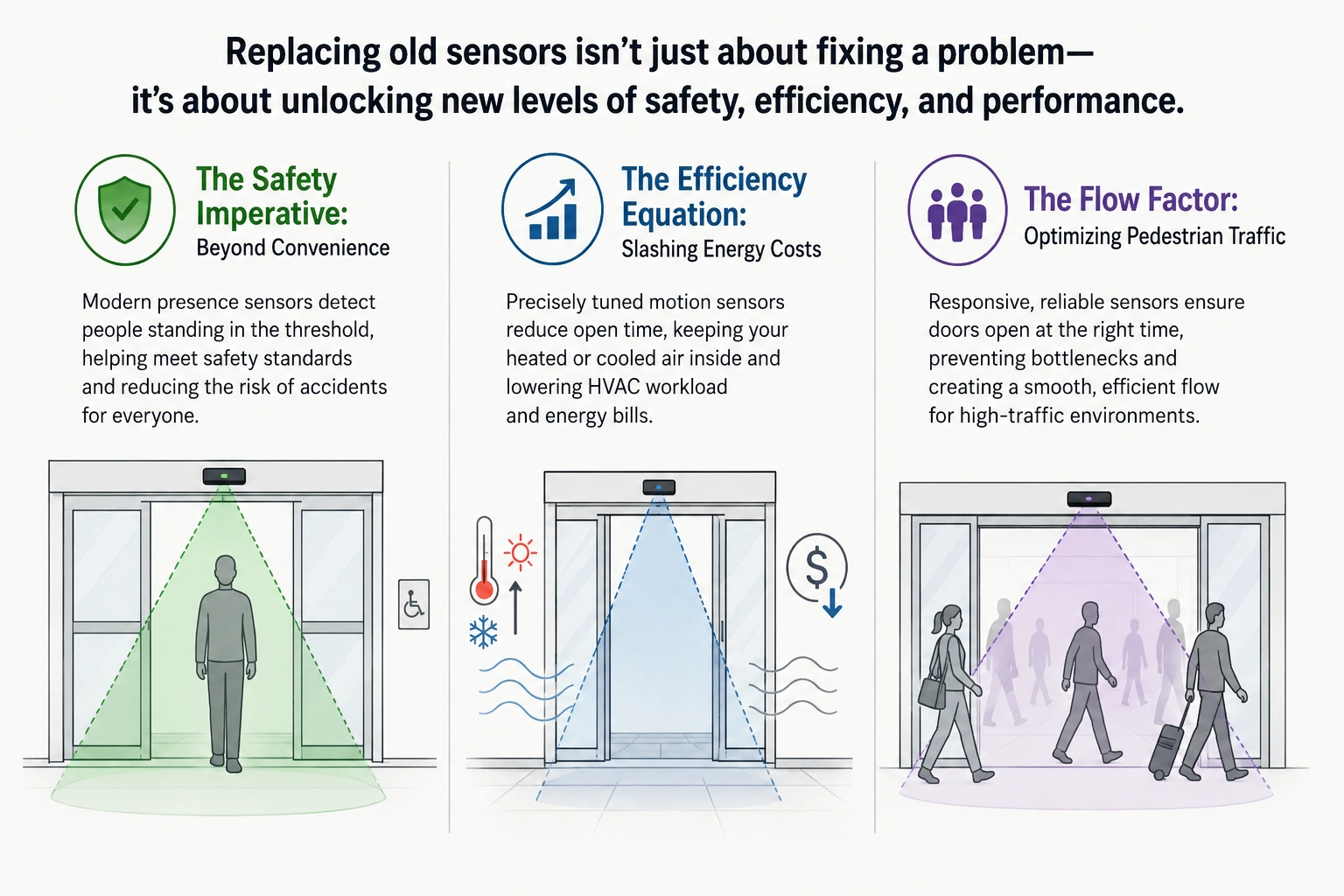
Replacing old sensors isn’t just about fixing a problem—it’s about unlocking new levels of safety, efficiency, and performance.

The Safety Imperative: Beyond Convenience

Modern presence sensors are incredibly sophisticated. They can differentiate between a person walking through the door and someone standing still in the threshold. This capability is crucial for meeting current ANSI/BHMA A156.10 safety standards, which are designed to protect pedestrians of all abilities. An upgrade can significantly reduce the risk of accidents and ensure your entrance is safe and accessible for everyone.

The Efficiency Equation: Slashing Energy Costs

An old or poorly calibrated motion sensor often holds the door open longer than necessary. Every extra second the door is open, your expensive heated or cooled air escapes, forcing your HVAC system to work harder. Modern sensors can be precisely tuned to the exact size and shape of the detection area, ensuring the door opens only when needed and closes as soon as the path is clear. This simple change can lead to noticeable reductions in your building’s energy consumption.

The Flow Factor: Optimizing Pedestrian Traffic

In high-volume locations like hospitals, retail stores, or airports, smooth pedestrian flow is essential. Outdated sensors that are slow to react can cause bottlenecks and congestion. Upgrading to responsive, reliable sensors ensures a seamless and efficient entry and exit experience, improving customer satisfaction and operational flow.

Choosing the Right Sensor for Your Needs


The right sensor depends entirely on the application. The demands of a busy commercial entrance are vastly different from those of a residential garage.

Commercial vs. Residential: What’s the Difference?

  • Commercial Applications: These prioritize safety, durability, and high-traffic performance. They must comply with strict ANSI standards and often use dual-technology sensors to provide robust motion and presence detection. The focus is on ensuring safe passage for the public.
  • Residential Applications: The most common example is the garage door. The primary safety feature is typically a pair of “photo-eye” safety beams near the floor. If this beam is broken while the door is closing, the door will immediately reverse. For homeowners experiencing issues, searching for garage door repair near me is often the first step toward a solution.

A Quick Guide to Sensor Technology

Technology How It Works Best For Potential Downsides
Active Infrared Emits targeted beams of IR light. Triggers when the beam is broken. Safety beams and precise presence detection in the threshold. Can be affected by direct sunlight or reflective surfaces.
Passive Infrared Detects the body heat of people and animals. Energy-efficient motion activation in stable temperature environments. Less effective in areas with rapid temperature fluctuations (e.g., hot climates).
Microwave Sends out microwave signals and detects motion by reading the returning waves. Large, wide detection areas for motion activation (e.g., supermarket entrances). Can sometimes “see” through thin walls or be triggered by movement outside the desired zone if not properly tuned.
Dual-Technology Combines both microwave (for motion) and infrared (for presence) into a single unit. The gold standard for modern commercial doors, offering the best of both worlds for safety and activation. Higher initial cost, but provides superior performance and safety.

A Practical Guide to Common Sensor Issues


Even the best sensors can act up. Here’s a quick troubleshooting guide based on common symptoms.

  • Symptom: The door doesn’t open when you approach.
    • Potential Cause: The motion sensor may be off, misaligned, or faulty. Check to ensure the sensor has power and its lens is clean.
  • Symptom: The door starts to close but then reopens, even when no one is there.
    • Potential Cause: A safety sensor or presence detector is being falsely triggered. This could be due to a reflective object, sunlight, or a malfunction.
  • Symptom (Garage Door): The door won’t close, and a light on the motor unit is blinking.
    • Potential Cause: The photo-eye safety beams at the bottom of the door are misaligned or obstructed. Check to make sure the lenses are clean and that the small LED lights on both sensors are lit and steady.

While some minor adjustments can be done yourself, diagnosing and replacing sensors on a commercial automatic door requires specialized knowledge to ensure it complies with safety standards.

Your Next Step to a Safer, More Efficient Entrance


Your automatic doors are the gateway to your building. They shape the first impression for visitors and are a critical part of your daily operations. By understanding the technology behind them and recognizing the signs of aging, you can make informed decisions that enhance safety, reduce energy costs, and improve the experience for everyone.

If your doors are showing their age, don’t wait for a failure to become a liability. A professional assessment can reveal opportunities for upgrades that pay for themselves in safety and efficiency. With over 15 years of experience, the team at A1 Doors provides a personal approach to every project, ensuring you get the right solution for your needs. For comprehensive door services tailored to your building, investing in a modern sensor system is one of the smartest upgrades you can make.

Frequently Asked Questions (FAQ)


How long do automatic door sensors last?

Most commercial-grade sensors have a lifespan of 5 to 10 years, depending on traffic volume and environmental conditions. Over time, electronic components can degrade, leading to less reliable performance.

Can I replace a sensor myself?

For residential garage door safety sensors, a confident DIYer can often perform a replacement by following the manufacturer’s instructions carefully. However, for commercial automatic doors, it is strongly recommended to hire a certified technician. These systems are complex, and improper installation can create serious safety hazards and violate building codes.

Why is my garage door sensor blinking?

A blinking light on a garage door photo-eye sensor usually indicates that the two sensors are not aligned with each other. One sensor sends the beam, and the other receives it. If they aren’t lined up perfectly, the beam is “broken,” and the door’s safety feature will prevent it from closing.

What are the latest ANSI standards for automatic doors?

The primary standard is ANSI/BHMA A156.10, which covers Power Operated Pedestrian Doors. It specifies requirements for sensor detection areas, signage, and safety features to protect users. A qualified technician will be up-to-date on these standards.