Selecting the Ultimate Garage Door Opener: A Modern Guide to Power, Acoustics, and Smart Integration


Published: Aug 5, 2026

When it’s time to upgrade or replace your garage door opener, you’re faced with a frustrating paradox. Mainstream retail guides offer surface-level reviews, while online forums debate highly technical home automation workarounds. The truth is, choosing the right system isn’t just about grabbing a box off a shelf. It requires balancing mechanical lifting capacity, real-world acoustics, and smart home compatibility.

To make an investment that lasts, you must evaluate how a system performs mechanically, how it sounds structurally, and how seamlessly it integrates into your daily life.
The Mechanical Foundation (Drive Type Comparison)


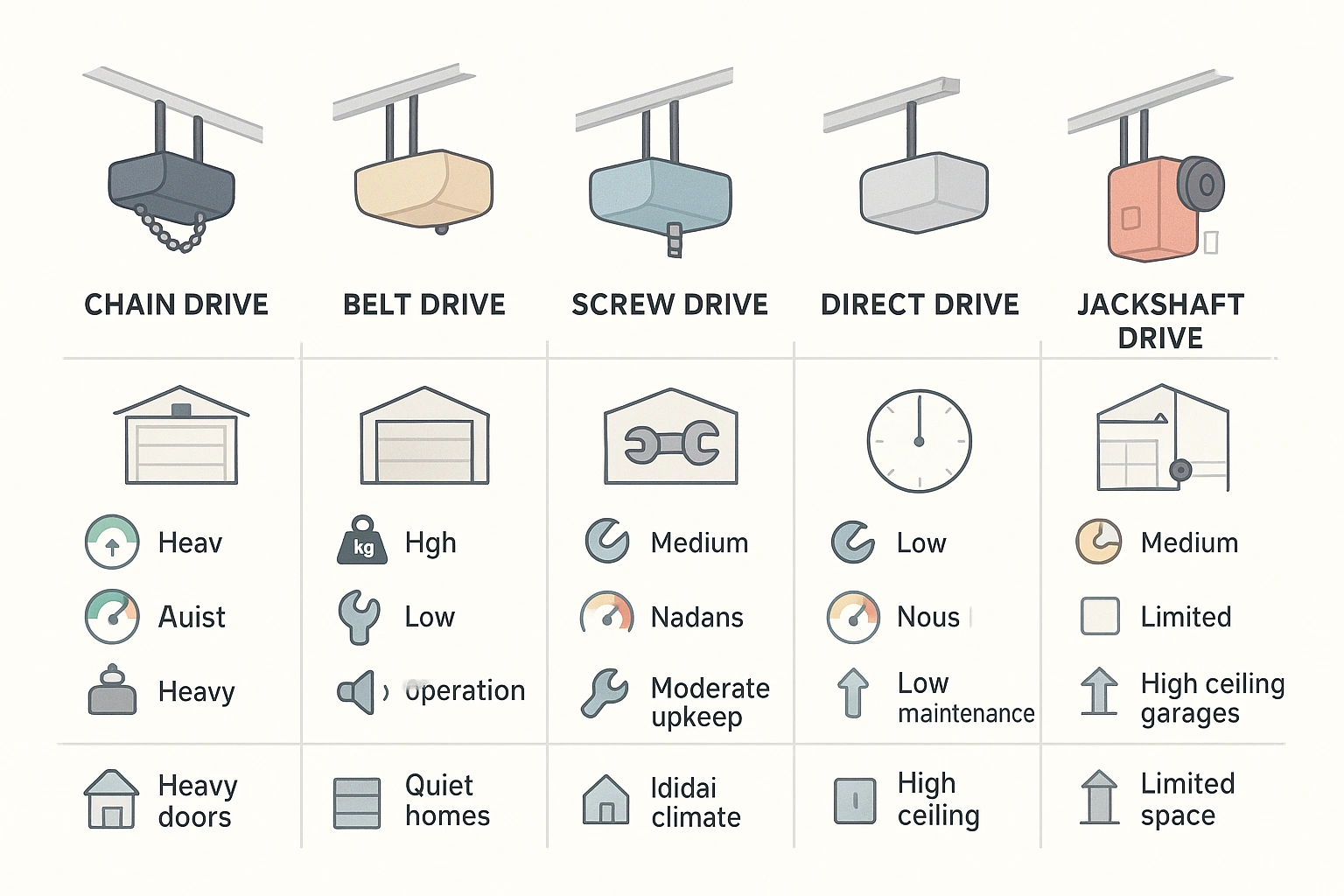
Garage Door Opener Mechanical Fundation

Choosing an opener starts with understanding the drive mechanism. The five main types vary significantly in noise, maintenance, and lifespan:

  • Chain Drive: Robust and economical, but highly metallic and loud. Ideal for detached garages.
  • Belt Drive: Steel-reinforced rubber belts offer smooth, whisper-quiet performance. Perfect for attached garages.
  • Screw Drive: Uses a threaded steel rod. Fewer moving parts means lower maintenance, though they struggle in extreme temperature fluctuations.
  • Jackshaft (Wall-Mount): Mounts beside the door rather than overhead, freeing up ceiling space. This is the premium choice for cathedral ceilings or homes requiring vertical storage space.
  • Direct Drive: The motor itself travels along a fixed chain. With only one moving part, it is incredibly reliable and virtually silent.

When selecting motor power, match your door’s physical weight. A 0.5 HP motor works for single-car aluminum doors. However, standard double-car insulated steel doors require at least 0.75 HP. For heavy custom timber, you’ll need 1.25+ HP or professional wood garage door panel repair to ensure smooth weight distribution before motor configuration. Professional automatic garage door service ensures that your spring tension matches your chosen horsepower perfectly.


The Acoustic Equation (Silent Operation Mechanics)


The Acoustic Equation For Garade Door Openers

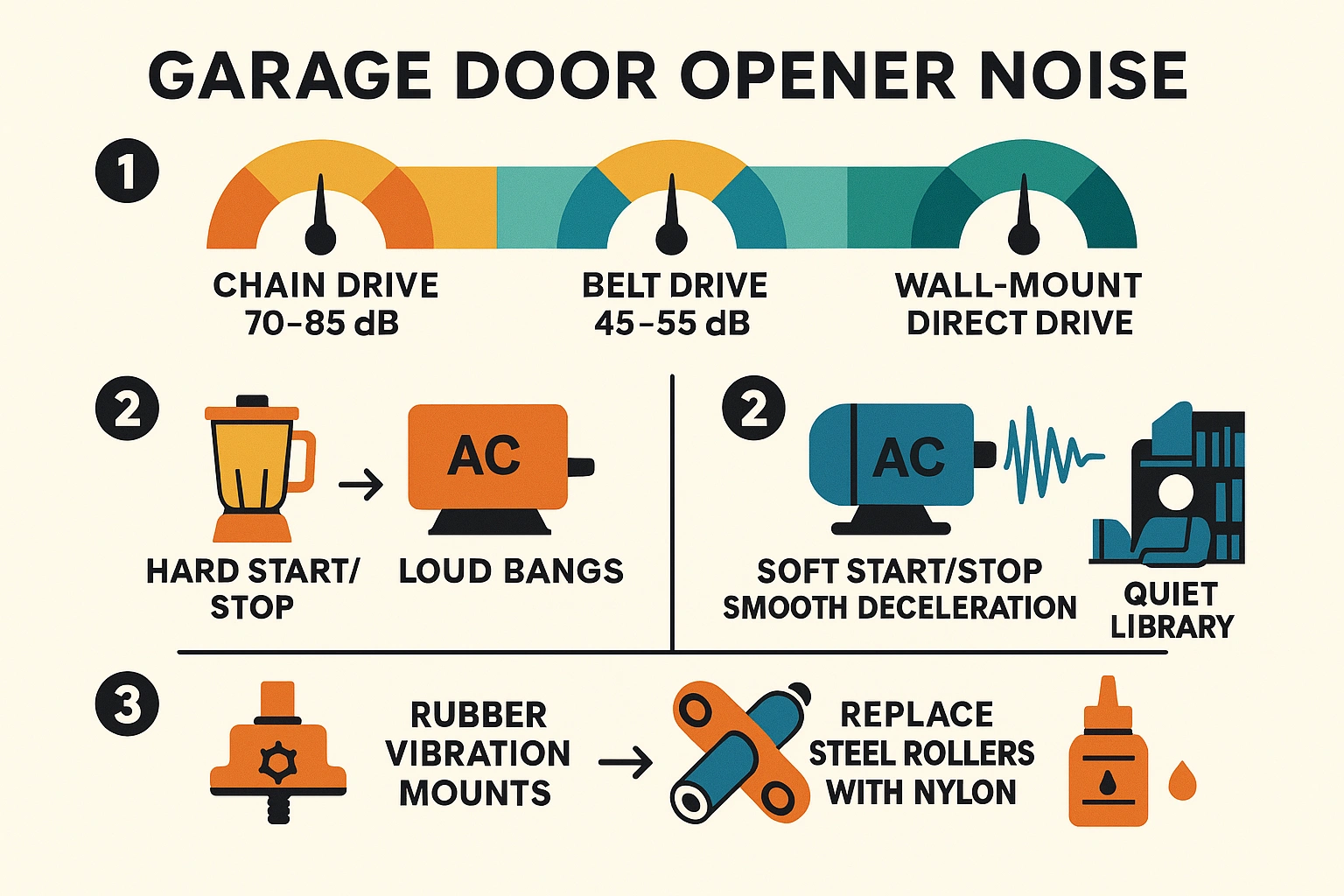
If your garage sits directly below a bedroom, noise isn’t just an annoyance; it’s a daily disruption. Noise perception is logarithmic. A typical chain drive operates at 70 to 85 dB (similar to a kitchen blender). A premium belt drive operates at 45 to 55 dB, while a high-end wall-mount direct drive runs under 40 dB—equivalent to a quiet library.

The secret to silent operation lies in the motor type and vibration dampening:

  • AC vs. DC Motors: AC motors run at a constant speed, producing a hard start and stop that slams the door against the header and floor. DC motors offer “soft start/stop” technology, slowly decelerating the door just before it touches the ground.
  • Structural Transmission: Up to 70% of garage door noise in adjacent rooms is caused by structural vibrations traveling through ceiling joists. Installing rubber isolation mounts can reduce this transmission by up to 15 dB.
  • The Roller Variable: Swapping noisy steel rollers for heavy-duty, 13-ball-bearing sealed nylon rollers reduces rolling noise by up to 50% (3 to 5 dB).

If you are hearing severe grinding or vibrations, scheduling a rapid a1 garage door repair checkup is critical to evaluate whether the noise stems from track misalignment rather than the motor itself.


The Smart Integration Matrix (Bypassing the Cloud)


Garage Door Openers The Smart Integration Matrix

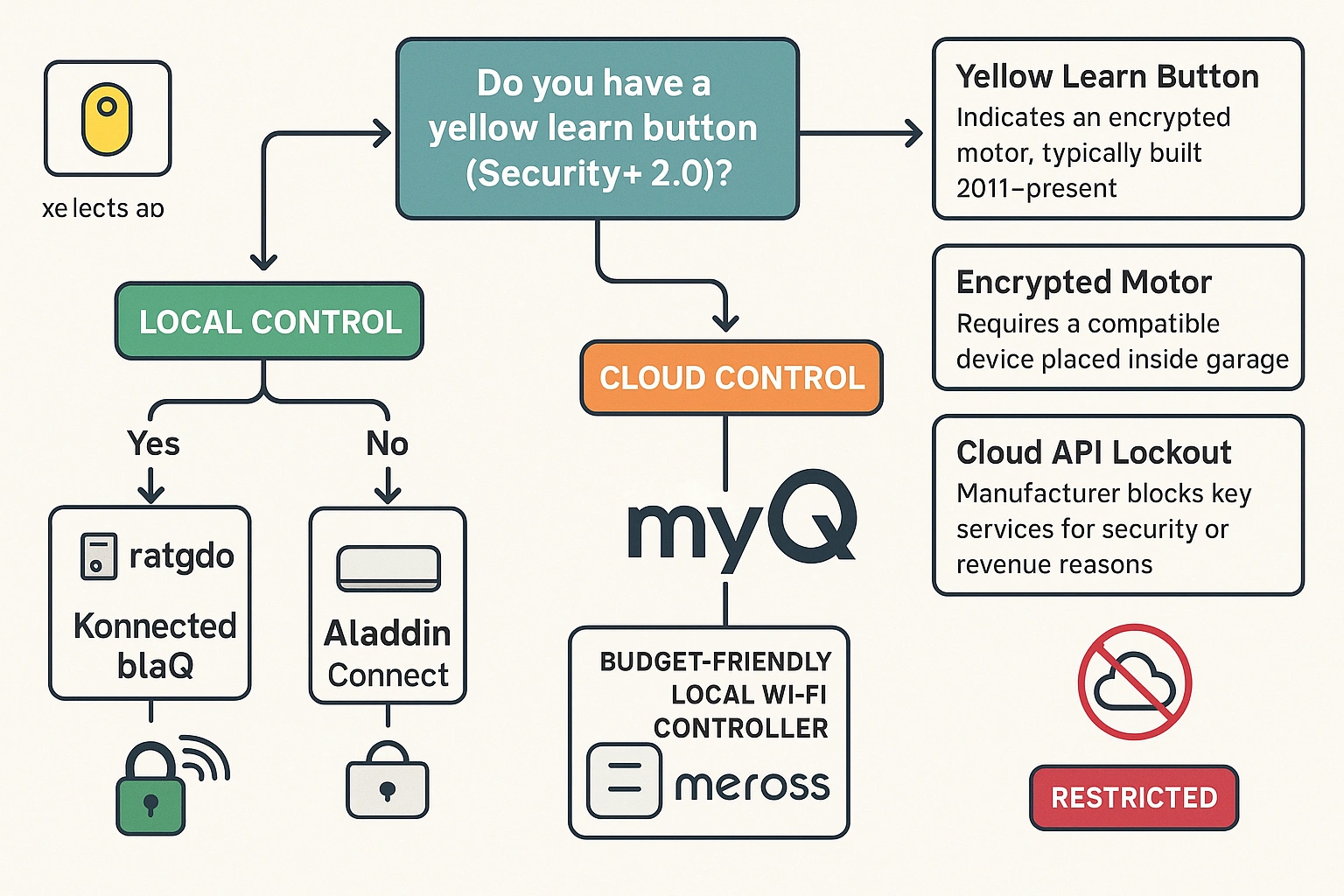
The smart home ecosystem has recently faced a massive shift. Between 2023 and 2026, Chamberlain’s myQ platform locked down its third-party APIs, shutting down open-source integrations like Home Assistant and Homebridge. This move pushed users toward paid, cloud-dependent subscriptions and app ads.

Savvy homeowners now actively evaluate Local Control vs. Cloud Control:

  • Cloud Control: Vulnerable to internet outages, server latency, and corporate policy shifts.
  • Local Control: (HomeKit Local, MQTT, ESPHome) Offers sub-second response times, offline functionality, and complete data privacy.

To navigate this landscape, consider these integration alternatives:

  1. Tailwind iQ3: Outstanding native integration with local auto-open geofencing.
  2. Meross Smart Controller (MSG100/200HK): Budget-friendly, reliable native Apple HomeKit (local) support.
  3. ratgdo / Konnected blaQ: The enthusiast’s choice. These small hardware units connect directly to your opener’s control board to allow total, offline, local serial communication, completely bypassing cloud lockouts.

The Yellow Learn Button (Troubleshooting Compatibility)


If your opener was manufactured after 2011 (Chamberlain, LiftMaster, or Craftsman), it likely features a yellow learn button, indicating Security+ 2.0 encryption. Unlike older systems that used simple dry-contact wall buttons, Security+ 2.0 units require an encrypted serial signal. Standard smart relays cannot trigger these motors directly.

To bypass this restriction, you have two reliable pathways:

  • Serial Local Controllers: Hardware like the ratgdo sends native serial signals directly over the wall button wires.
  • The Soldered Remote Workaround: If utilizing standard smart relays (like Meross), you can use an accessory wireless remote (like the Meross RGR910) where the dry-contact relay is soldered directly to the remote’s button contacts. Triggering the smart relay simulates a physical button press on the encrypted remote.

Secure Your Perfect Setup


Whether you are seeking silent operation, rugged performance, or advanced offline smart automation, selecting the right hardware makes all the difference. For expert guidance, troubleshooting, or professional door repair near me in Connecticut, trust A1 Doors Services to keep your home safe, quiet, and secure.

Frequently Asked Questions


What is the quietest garage door opener type?

Jackshaft (wall-mount) and premium belt-drive openers running on DC motors with soft start/stop technology are the quietest, running under 40-50 dB.

Why did my smart garage door integration stop working?

If you used Home Assistant or Homebridge with a myQ-enabled opener, your system was likely impacted by Chamberlain’s API block. Moving to local hardware like ratgdo or Tailwind restores this functionality.

Can I install a smart opener on an unbalanced door?

No. Disconnect your opener and pull the emergency release chord. If the door doesn’t stay balanced halfway, your springs are unbalanced. Running an opener on an unbalanced door will burn out the motor prematurely.