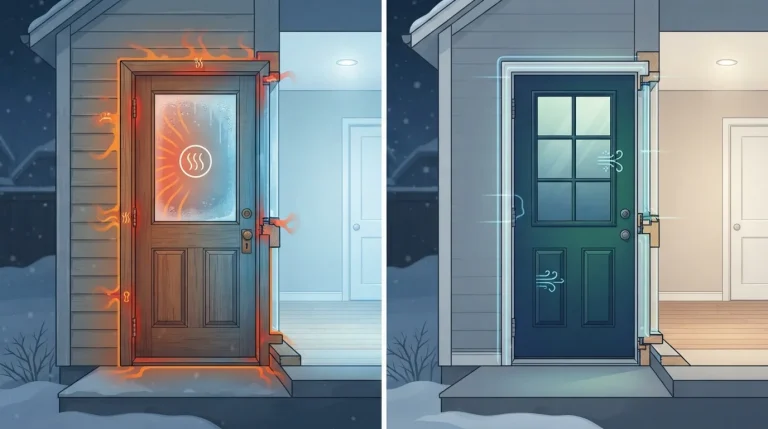
When winter temperatures drop below freezing, patio door track assemblies often become ice traps. A door frozen shut isn’t just an inconvenience—it signals a breakdown in your home’s thermal envelope and drainage design. For homeowners evaluating whether to execute a quick maintenance routine or hire a professional, understanding the mechanics of frozen sills and clogged weep holes is essential to preventing subfloor water damage and costly frame replacement.
Sliding Glass Door Repair in Winter: Frozen Sills and Condensation Drains
Published: Nov 12, 2026
Emergency Protocol: How to Safely Thaw a Frozen Sliding Door
If your patio door is locked tight by ice, force is your worst enemy. Yanking the handle can tear vinyl weather seals or sheer roller bearings off their track alignment.
CRITICAL SAFETY WARNING: Never pour hot or boiling water onto a frozen patio door frame, nor use high-temp heat guns. While architectural tempered glass can withstand uniform heat up to 470°F, localized thermal shock occurs at temperature differentials ($Delta T$) as low as 75°F to 100°F. Applying 150°F water to a -10°F panel can instantly shatter the unit, resulting in a $500+ glass replacement emergency.
To safely free a frozen door:
- Apply Isopropyl Alcohol: Spray a 70% rubbing alcohol solution along the bottom track sill and weep openings. Isopropyl alcohol lowers the freezing point of water to -20°F, rapidly dissolving ice bonds without thermal stress.
- Use Radiant Warmth: Direct a low-temperature hair dryer or portable room heater at the interior metal sill channel, holding heat sources at least 12 inches away.
- Clear Debris Softly: Once ice slushes, clear the channel using a plastic putty knife or stiff nylon brush—never metal tools.
Diagnostic Flowchart: Pinpointing Your Winter Issue
Before investing in materials or service calls, pinpoint the exact mechanical failure causing your cold-weather door issues.
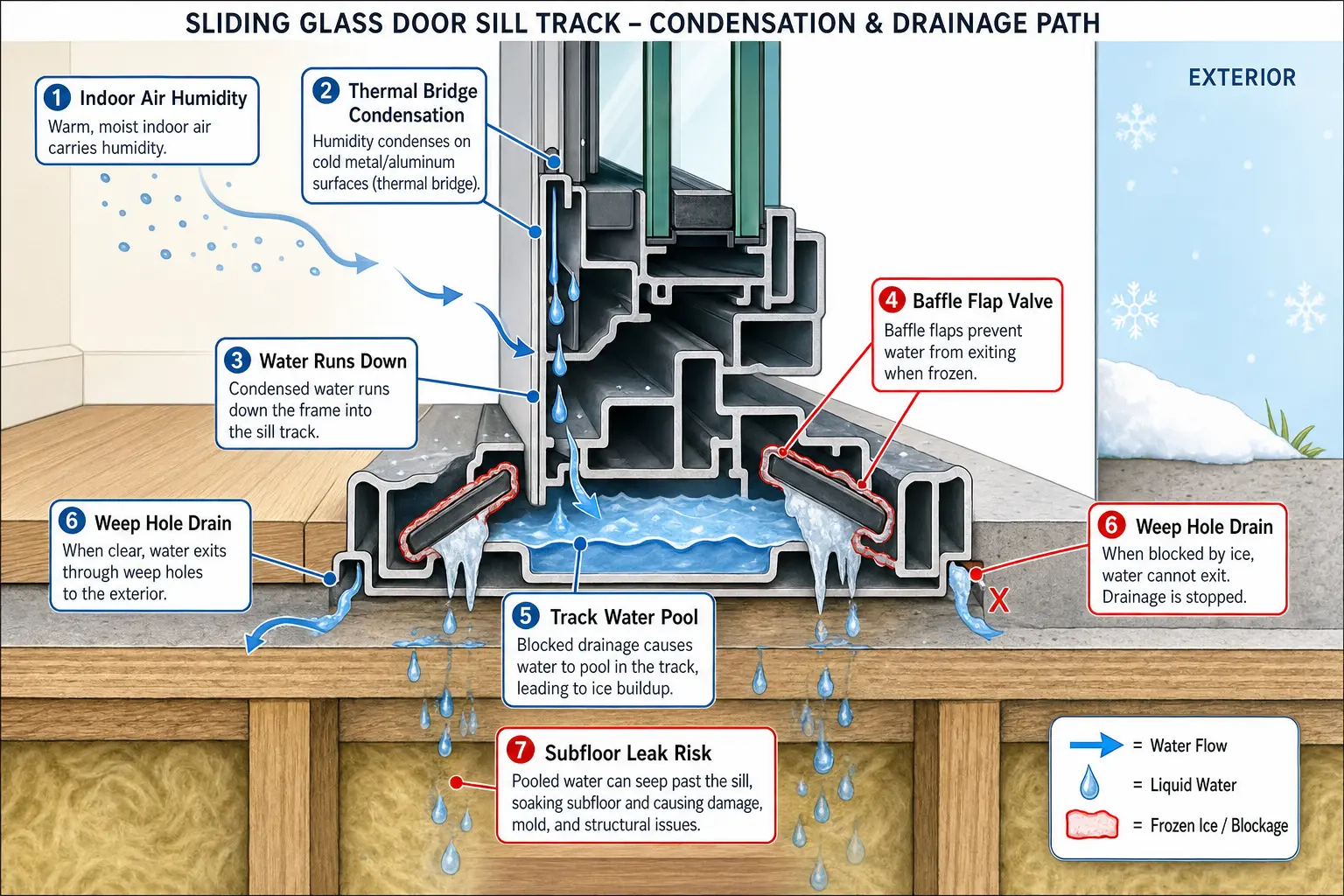
- Symptom 1: Condensation trapped between glass panes Blown Insulated Glass Unit (IGU) Seal. Requires glass panel replacement.
- Symptom 2: Water pooling on indoor flooring/mat Clogged or Frozen Exterior Weep Holes. Drainage pathway is blocked.
- Symptom 3: Ice buildup along the inner sill track Thermal Bridge Condensation Runoff. High indoor relative humidity meeting cold frame extrusions.
The Anatomy of a Frozen Sill and Weep Drain Cascade
Sliding door extrusions rely on continuous gravity drainage paths. Standard door sills are engineered according to WDMA and ASTM standards to catch and drain up to 1 to 2 gallons of water per hour during heavy condensation or rain. However, sub-zero weather disrupts this balance through a predictable physical cascade.
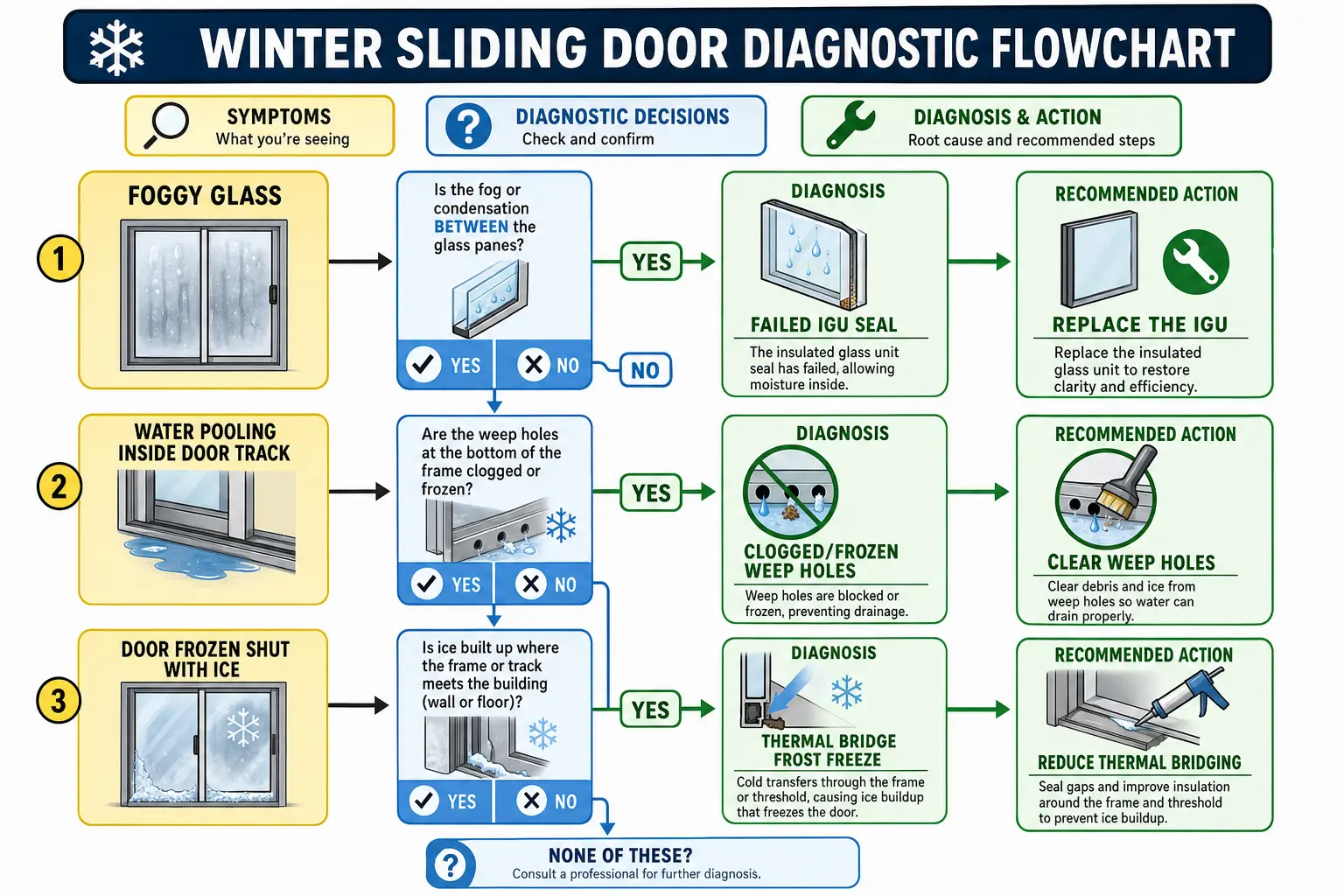
- Thermal Bridging: Non-thermally broken aluminum or older vinyl frames transfer exterior sub-zero temperatures directly into the home.
- Condensation Runoff: Indoor warm air (relative humidity $ge 40%$) contacts cold frame metal, forming water droplets that stream down into the sill track.
- Baffle Freezing: Liquid flows toward exterior weep slots. If exterior temperatures drop below freezing, gravity flap valves freeze shut.
- Track Overspill: Water pools inside the track channel. Through capillary action, backed-up water spills backward over interior track dams onto subflooring, causing hidden joist rot and mold.
Beyond structural water risks, unsealed or drafty sliding door sills account for up to 15% of residential thermal envelope heat loss, inflating monthly heating bills by $25 to $65.
DIY Maintenance for Winter Track Drainage
Restoring track functionality requires targeted clearing and sealing. If you need to fix back door track assemblies, follow these practical steps:
- Clear Exterior Weep Slots: Inspect the exterior bottom frame for small drainage slots. Clean out dirt, leaf debris, and pine needles using a soft nylon brush and compressed air. Avoid using rigid wire tools that can puncture delicate internal baffle flaps.
- Flush Mineral Buildup: Pour a warm 50/50 solution of white vinegar and water along the inner track channel to dissolve hard water scale and calcium deposits restricting flow.
- Adjust Roller Height Screws: Turn the adjustment screws near the bottom corners of the door panel to raise clearance by 1/8 inch. This keeps bottom vinyl sweeps from dragging directly in accumulated ice water.
- Upgrade Weatherstripping: Replace worn wool pile sweeps with closed-cell EPDM foam seals, and install exterior weep hole hoods to block wind-driven freeze-ups.
Chemical Specs: Low-Temp Lubricants vs. Household Grease
Choosing the wrong lubricant during winter can destroy roller assemblies. Petroleum-based lubricants (like traditional WD-40 Multi-Use or lithium grease) experience a 300%+ increase in viscosity at 0°F, transforming into a tacky glue that captures grit, binds wheel bearings, and shears rollers off their tracks.
Instead, use dry-film PTFE sprays or high-grade silicone sprays. PTFE leaves a micro-thin fluoropolymer layer that performs reliably down to -40°F without attracting abrasive sand or thickening in freezing weather.
MOFU Decision Matrix — DIY Fix vs. Professional Repair vs. Door Replacement
Evaluating whether to address winter track failures yourself or bring in licensed technicians comes down to component condition, scope of damage, and overall investment.
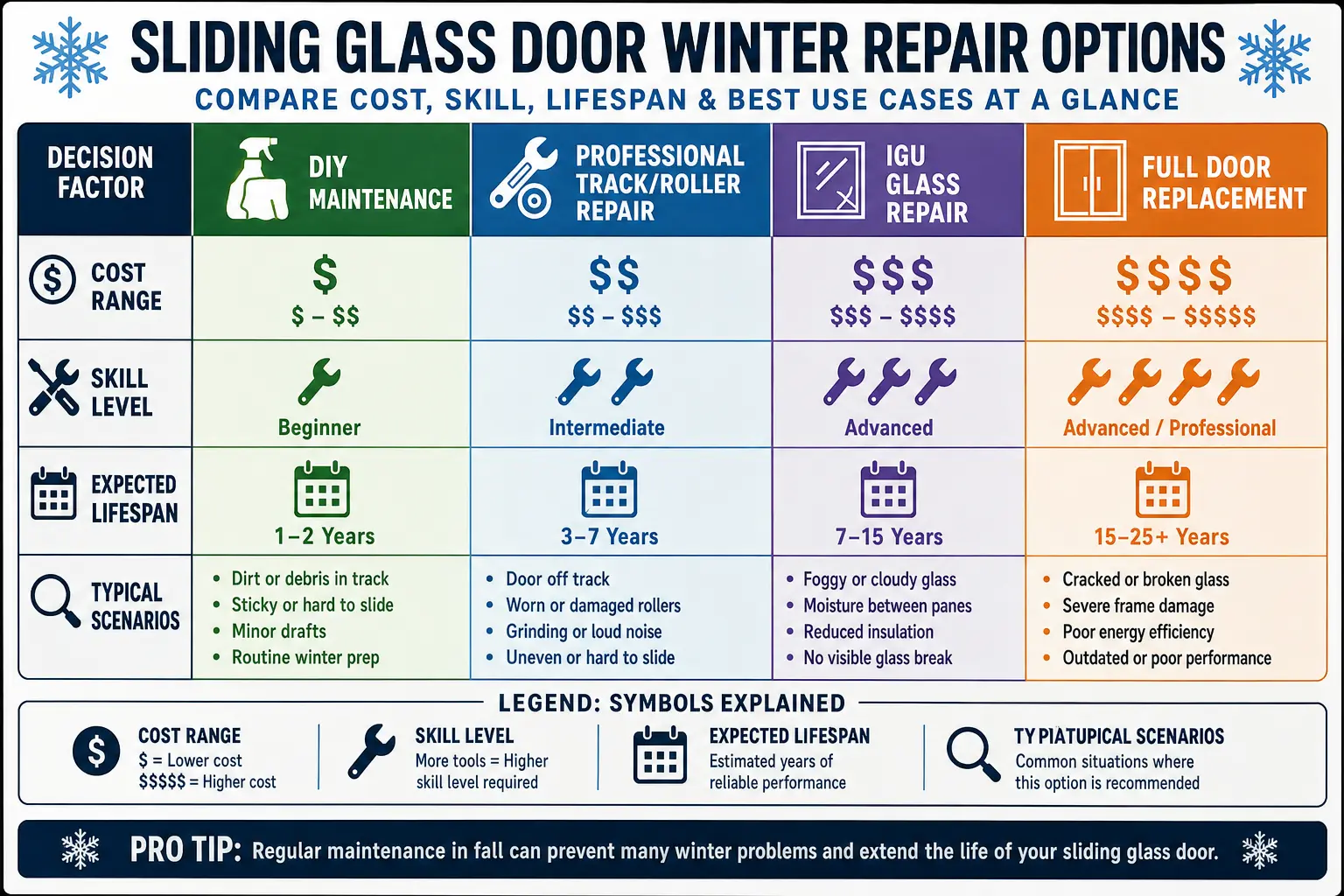
- DIY Maintenance: Best for surface debris, clogged weep holes, or dry weatherstripping. Extends seasonal reliability by 1 to 3 years.
- Pro Track & Roller Restoration: Ideal for corroded stainless rollers, misaligned track rails, or bent sill caps. Delivers 5 to 10 years of smooth performance.
- Glass Unit (IGU) Replacement: Necessary when internal seal failure produces permanent fogging between glass panes. Preserves existing structural frames for 10 to 15 years.
- Full Thermal-Break Replacement: Required for warped frames, severe subfloor rot, or non-thermally broken units causing non-stop freezing. Provides 20+ years of high-efficiency protection.
Frequently Asked Questions
Do all sliding glass doors have weep holes?
Yes, nearly all exterior vinyl and aluminum sliding patio doors feature engineered weep holes along the bottom exterior frame to allow condensation and wind-driven water to drain out harmlessly.
Can I drill new weep holes into my sliding door track?
No, you should never drill arbitrary holes into your door frame. Doing so can puncture hidden internal chamber barriers, leading direct water leakage straight into your subfloors and permanently destroying the frame’s structural integrity.
Why is ice building up on the inside track of my sliding door?
Indoor ice forms when high indoor humidity meets non-thermally broken door frames in sub-freezing weather, combined with clogged weep holes that trap runoff water inside the sill track overnight.
When winter weather compromises your sliding door’s performance, taking swift, knowledgeable action protects your home from expensive water damage and heating loss. If basic clearing and adjustment don’t resolve your track ice issues, consult fully trained, licensed professionals to inspect your roller mechanics, restore internal drainage pathways, and ensure your entryway remains smooth and secure all winter long.