(855) 676-0881

Door Hard to Close in a Heated House: Stack Effect and Seal Compression


Published: Nov 24, 2026

A door becomes hard to close in a heated house primarily due to indoor air pressure imbalances (the stack effect), cold-stiffened weatherstripping, and seasonal material shifts that prevent the latch from engaging cleanly. When winter heating creates a stark temperature gap between warm interior rooms and freezing outdoor air, rising warm air alters pressure across doorways while low temperatures harden perimeter seals—forcing you to push or slam the door just to make it catch.

Common Causes of Winter Door Resistance:

  • Stack effect & air pressure differentials: Rising warm air inside a heated home creates negative pressure on lower levels and positive pressure upstairs, physically pushing or pulling against the door slab as it swings shut.

  • Weatherstripping compression & stiffening: Freezing temperatures cause rubber and vinyl perimeter seals to lose elasticity and stiffen, creating extra resistance against the jamb before the latch bolt reaches the strike plate.

  • Thermal & moisture movement: Dry indoor heating paired with cold exterior air causes door slabs and jambs to subtly contract or bow, throwing off the precise alignment needed for smooth latching.

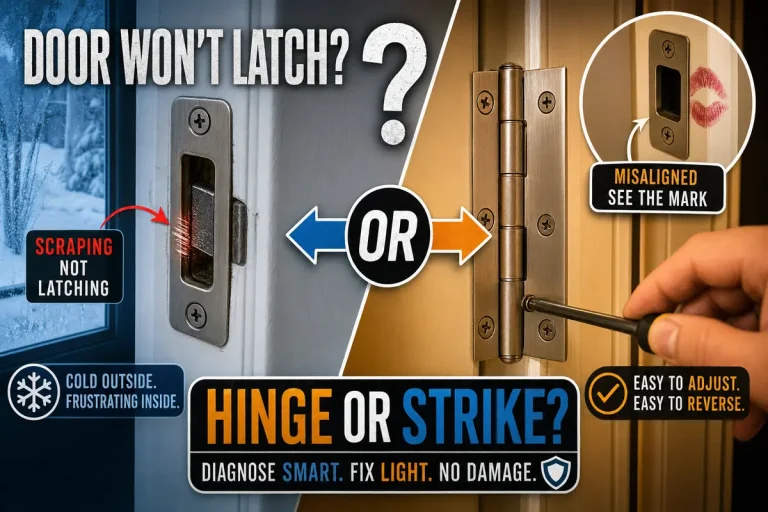
  • Hinge & strike plate misalignment: Minor seasonal framing shifts or worn hinge screws prevent the latch from lining up squarely with the strike plate opening.
The Physics of Stack Effect & Door Resistance


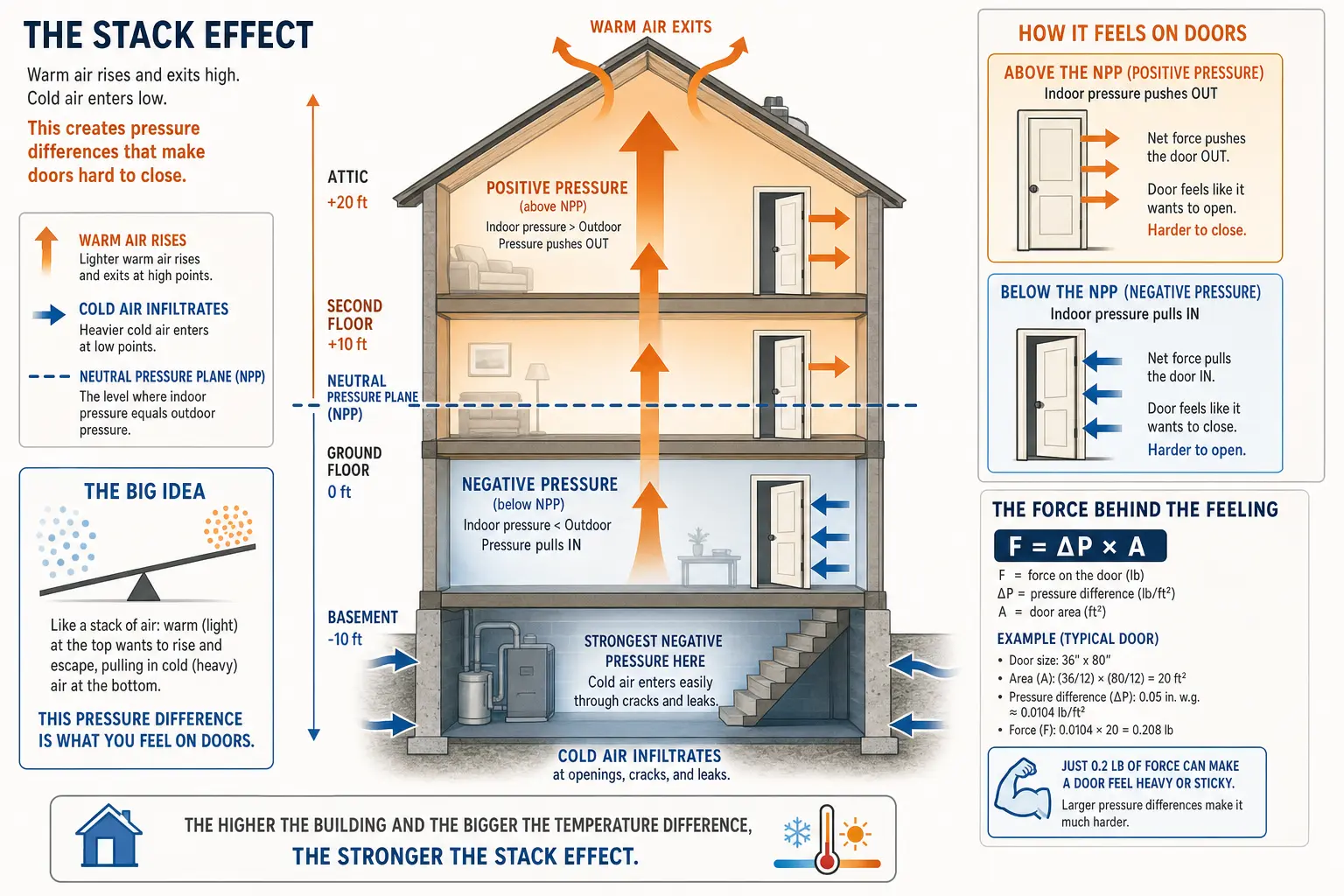
Stack effect occurs when warm indoor air rises toward the upper levels of a home due to thermal buoyancy. As warm air exfiltrates through upper-level ceiling penetrations, it creates a zone of positive air pressure at the top of the structure and negative air pressure at lower levels, drawing cold outdoor air inward through basement and ground-floor cracks.

This diagram clarifies how stack effect creates positive pressure upstairs pushing doors outward and negative pressure downstairs pulling doors inward, making doors hard to close during winter heating.

The physical force acting on a door leaf is governed by the equation $F = Delta P cdot A$, where $Delta P$ represents the pressure differential and $A$ represents the surface area of the door.

In a multi-story home with a 60°F temperature difference between indoors (70°F) and outdoors (10°F), stack effect generates a pressure gradient of 15 to 30 Pascals (Pa) between the basement and top floor. Across a standard 3′ x 7′ entry door (21 square feet), a 25 Pa pressure differential exerts 10.4 pounds of continuous pneumatic force against the door face. Because standard residential latches and auto-closers are rated for 5 to 8 pounds of operating resistance, an extra 10+ pounds of air pressure prevents automatic latching and makes manual closure feel heavy and resistant.

Need a Quick Fix?

Tell us what’s wrong with your door — we’ll get it sorted.

Seal Compression Dynamics: Why Cold Weather Hardens Weatherstripping


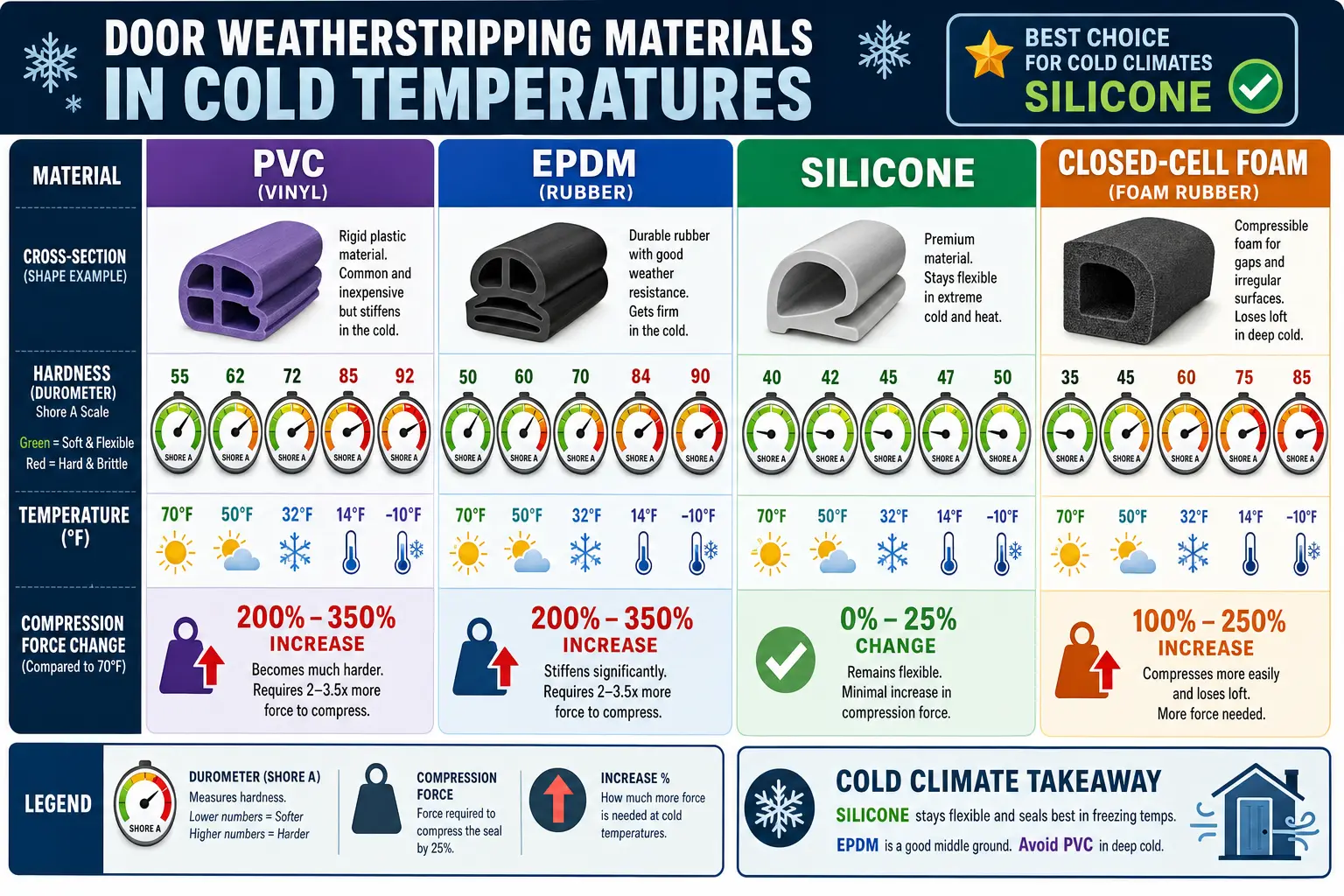
The second major contributor to winter door binding is polymer cold hardening. Weatherstripping materials experience significant changes in elastomeric durometer (hardness) when exposed to freezing exterior temperatures.

This chart helps remember how different weatherstripping materials react to cold temperatures, emphasizing why silicone remains flexible and optimal for winter door seals.

Standard PVC and EPDM rubber weatherstrips experience a 200% to 350% increase in compression force resistance as ambient temperatures drop from 70°F to below 32°F. Near their polymer glass transition temperature ($T_g$), these materials lose elastic memory and behave like solid plastic blocks, requiring higher mechanical closure force before the latch bolt can engage the strike plate. By contrast, high-grade silicone bulb seals maintain flexibility down to -40°F, preserving low closure force requirements year-round.

Closed-Door HVAC Pressure Imbalance


Forced-air furnace systems can intensify stack effect forces within interior rooms. When an interior bedroom door is closed with an active supply register supplying 100 CFM of heated air but no dedicated return duct, the room pressurizes by +10 to +25 Pa relative to the central hallway. This turns closed rooms into pressurized chambers, generating resistance against interior doors and forcing air through keyholes and perimeter gaps with an audible whistle.

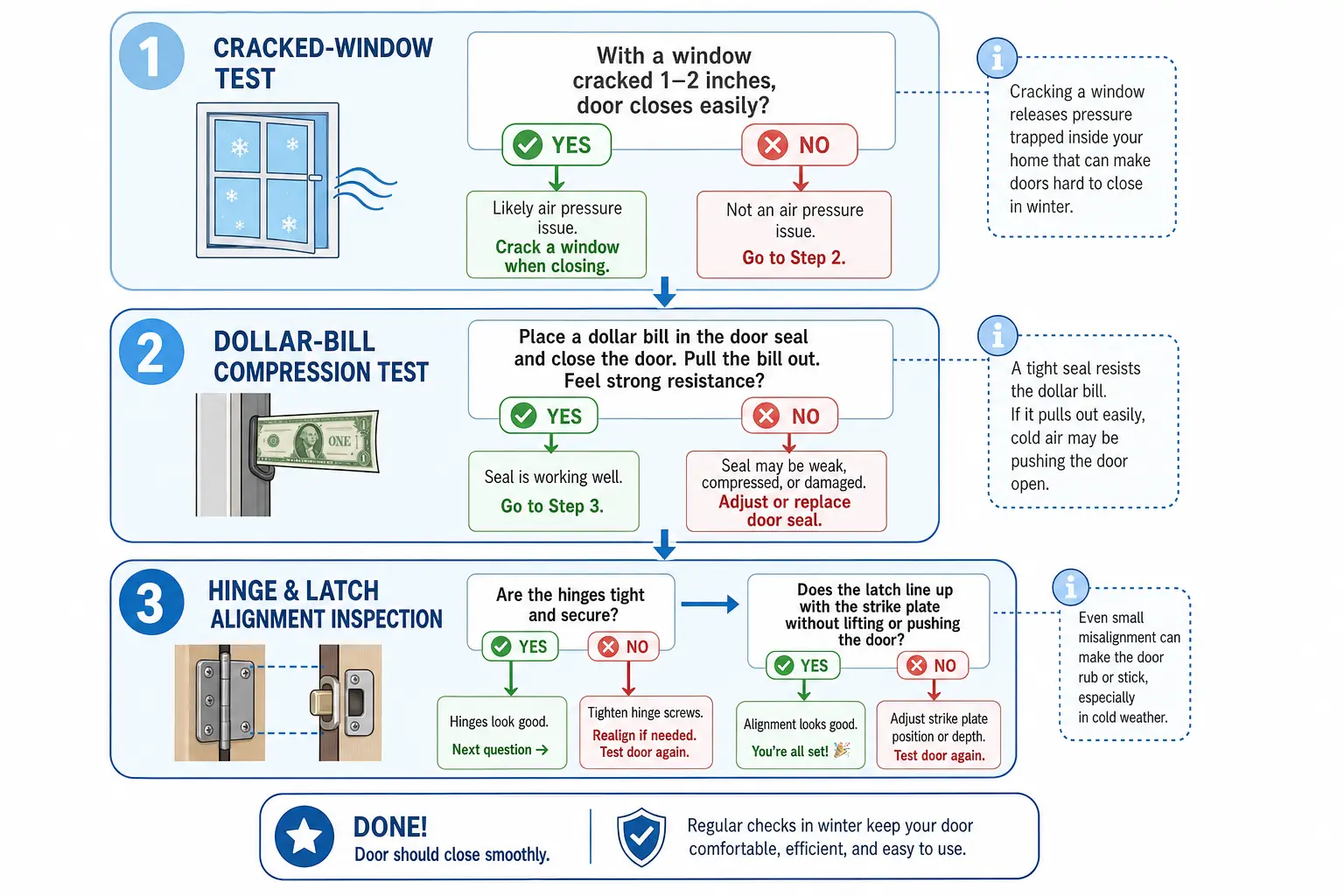
Interactive Diagnostic Flowchart


Pinpointing whether door closure resistance stems from air pressure differentials, hardened weatherstripping, or mechanical frame misalignment requires a systematic diagnostic approach.

This interactive flowchart guides homeowners through quick tests to diagnose whether door closing issues stem from air pressure or mechanical problems, empowering effective troubleshooting.

  1. The Cracked-Window Test: Open a nearby window 1/4 inch. If the door immediately closes and latches without resistance, your primary issue is building stack pressure or HVAC air imbalance.
  2. The Dollar-Bill Compression Test: Place a dollar bill between the door perimeter seal and frame, then latch the door. If pulling the bill out requires excessive effort near the latch during cold weather, your weatherstripping has hardened or over-compressed.
  3. The Latch Margin Inspection: Check latch bolt alignment relative to the strike plate tang to rule out hinge sag or mechanical frame movement.

Targeted Remediation Blueprint


Resolving winter door binding requires matching the diagnostic root cause to the appropriate mechanical or environmental correction:

  • Hardware Adjustments: Shift adjustable strike plate tangs by 1–2 mm or utilize a professional door closer repair service to recalibrate latching speed and spring tension against thermal pressure differentials.
  • Weatherstrip Upgrades: Replace rigid PVC or foam seals with high-performance silicone bulb seals that resist cold-weather hardening.
  • Air Pressure Balancing: Increase interior door undercut clearances to 3/4 inch or install pressure-relief transfer grilles. Air sealing attic bypasses and basement rim joists stabilizes the neutral pressure plane across the entire building.

Partnering with experienced door technicians ensures that structural framing, hardware alignment, and seal integrity are optimized for dependable, effortless door operation in every season.

Frequently Asked Questions


Why does my interior door slam shut when the heating system runs?

When forced-air central heating runs without adequate return pathways in closed rooms, positive static pressure builds inside the room. This air pressure pushes forcefully against the door leaf toward lower-pressure hallways, causing the door to slam shut when released.

Will replacing weatherstripping resolve winter door sticking?

Replacing hardened PVC or aged EPDM foam weatherstripping with low-durometer silicone bulb seals eliminates mechanical seal stiffness caused by sub-freezing temperatures. However, if strong stack pressure differentials exceed 20 Pascals, building envelope air sealing is also required.

How do I distinguish between foundation settlement and stack effect door binding?

Perform the Cracked-Window Test by opening an adjacent window 1/4 inch. If the door instantly latches smoothly, the issue is thermodynamic air pressure. Physical foundation settlement causes permanent frame misalignment that remains unchanged regardless of window position.