(855) 676-0881

Pocket Door Hardware Explained: Rails, Hangers, Guides and Pulls


Published: Nov 26, 2026

Pocket door hardware is the integrated mechanical system—comprising an overhead track, split-stud wall frame, suspension rollers, alignment guides, and recessed pulls or latches—that allows a door slab to glide horizontally into a concealed wall pocket instead of swinging on hinges. While this space-saving design frees up roughly 10 square feet of usable floor area, its long-term reliability depends entirely on the hidden components engineered behind the drywall.

To prevent sticking, wobbling, or derailing once a wall is closed up, a complete pocket door assembly relies on two core groups of components:

  • Overhead Track, Framing, and Rollers: An aluminum or steel header rail pairs with split studs to form the wall pocket and carry the door’s full load. Multi-wheel, ball-bearing hangers suspend the slab from above—typically rated for 80–150 lbs on standard hollow doors or 200+ lbs for heavy solid-core slabs—while integrated bumpers and soft-close dampers control travel speed.

  • Guides, Pulls, and Locking Hardware: Discrete bottom floor guides eliminate lateral sway without requiring a recessed floor channel. Recessed face pulls and pop-out edge pulls sit completely flush so the slab clears the jamb cleanly, while hook latches, magnetic catches, or privacy locks secure the door when closed (available in deep-cut mortise or quick-install non-mortise designs).

Selecting the right combination of track geometry, load ratings, and tolerances prevents premature wear, rattling, and costly wall tear-outs. Whether you are upgrading a residential pantry or scheduling professional door repair near me for a high-traffic commercial space, understanding these four hardware pillars ensures smooth, quiet operation for decades.
Anatomy of a High-Performance Pocket Door System


A pocket door system relies on four integrated components working in exact alignment: the overhead rail (track), the trolley hanger assemblies, the floor guide, and the trim pulls or locksets.

When correctly specified, these components distribute weight evenly, prevent lateral sway, and allow the door to slide effortlessly into its wall pocket. Skimping on any single element compromises the entire system, leading to premature wear and alignment failures.

Need a Quick Fix?

Tell us what’s wrong with your door — we’ll get it sorted.

Rails & Track Systems: Enclosed Box vs. Open J-Track


The overhead rail carries the entire weight of the door slab. Track design directly determines whether your door operates reliably or constantly derails.

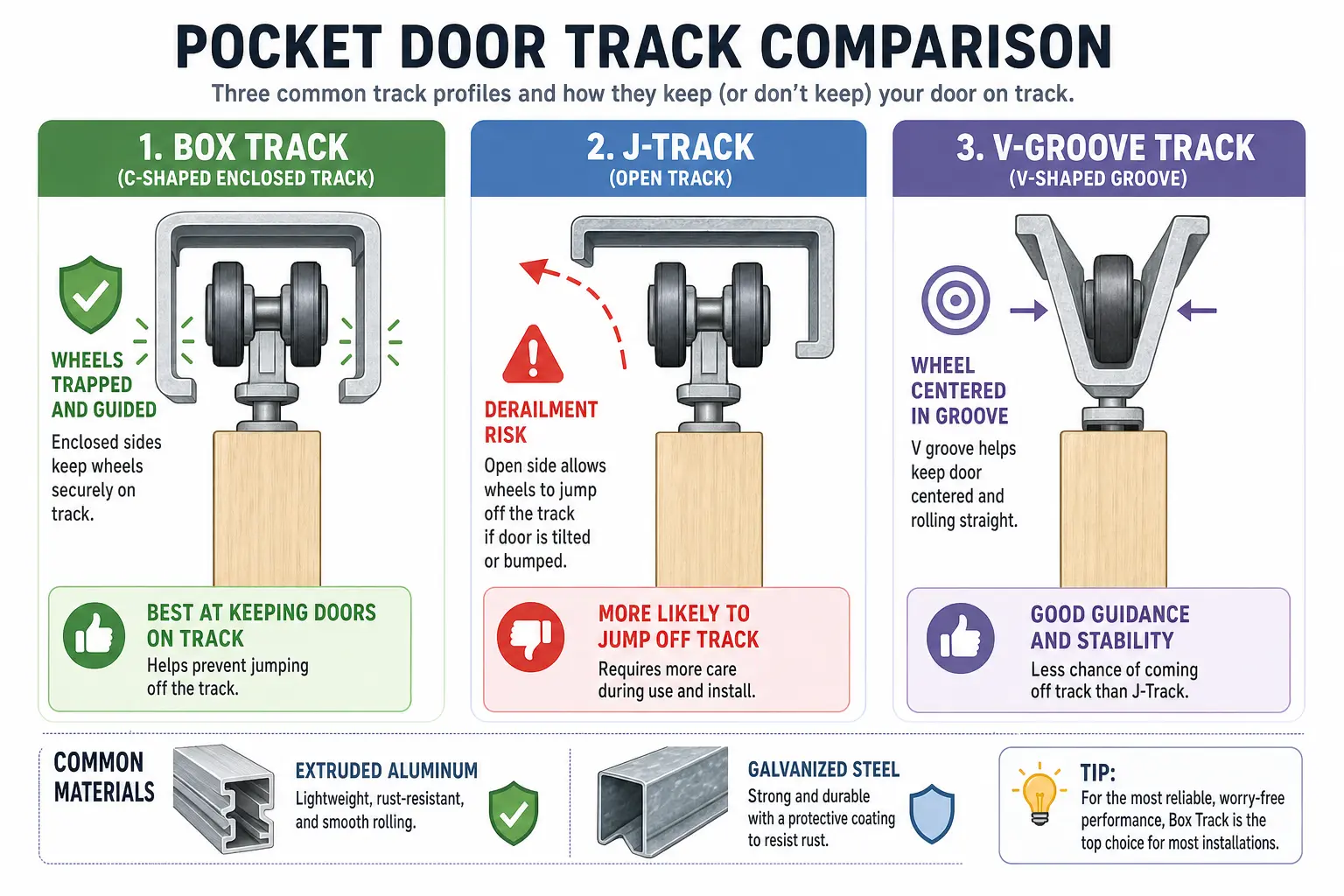
  • Open J-Tracks: Found in budget kits, J-tracks feature an open-sided channel where the roller wheels sit inside a hooked ledge. Under aggressive movement or slight lateral pressure, the rollers can easily jump out of the groove, leaving the door trapped at an angle inside the pocket wall.
  • Enclosed C-Shape Box Tracks: Premium pocket door systems utilize heavy-gauge extruded aluminum or galvanized steel box tracks. The track completely encloses the hanger wheels on both sides. This geometry makes it physically impossible for the rollers to jump off the rail, offering true jump-proof security.

For long-term reliability, look for tracks meeting ANSI/BHMA A156.14 Grade 1 standards, which certify that the system has completed a minimum of 100,000 continuous operation cycles under maximum rated load.

This diagram clarifies the key mechanical differences between pocket door track types. The enclosed Box Track traps the rollers inside, preventing door jump-off, while the open J-Track lacks this protection, increasing derailment risk. Understanding these track designs helps you select hardware for durable, trouble-free operation.

Hanger Assemblies & Rollers: Load Capacities and Damping


The hanger assembly connects the top of the door slab to the overhead track. Choosing the right wheel configuration depends directly on door weight:

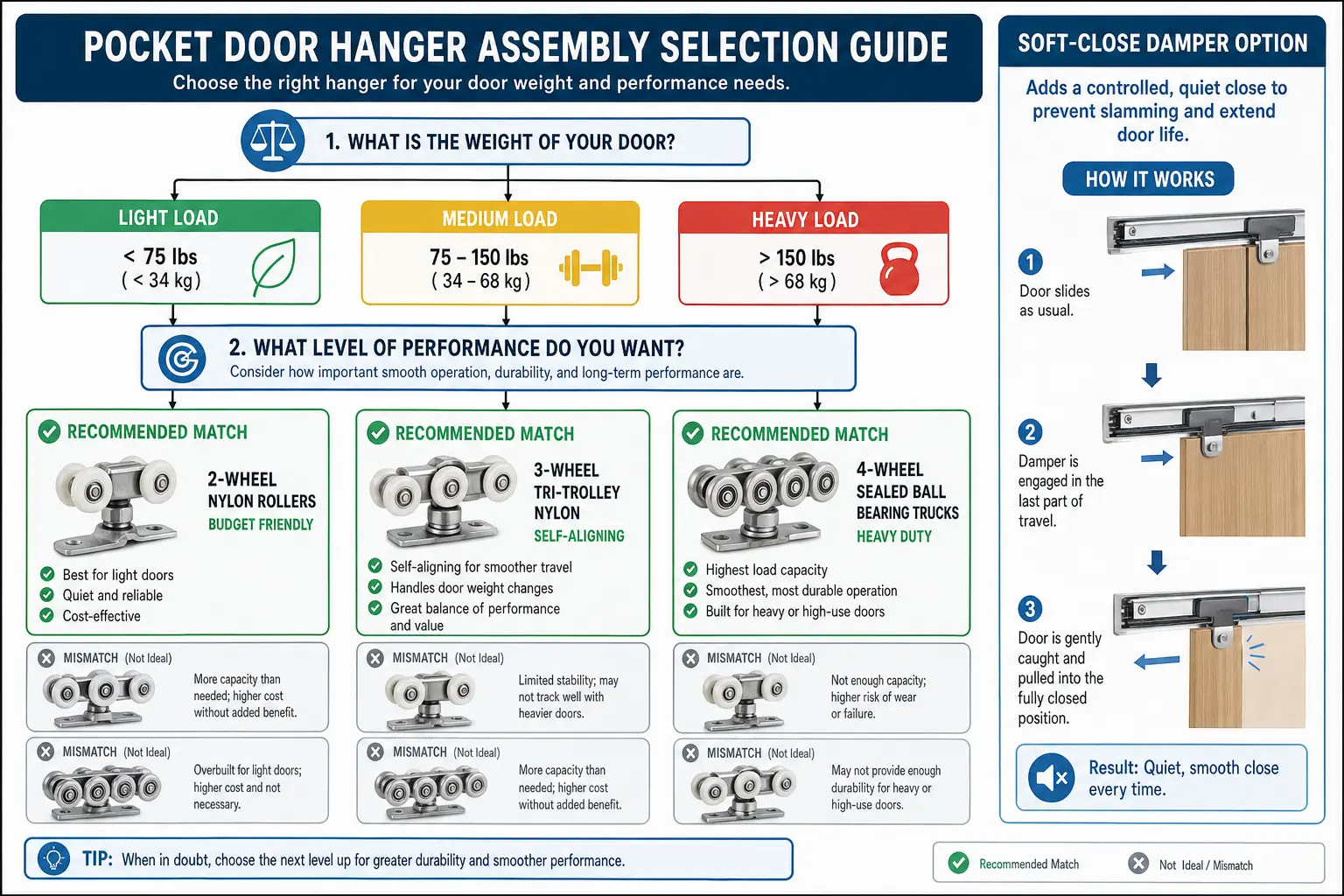
  • Light Duty (Up to 75 lbs): 2-wheel nylon hangers on standard axles. Ideal for light hollow-core doors, though prone to minor chatter over time.
  • Medium Duty (75 to 150 lbs): 3-wheel or 4-wheel nylon trolleys. Nylon treads over steel axles reduce noise while distributing weight over solid core wood doors.
  • Heavy Duty (150 to 250+ lbs): 4-wheel precision ball-bearing trucks featuring solid brass or heavy steel construction. Essential for heavy solid oak, soundproof core, or glass architectural doors.

Modern hanger assemblies also integrate bilateral soft-close and soft-open hydraulic dampers. These mechanisms catch the door in the final 2 inches of travel, gently drawing it closed or open without slamming, protecting both the door edge and the internal wall frame.

This flowchart guides you step-by-step through selecting the right hanger assembly by matching door weight and performance needs. Incorporating soft-close dampers prevents door slamming, enhancing door longevity and user comfort.

Door Guides & Floor Systems: Stopping Wobble and Rattle


Top hangers suspend the door, but the bottom guide keeps it traveling in a straight line. Without a proper guide, the bottom of the door will swing side-to-side, scratching the finish against the split stud trim.

Standard entry-level kits use surface-mounted plastic jamb shoes. While inexpensive, these plastic clips remain visible at the base of the frame and can scratch the wood finish over time.

The professional standard is a concealed bottom T-guide system. This method requires routing a clean 1/4-inch wide by 3/4-inch deep continuous slot into the bottom edge of the door slab. A small T-shaped post anchors to the floor at the pocket opening, sliding completely unseen inside the door’s hidden bottom groove for smooth, rattle-free stability.

Pulls, Handles & Locksets: Mortise and Bore Tolerances


Hardware selection for pocket door edges requires strict attention to clearance tolerances. Standard flush cup pulls require a minimum of 3/32″ to 1/8″ clearance between the face of the door and the split stud jamb casing to prevent scraping trim work during movement.

  • Pop-Out Push-Release Bumpers: For doors that sit completely flush inside the wall cavity when open, a spring-loaded edge bumper allows users to press the hidden door edge to pop it out smoothly.
  • Bore Conversions vs. Full Mortise: Converting a standard swinging door slab into a pocket door is easy using hardware designed for standard 2-1/8″ cross-bore holes with a 2-3/8″ backset. For heavy commercial application, dedicated notched pocket mortise locks (typically requiring a 3-1/8″ H x 1-15/16″ D cutout) provide maximum security and robust latching.

Hardware Selection and Future-Proof Maintenance


To protect your investment, always insist on a system with a removable header track keyway. Quick-release mounting brackets allow technicians to detach the track section and hanger trucks directly through the finished opening—meaning roller replacement or damper adjustments can be completed in minutes without cutting into drywall.

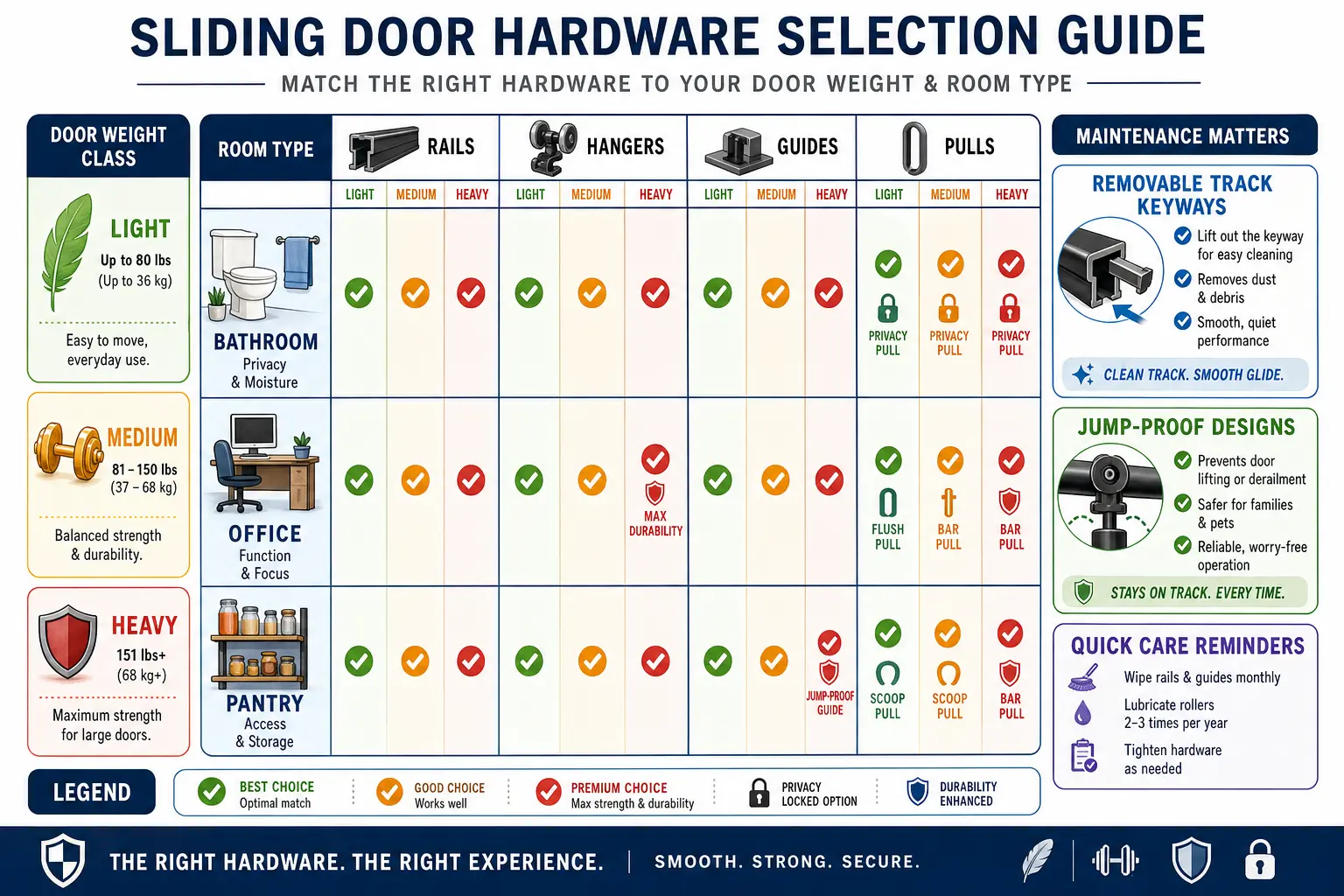
This concise matrix anchors your hardware selection knowledge, summarizing ideal component choices by door weight and application while highlighting maintenance-friendly features to future-proof your installation.

Frequently Asked Questions


How do I prevent my pocket door from jumping off its track?

Select an enclosed C-shape aluminum or steel box track rather than an open J-track. Box tracks physically trap the hanger wheels inside the rail, preventing derailment even during quick or heavy force.

Can I convert a standard swinging door slab into a pocket door?

Yes. You can adapt a standard swinging door slab by using pocket door locksets that fit a standard 2-1/8″ cross-bore with a 2-3/8″ backset, provided the door edge is routed for a bottom guide slot.

How can I service pocket door hardware without damaging my drywall?

Install hardware systems featuring removable header keyways and quick-release hanger clips. This allows you to slide out the hardware and rollers directly through the door opening without disturbing the finished wall.


Need Expert Guidance for Your Door Systems?

Whether you are specifying hardware for a new architectural build or need expert assistance with existing installations, working with seasoned professionals makes all the difference. At A1 Doors Services, our licensed technicians bring over 15 years of practical field experience to every residential and commercial project. Contact our team today for personal, reliable door service tailored to your exact budget and hardware needs.