(855) 676-0881

Aluminum Door Frames in Cold Climates: Thermal Breaks and Frost Lines


Published: Nov 20, 2026

Architects, builders, and building owners often face a dilemma when selecting exterior doors for cold climates (US Climate Zones 5 through 8): the sleek architectural aesthetic of aluminum versus the harsh reality of winter freezes. Standard extruded aluminum conducts cold at a rate of 160 to 200 W/m·K. Without proper thermal isolation, cold migrates directly into interior spaces, causing frost formation, high heating bills, and frame condensation.

Evaluating modern aluminum entrance systems requires understanding how advanced thermal breaks and sub-floor threshold isolation mitigate cold bridging during sub-zero conditions.
The Physics of Cold-Climate Aluminum: Thermal Bridging & Thermal Breaks


Uninsulated aluminum acts as a direct heat sink during freezing conditions. To stop rapid conductive losses, modern architectural aluminum relies on internal thermal breaks that separate the exterior metal profile from the interior frame.

The choice of thermal break material determines long-term structural and thermal success:

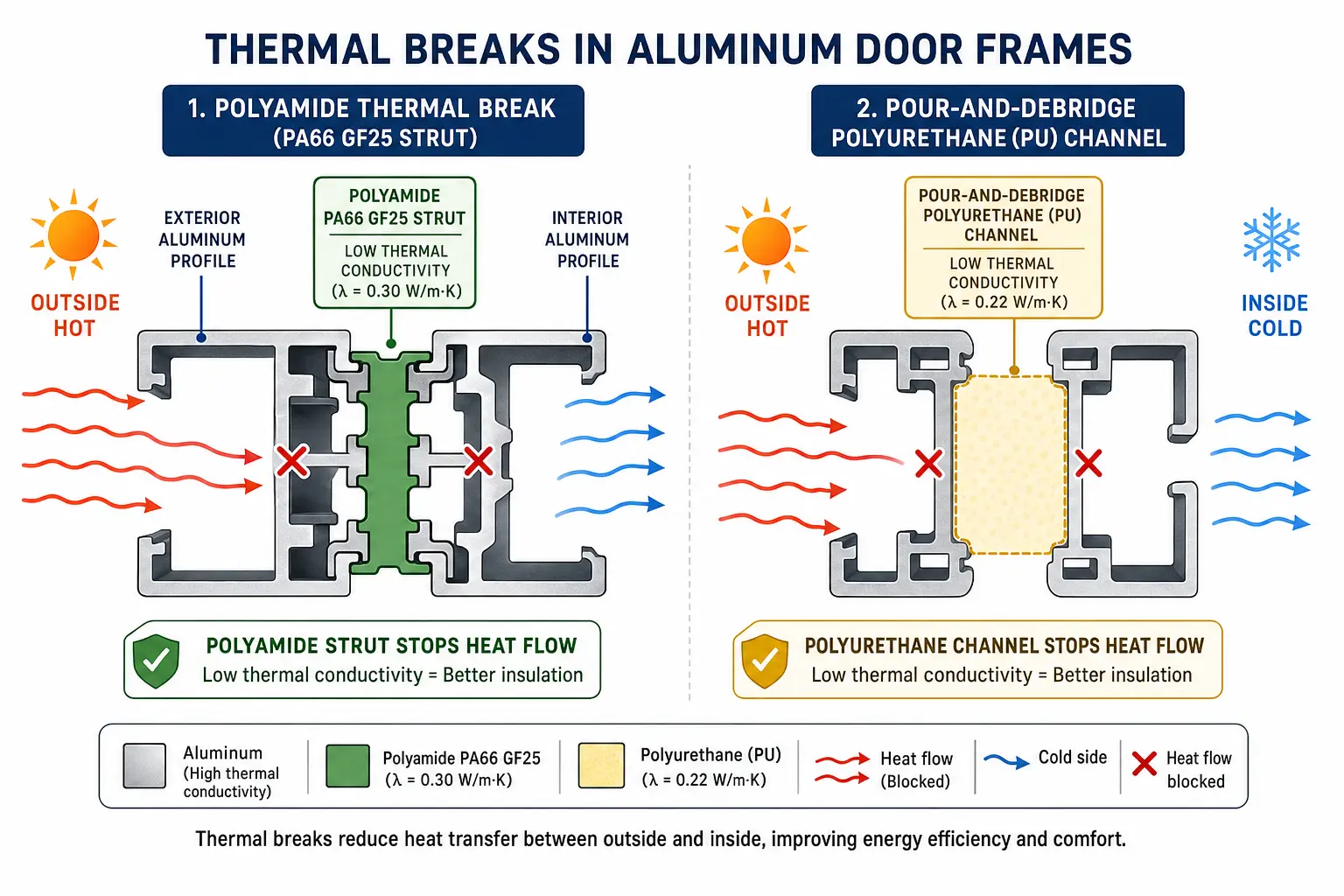
  • Polyamide 66 with 25% Fiberglass (PA66 GF25): Mechanically crimped polyamide struts offer a thermal conductivity of just 0.25 to 0.30 W/m·K—a 500x to 600x reduction compared to standard aluminum. Crucially, PA66 matches aluminum’s coefficient of thermal expansion ($alpha approx 23 times 10^{-6}/text{K}$), preventing structural shear failure or gasket separation during seasonal temperature swings.
  • Pour-and-Debridge (P&D) Polyurethane: Polyurethane resin is poured into a channel and mechanically debridged. While effective in mild regions, extreme freeze-thaw cycles can cause P&D breaks to dry-rot, embrittle, or lose structural shear strength over large panel spans.

When evaluating various types of door materials, selecting multi-cavity polyamide struts with a width between 24mm and 34mm is essential for preventing structural bowing and thermal breakdown. If existing installations show signs of frame separation, prompt aluminum door repair is necessary to restore structural envelope integrity.

Thermal breaks in aluminum door frames create a barrier that drastically reduces heat flow, preventing cold bridging. Polyamide PA66 GF25 offers superior structural integrity and thermal performance compared to Pour-and-Debridge polyurethane, crucial for cold climate durability.

Need a Quick Fix?

Tell us what’s wrong with your door — we’ll get it sorted.

The Frost Line and Threshold Interface


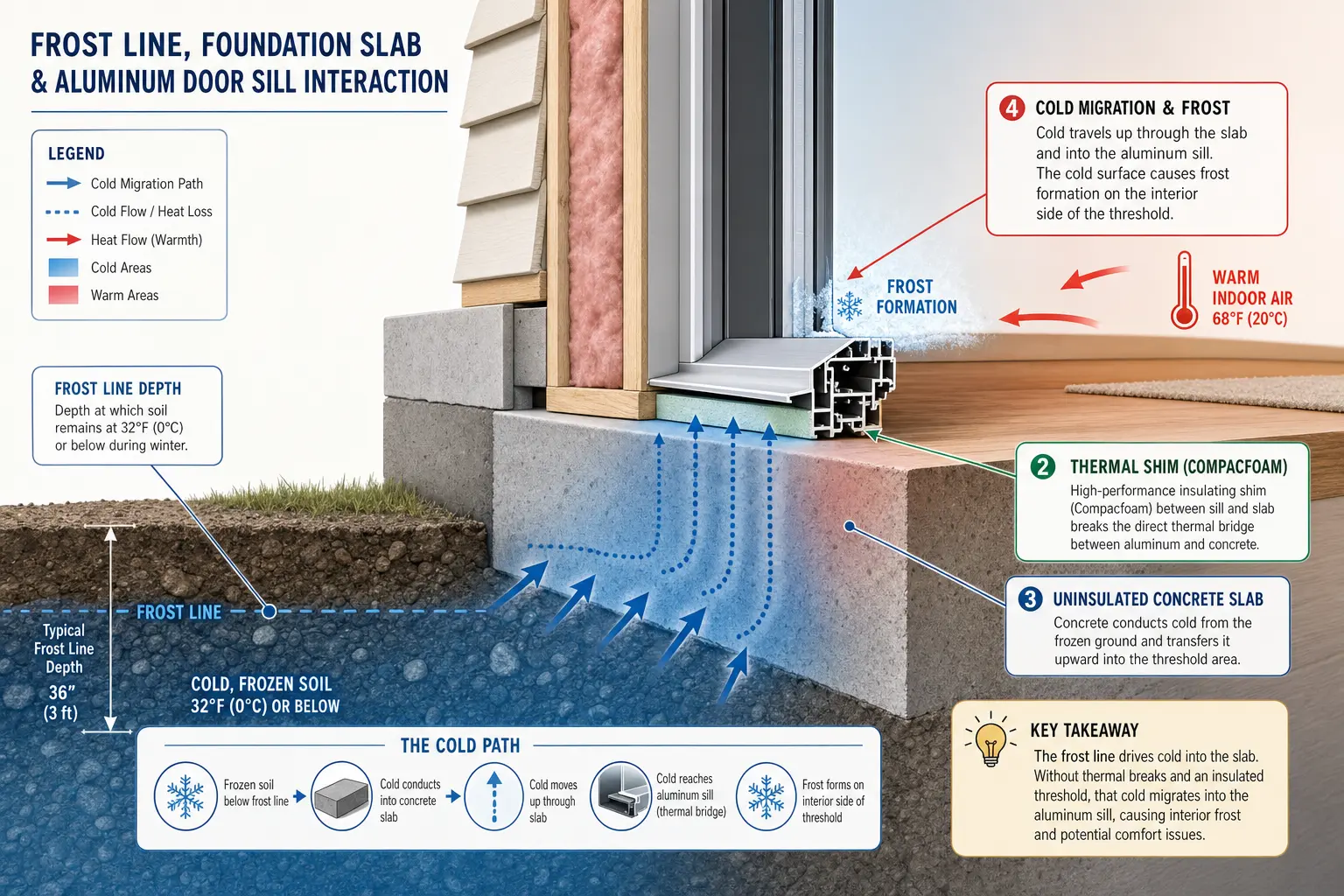
Even an expertly engineered frame can fail if the threshold forms a cold bridge at the foundation slab. In freezing regions, the exterior frost line penetrates perimeter soil and concrete footings. If an aluminum sill rests directly on an uninsulated slab, three-dimensional thermal bridging pulls cold up through the bottom of the doorway.

Preventing bottom-corner frost accumulation requires insulating the slab-to-sill junction:

  • Thermal Isolation Sills: Non-compressible load-bearing shims (such as high-density PET or Compacfoam) must be placed underneath the sill extrusion to decouple the metal frame from the cold slab edge.
  • Sub-Sill Insulation Profiles: Continuous rigid insulation around the perimeter foundation prevents heat from leaking downward past the sub-floor.

Proper execution prevents winter moisture damage beneath entry points. Projects requiring remediation often benefit from complete services like replacing exterior door jamb and threshold to eliminate continuous cold bridges.

Understanding how the frost line interacts with the building slab and door sill is key to preventing cold migration and frost buildup inside. Thermal shims beneath the aluminum sill break conduction, protecting interior floors in cold climates.

Condensation and Frost Formation Mechanics


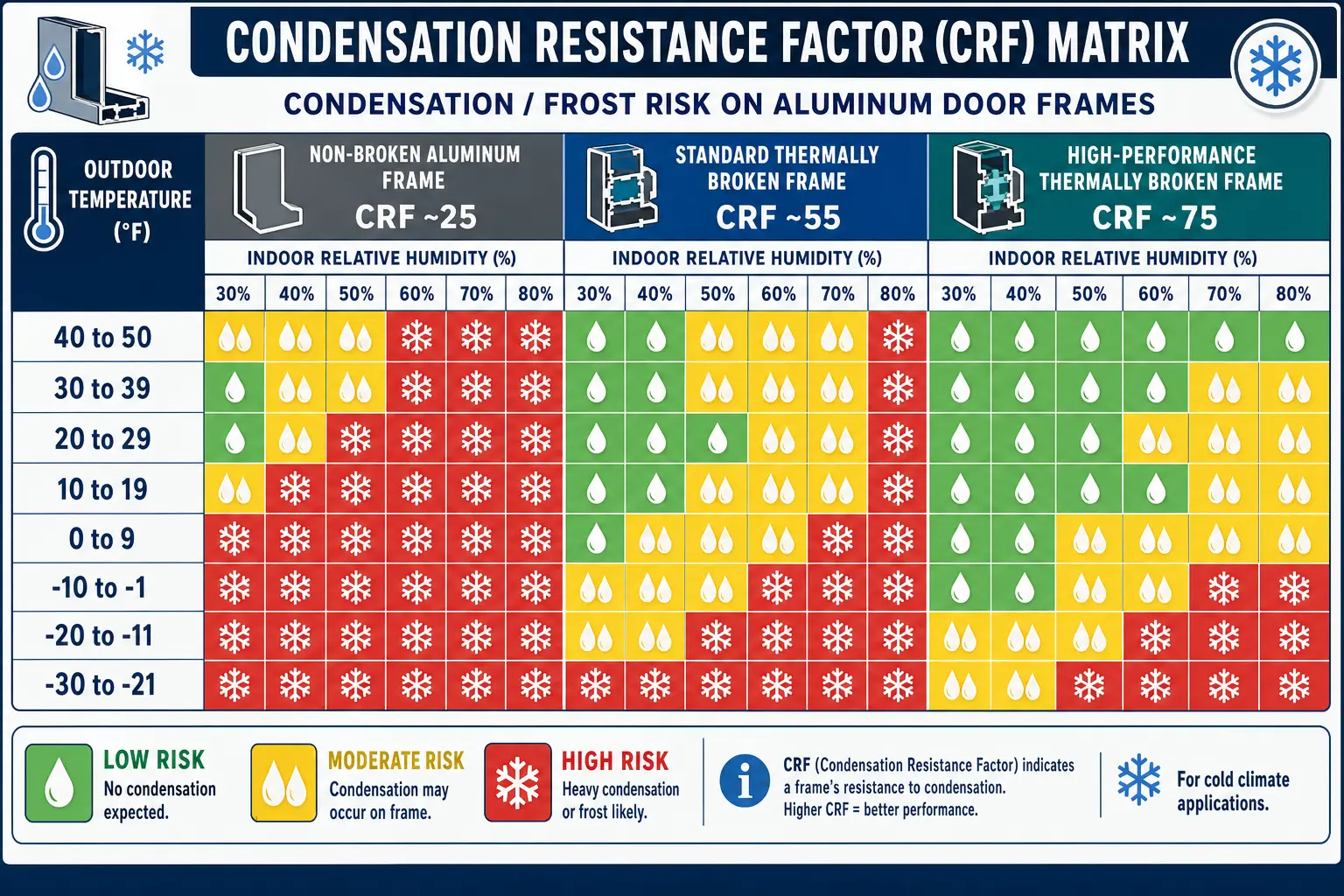
Interior surface condensation occurs when internal frame temperatures fall below the indoor air dew point. Non-broken aluminum frames often yield a Condensation Resistance Factor (CRF) of just 15 to 25, resulting in immediate condensation at 35°F (1.6°C) exterior temperatures under standard indoor humidity (35% RH).

High-performance thermally broken systems achieve CRF ratings between 68 and 78+, remaining dry down to -15°F (-26°C) outdoor conditions. To ensure balance across the entire opening, the frame’s performance should match the glass assembly. Verify that the system’s overall door u factor aligns with center-of-glass metrics ($le 0.25text{ Btu/h}cdottext{ft}^2cdot^circtext{F}$) so the metal profile does not become a thermal sink.

This matrix simplifies understanding when condensation and frost form on aluminum door frames under varying indoor humidity and outdoor temperatures. Higher CRF ratings significantly reduce condensation risk, critical for cold climate door performance.

Selecting Cold-Climate Door Assemblies


When evaluating high-performance aluminum entrance doors or commercial entrances, look for specs designed for thermal integrity:

  1. Structural Polyamide Depth: Specify minimum 24mm to 34mm multi-cavity PA66 struts filled with aerogel or expanded polyethylene foam.
  2. Compression Weather Seals: Ensure continuous perimeter air barriers utilizing heavy-duty EPDM gaskets and appropriate types of kerf weatherstripping to achieve air infiltration rating.
  3. Glazing Integration: Combine frames with triple-pane insulated glass units (IGUs), warm-edge composite spacers, and dual Low-E coatings.

Whether managing high-traffic commercial spaces or custom residential entries, partnering with technicians experienced in commercial storefront door repair ensures that seal integrity, hardware alignment, and thermal barriers operate reliably through extreme cold cycles.

Frequently Asked Questions


Will thermally broken aluminum doors sweat in sub-zero weather?

Thermally broken aluminum doors engineered with polyamide struts ($ge 24text{mm}$) and high CRF ratings (68 to 78+) resist sweating even at temperatures below -15°F, provided indoor relative humidity remains within normal ranges (30% to 35%).

How do polyamide thermal breaks compare to vinyl frame performance?

While vinyl (uPVC) offers low conductivity, it has a high coefficient of thermal expansion ($alpha approx 70 times 10^{-6}/text{K}$), nearly three times that of aluminum. This high movement causes frame bowing and seal failure in cold regions. Thermally broken aluminum offers structural strength for large spans with minimal thermal expansion.

Why is frost forming at the bottom sill of an insulated door?

Bottom-corner frost typically indicates continuous conduction through an uninsulated concrete foundation slab or missing sub-sill thermal shims. Isolating the threshold from the sub-grade frost line eliminates this cold bridge.