(855) 676-0881

Fiberglass Door Care in Winter: Thermal Bowing and Skin Cracks


Published: Nov 10, 2026

Fiberglass entry doors are widely praised for their durability and low maintenance, but severe winter weather tests their structural limits. When sub-zero winds blast your entryway, you might find your door sticking at the top corner, refusing to latch, or showing hairline surface cracks.

Before assuming your door is permanently ruined and budgeting thousands for an immediate replacement, it is crucial to understand what is happening beneath the surface. Knowing how extreme temperature shifts affect door materials helps you determine whether your slab is experiencing temporary thermal movement or requiring targeted restoration.
The Science of Winter Thermal Bowing (Why Doors Warp in Cold Weather)


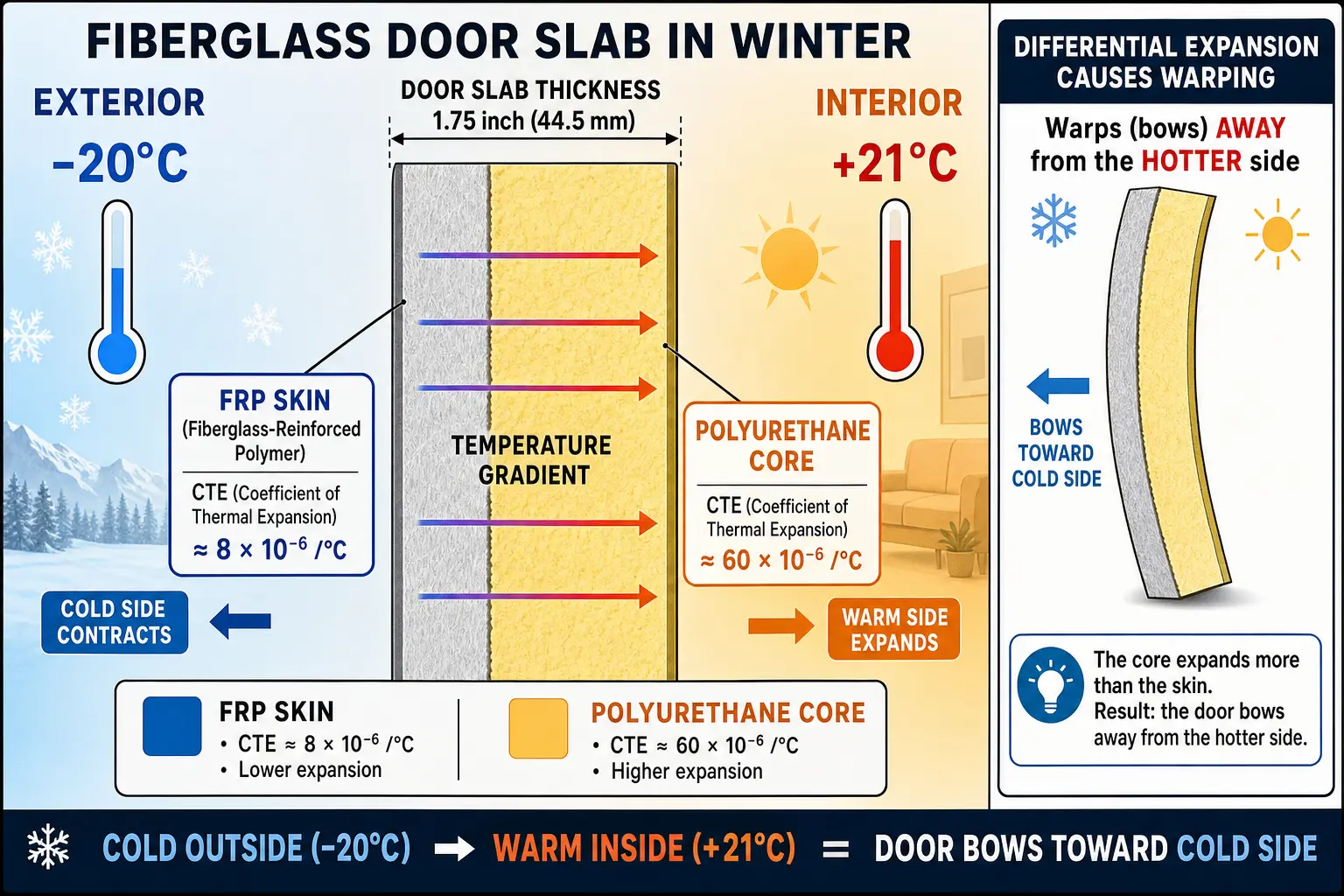
Thermal bowing occurs when extreme temperature differentials exist between the inner and outer faces of a door. In deep winter, your entry door slab acts as a 1.75-inch barrier between freezing outdoor air—say -20°C (-4°F)—and a heated indoor foyer at +21°C (+70°F). This creates a continuous 41°C (74°F) thermal gradient across a thin profile.

This diagram clarifies how extreme winter temperature differences across a fiberglass door’s layers cause differential expansion, leading to thermal bowing. It visualizes material science concepts to make door warping understandable.

This thermal gradient triggers differential material movement. The door’s inner component, an insulating polyurethane core, expands and contracts at a rate of $35text{–}50 times 10^{-6}/text{K}$, while the outer Fiberglass Reinforced Polymer (FRP) skin shifts at a rate of $12text{–}20 times 10^{-6}/text{K}$.

Because the interior face expands while the exterior face contracts, asymmetric flexural stress forces the top and bottom corners to pull inward toward the heated living space.

Solar radiation amplifies this stress. Direct sunlight on dark doors can raise exterior skin temperatures to 60°C (140°F), creating a thermal delta of up to 80°C (144°F). Under high exposure, doors bow away from the heated face.

Interactive Diagnostic Tree: Is Your Bowed Door Repairable or Ruined?


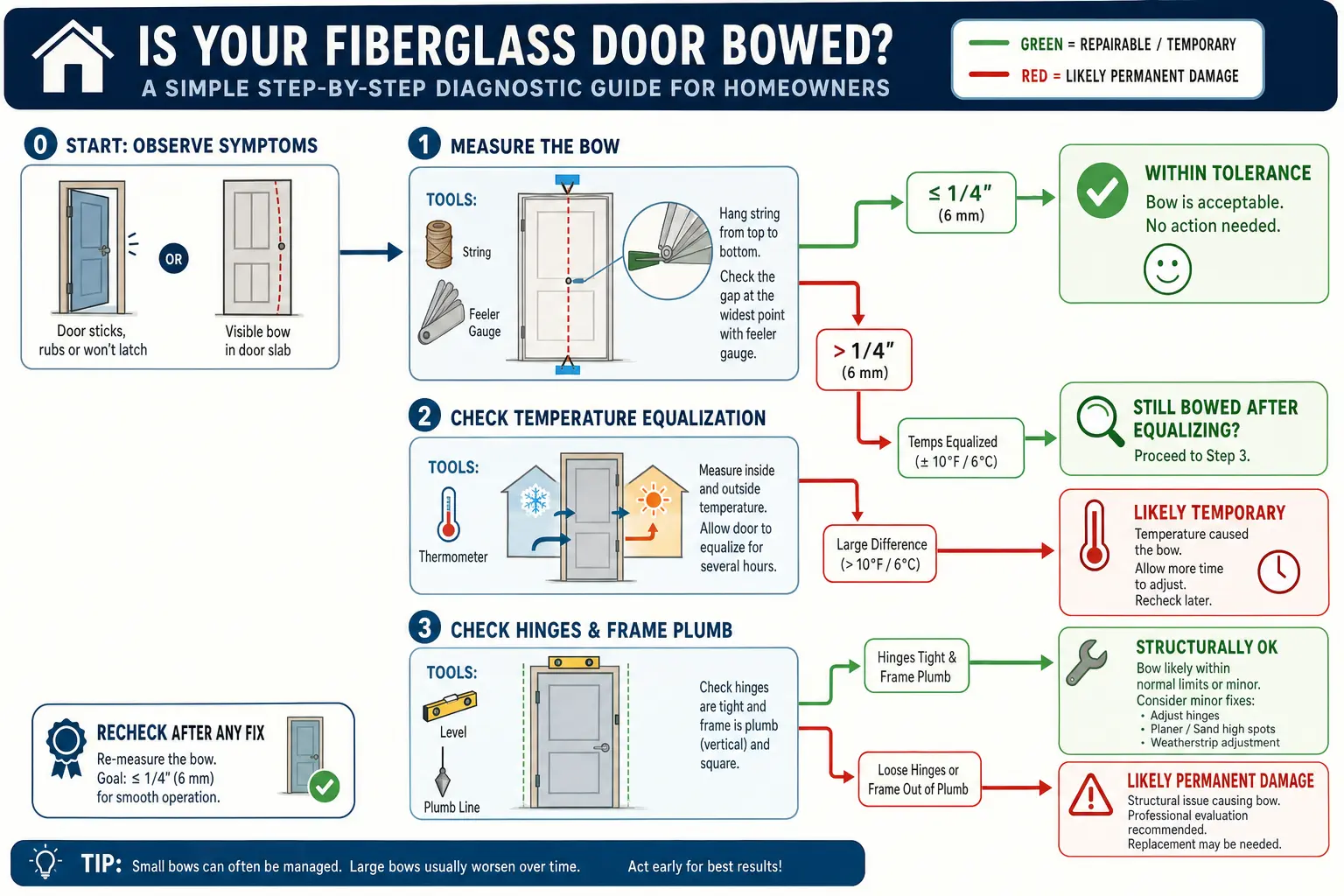
To evaluate whether your door has suffered permanent plastic deformation or temporary elastic deflection, use this simple diagnostic protocol.

This flowchart empowers homeowners to diagnose whether their fiber glass door’s bowing is temporary winter deflection or permanent structural damage, guiding effective decision-making.

  1. The String Line Test: Pull a taut piece of string vertically from top to bottom edge on the inside face. Measure the gap between the string and the center of the slab using a feeler gauge. Major manufacturers (Therma-Tru, ProVia) specify that bowing up to 1/4 inch is normal elastic distortion and not a manufacturing defect.
  2. Temperature Equalization Test: Wait for a milder day (around 15°C / 60°F) or release thermal pressure by opening room airflow. If the bow disappears and the latch aligns smoothly, the slab’s structural core remains intact.
  3. Plumb Verification: Check the frame with a 6-foot level. If frame jambs are out of plumb, mechanical binding is occurring due to structural settling rather than slab bowing. When minor hardware shifts fail, consulting a local expert for door repair near me ensures frame and alignment issues are correctly resolved.

Fiberglass Skin Cracks: Identification and Freeze-Thaw Hazards


Cold weather also exposes surface vulnerabilities. Exterior damage typically falls into three categories:

  • Gel-Coat Crazing: Hairline surface fractures in the outer clear protective layer caused by UV breakdown.
  • Topcoat Chalking: Dull, chalky residue resulting from degraded sealant.
  • Structural FRP Cracks: Deep fissures around panel joints or locksets caused by stress concentration.

Winter moisture makes hairline cracks dangerous. Water penetrating small surface openings expands by 9% in volume upon freezing, generating up to 30,000 PSI of hydrostatic pressure. This force turns minor gel-coat crazing into core delamination over a single season.

Step-by-Step Restoration Protocols


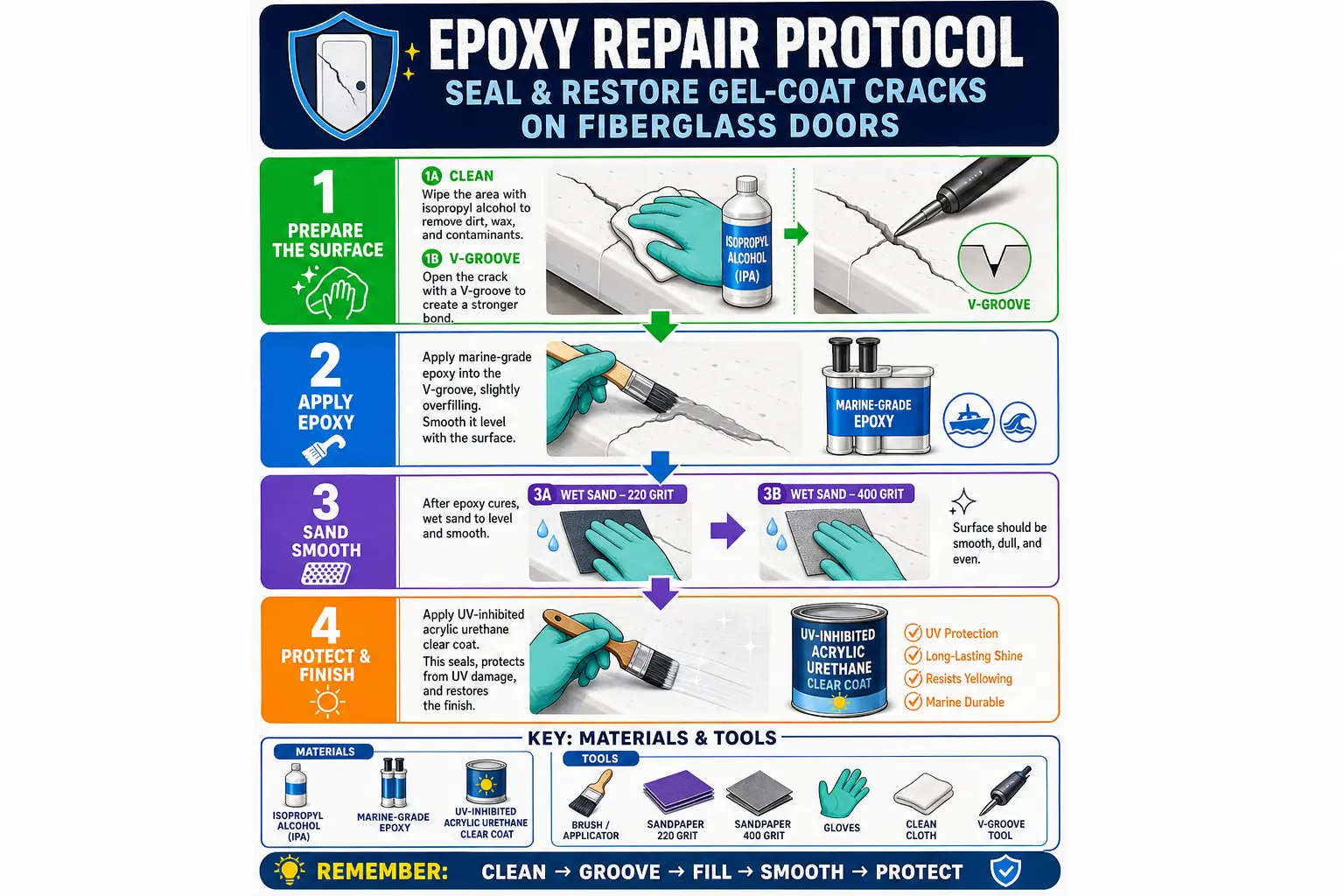
Restoring damaged gel-coats before moisture freezes prevents structural decay.

This infographic visually anchors the expert epoxy restoration process, making it easy to remember and execute professional-quality repairs on fiberglass door skin cracks.

For minor surface repair:

  1. Clean & Prep: V-groove the crack slightly with a carbide scraper, then clean thoroughly using isopropyl alcohol.
  2. Fill: Apply a 2K marine-grade epoxy or vinyl ester resin into the fissure using a flexible putty knife.
  3. Finish: Wet-sand flush using 220-grit and 400-grit sandpaper, then seal with a UV-inhibited acrylic urethane topcoat.

Mechanical Adjustments and Prevention Safeguards


Temporary bowing can be managed through smart seasonal adjustments:

  • Adjustable Strike Plates: Move adjustable latch boxes outward by 1/16 to 1/8 inch to allow deadbolts to catch without binding during cold snaps.
  • Hinge Shimming: Place thin composite shims behind center hinges to relieve pressure on pulled top and bottom corners. Similar techniques are used for commercial door adjustment when entryways drag or misalign under heavy seasonal use.
  • Multi-Point Locks: Installing 3-point locking mechanisms secures the top, middle, and bottom of tall doors, physically counteracting thermal distortion.

To protect manufacturer warranties, choose paint colors with a Light Reflectance Value (LRV) greater than 50% on sun-exposed doors. Avoid unvented glass storm doors, which trap heat and cause surface temperatures to exceed 71°C (160°F), voiding warp coverage.

If structural damage exceeds limits, review standard guidelines for exterior door installation or prepare to replace front door systems with engineered multi-point setups.

Frequently Asked Questions


Can I force a bowed fiberglass door flat using weights or clamps?

No. Forcing a cold fiberglass door slab flat using heavy weights or structural clamps can fracture the brittle internal composite stiles or cause permanent core delamination. Allow ambient indoor and outdoor temperatures to equalize naturally to see if the elastic bow relaxes.

Will thermal bowing permanently damage my lockset or door frame?

Temporary thermal bowing itself will not ruin locksets, but forcing an unaligned deadbolt into a bound strike plate can strip hardware gears, bend latch bolts, and crack wood frame jambs. Adjusting strike plates during cold months prevents mechanical failure.

Does a bowed fiberglass door void my home energy efficiency rating?

Significant thermal bowing breaks the contact seal against perimeter weatherstripping, allowing cold drafts and air infiltration that increase winter heating loads. Upgrading to ultra-flexible memory foam weatherstripping helps maintain energy seals even when minor thermal flex occurs.