The durability of your door’s latching mechanism is governed by the standards established by the American National Standards Institute (ANSI) and the Builders Hardware Manufacturers Association (BHMA):
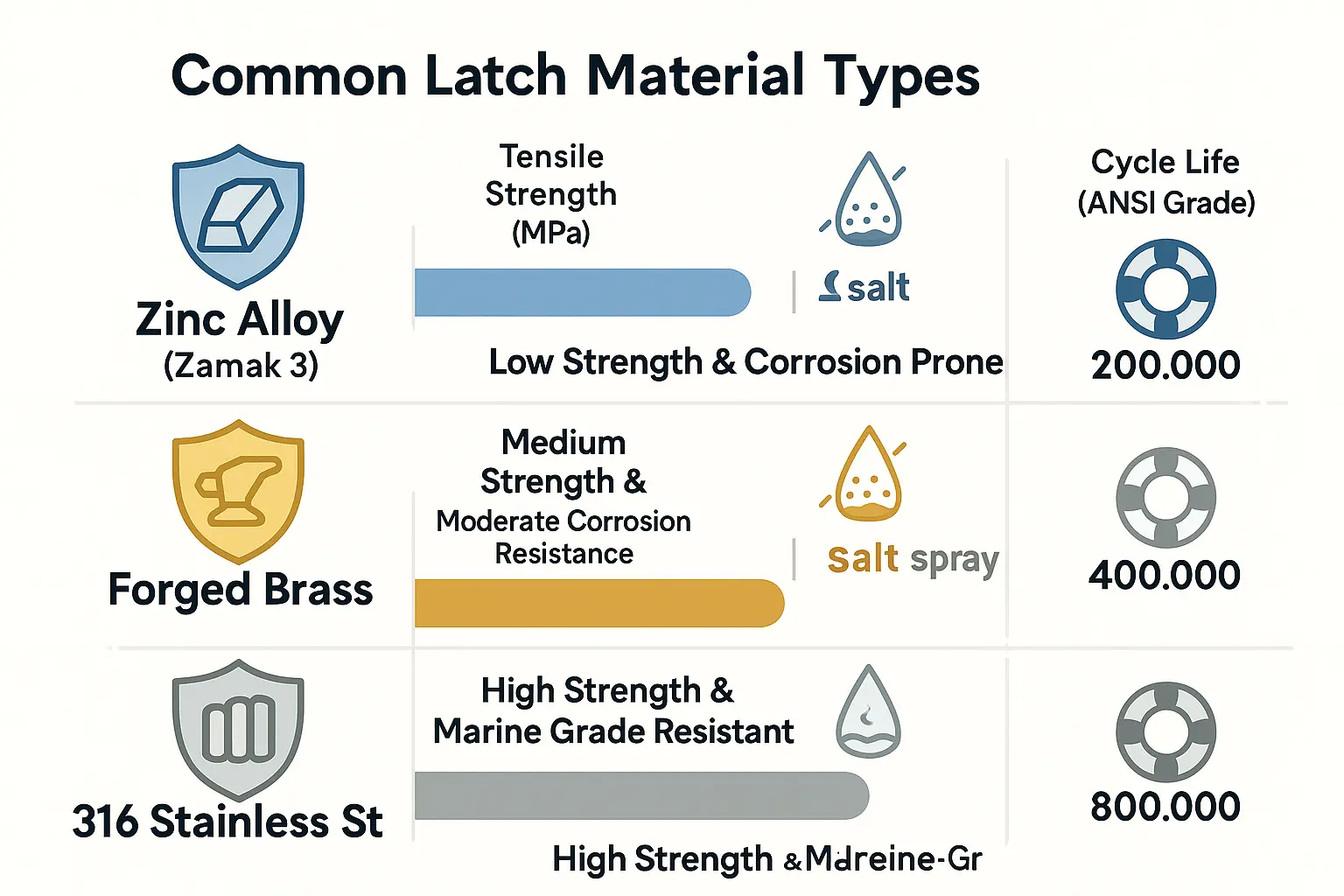
- ANSI Grade 1 (Heavy Commercial): Engineered to withstand 1,000,000 cycles and high torque loads.
- ANSI Grade 2 (Light Commercial / Heavy Residential): Engineered to withstand 400,000 to 800,000 cycles.
- ANSI Grade 3 (Standard Residential): Engineered to withstand 200,000 cycles.
A standard family of four operates an entry door approximately 15 times a day (5,475 cycles per year). While a Grade 3 builder-grade lock is designed to last over 30 years under perfect laboratory conditions, real-world stressors like door slamming, alignment shifts, and environmental changes routinely compress this lifespan to just 5 to 10 years.
The choice of metal is critical to how hardware resists this wear:
- Zinc Alloy (Zamak 3): Common in low-cost residential hardware. While easy to cast, Zamak 3 has a low tensile strength (~283 MPa) and is highly susceptible to “creep” (permanent deformation under sustained stress) and impact shearing.
- Forged Brass & 316 Stainless Steel: Found in high-end, architectural-grade hardware. Boasting tensile strengths exceeding 500 MPa, these materials resist cyclic wear and impact fatigue far more effectively.
The Coastal and Salt-Air Threat
For homes and businesses near Connecticut’s coastline, airborne sodium chloride (salt spray) deposits inside unsealed latch casings. This triggers galvanic corrosion when two dissimilar metals—such as a steel spindle rotating inside a zinc-alloy cam—come into contact in the presence of humid, salty air. This electrochemical reaction accelerates the decay of the zinc, freezing the mechanism. Upgrading to high-durability, corrosion-resistant hardware or scheduling a robust storm door replacement is often the most cost-effective path to preventing seasonal lock failures in coastal environments.