(855) 676-0881

Hollow Core vs. Solid Core vs. Solid Wood Interior Doors: The Ultimate Material & Construction Guide


Published: Sep 16, 2026

Choosing interior doors is one of the most critical, yet frequently underestimated, decisions in residential design and remodeling. Beyond aesthetic appeal, the internal composition of a door slab dictates how your home manages sound, handles daily physical impacts, resists seasonal warping, and impacts your structural framing.

Understanding the core material science of your doors allows you to allocate your budget strategically—investing in premium construction where performance matters most, while utilizing cost-effective alternatives elsewhere.


Quick Decision Matrix: The 60-Second Comparison


When evaluating interior doors, homeowners generally weigh five key performance metrics against cost. This matrix outlines how each core material operates under real-world conditions:

Performance Metric Hollow Core Solid Core (MDF/Composite) Solid Wood (Natural Timber)
Average Unit Cost $60 – $120 $150 – $350+ $400 – $1,000+
Acoustic Rating (STC) 12 – 15 (Real-World) 27 – 35 30 – 34 (Species-Dependent)
Weight (Standard Slab) 20 – 30 lbs 50 – 80 lbs 75 – 110+ lbs
Seasonal Warp Risk Negligible Near 0% Up to 1/4″ dimensional shift
Impact Resistance Low (Puncture risk) High Exceptionally High

Deep Dive: Anatomy & Internal Construction (With Visuals)


To appreciate the cost and performance differences between these options, we must look inside the door slab.
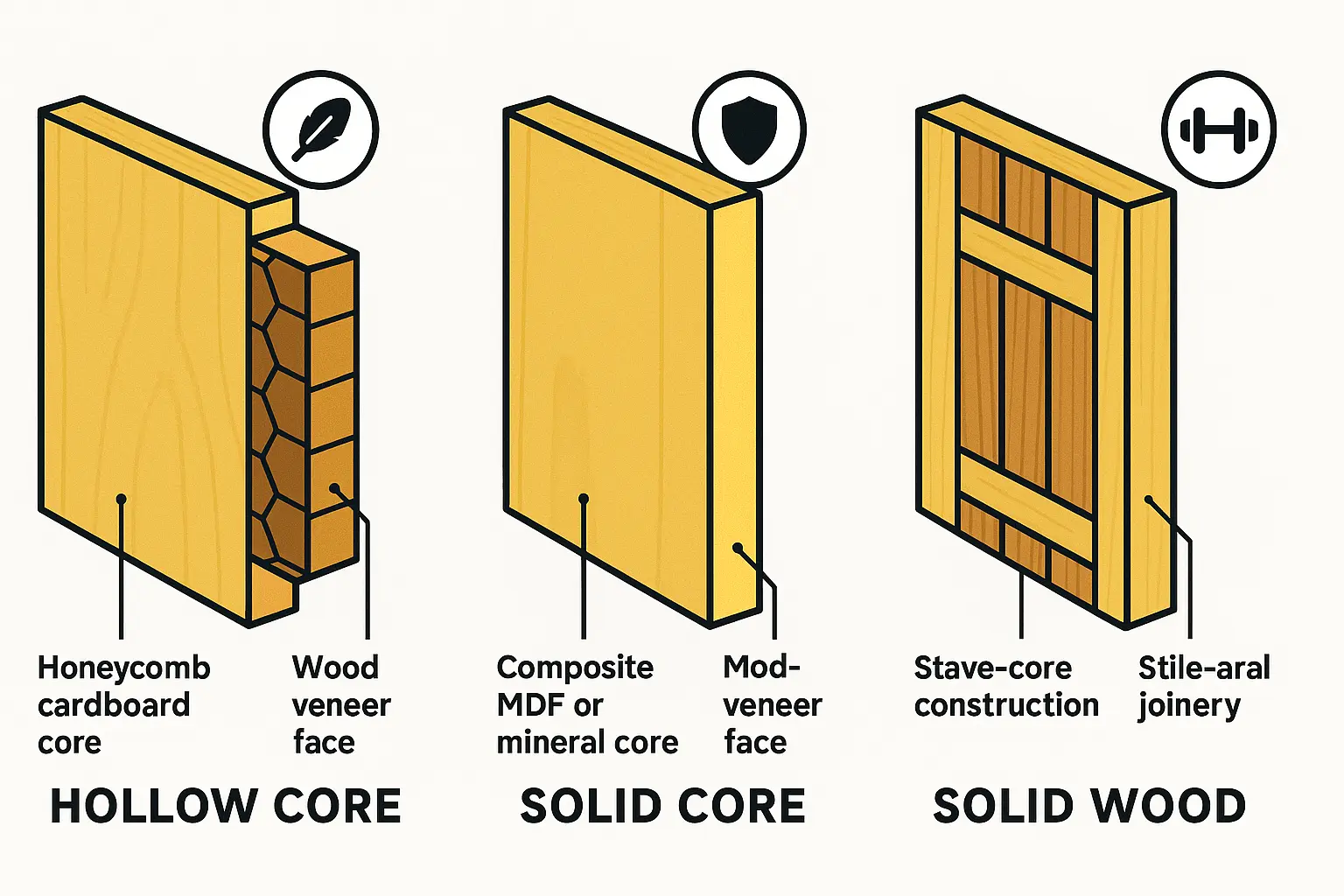
Visualizing the internal structures of interior doors helps demystify material composition and engineering, enabling informed material choice decisions.

Hollow Core Doors

Despite the name, these doors are not completely empty. They feature an internal structural honeycomb grid made of cardboard or light fiberboard. This grid is sandwiched between thin wood veneers or medium-density fiberboard (MDF) skins. The perimeter consists of a basic soft-wood frame to provide structural points for hinges and locksets.

Solid Core Doors

Engineered solid core doors are manufactured by filling the entire inner cavity with a dense composite material, typically high-density wood fiber, particleboard, or a mineral core. This core is then laminated with premium wood veneers or paint-grade MDF faceplates. This engineering eliminates internal air pockets, creating a heavy, uniform slab.

Solid Wood Doors

True solid wood doors are crafted from 100% natural hardwood or softwood timber planks. Unlike historical single-slab designs, modern premium solid wood doors utilize “stile-and-rail” construction. Staves of natural wood are glued together to form engineered side stiles, rails, and floating center panels. This complex joinery allows individual wood components to move independently without tearing the door apart.


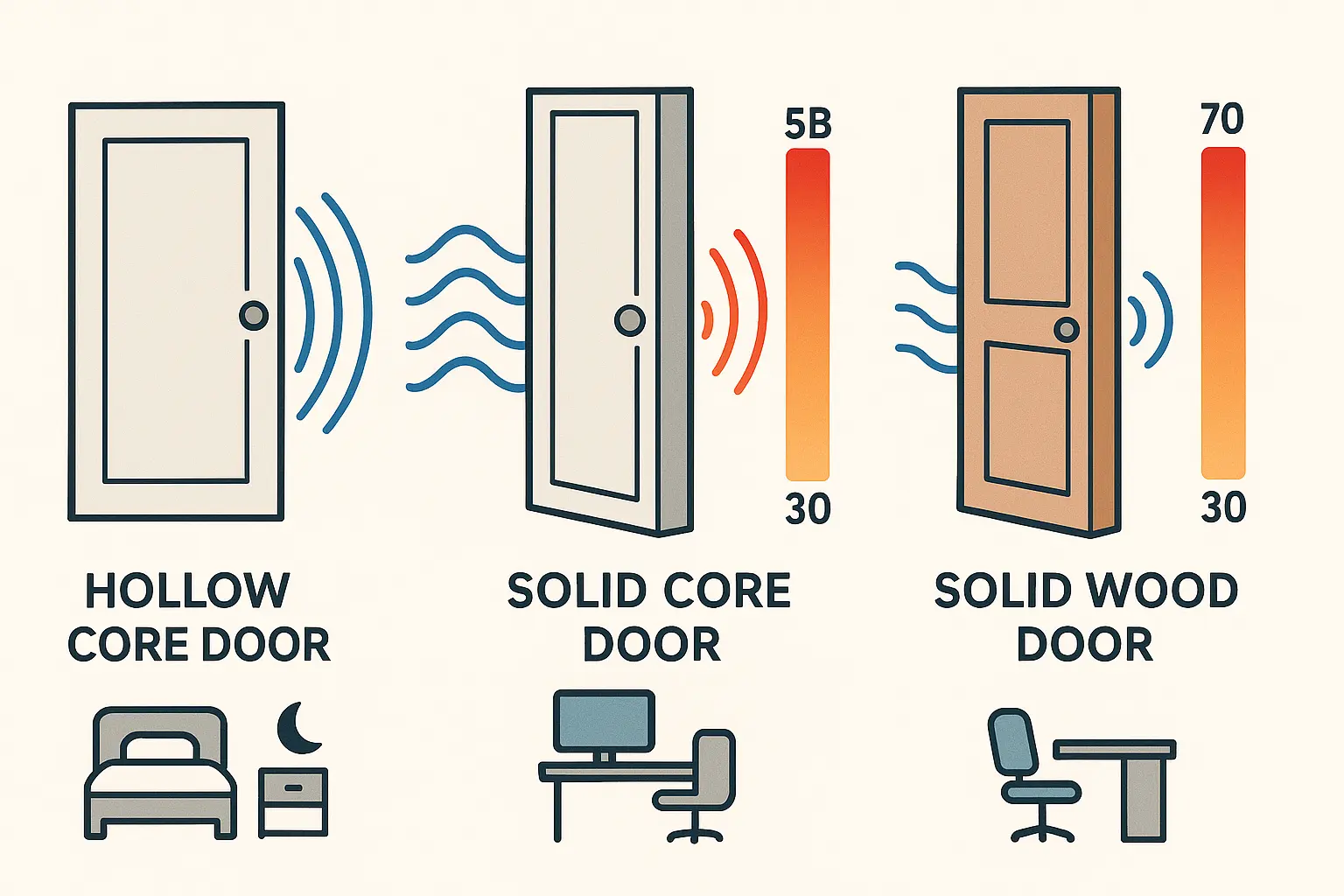
Acoustic Showdown: The Sound Transmission Class (STC) Breakdown


Acoustic comfort is often the most critical unstated need for home offices, bedrooms, and bathrooms. Sound isolation is measured via Sound Transmission Class (STC), where higher numbers represent superior decibel reduction.

Understanding how sound travels through door materials clarifies acoustic performance differences and the importance of door choice for quiet spaces.

Under laboratory conditions, hollow core doors register an STC of 20 to 25. However, in real-world residential framing without perimeter seals, this drops to an STC of 12 to 15. Normal conversational speech passes through them with ease.

To resolve sound leakage, installing a dense soundproof door with a solid composite or wood core is essential. High-density solid core doors deliver an STC rating of 27 to 35, reducing clear speech to a muffled, unintelligible murmur. Natural hardwoods provide an STC of 30 to 34, depending heavily on the density of the wood species (such as heavy Oak vs. lighter Pine). For maximum acoustic performance, pair your dense doors with neoprene perimeter gaskets and bottom drop-seals.


The Warping Science: Humidity and Environmental Performance


Wood is hygrothermal, meaning it naturally absorbs and releases moisture. In high-humidity zones like master bathrooms, laundry rooms, or coastal homes, environmental shifts present a major risk.

Natural solid wood can expand or contract up to 1/4 inch across its width seasonally. If raw timber is exposed to moisture, the uneven rate of expansion between the interior wood grain and exterior faces causes bowing, cupping, and binding within the door frame. Modern manufacturers mitigate this with floating panels and engineered core stiles, but some seasonal movement remains inevitable.

Conversely, engineered solid core and MDF doors exhibit a warp rate near 0% across standard home humidity fluctuations. Because composite fibers are multi-directional and sealed with industrial resins, they lack a natural grain direction, making them exceptionally stable in humid conditions.


Structural & Installation Requirements: Can Your Frame Handle It?


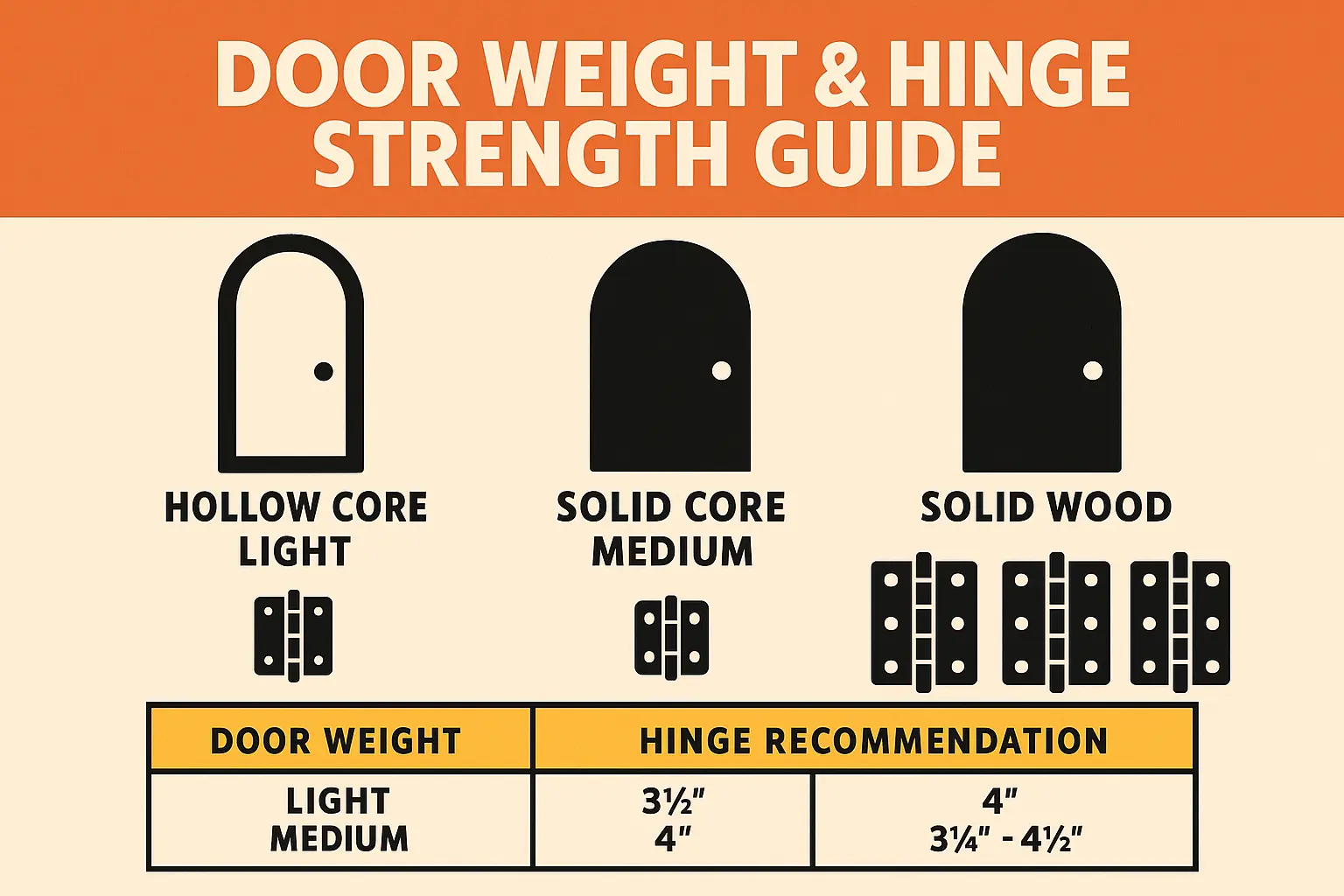
Before purchasing premium heavy slabs, you must evaluate your existing home infrastructure. The physical weight of your door dictates your choice of hinges, fasteners, and framing stability.

Matching door weight to appropriate hinge size and number prevents installation issues and prolongs door longevity.

  • Hollow Core (20–30 lbs): Can be safely hung on standard 3.5-inch residential hinges anchored into basic softwood door jambs.
  • Solid Core (50–80 lbs): Requires robust, heavy-duty 4-inch hinges. The top hinge must be secured with at least one 3-inch screw passing through the jamb and directly into the structural wall studs.
  • Solid Wood (75–110+ lbs): Often requires three heavy-duty ball-bearing hinges and reinforced framing. Hanging a solid timber door on an unreinforced, lightweight frame will lead to sagging, latch misalignment, and accelerated wear on the jamb.

If you are upgrading to heavier slabs, consulting professional interior door installers near me ensures your framing is structurally sound. If your frame is already showing signs of wear or sag, addressing the structural foundation with a professional door jamb repair cost assessment will prevent costly alignment issues down the road.


Hollow Wood Doors: The Smart Compromise


If you love the organic beauty of natural wood grain but have budget or weight constraints, “hollow wood doors” offer an elegant middle ground. These doors utilize standard hollow core construction but are wrapped in premium, genuine hardwood veneers such as Birch, Lauan, Oak, or Cherry.

This configuration delivers the visual warmth and high-end stain capabilities of solid natural timber at a fraction of the cost. They are highly suitable for secondary spaces like guest closets, pantries, or linen storage, allowing you to maintain design continuity throughout the home without paying for heavy solid cores where acoustic isolation is unnecessary.


Frequently Asked Questions


Can a standard lightweight door frame support a solid wood or solid core door?

No, lightweight frames designed for hollow doors usually cannot handle the 50 to 110-pound weight of solid slabs without modification. Installing a heavier door typically requires adding a third hinge, utilizing longer 3-inch structural screws that anchor deep into the wall studs, or upgrading to a reinforced solid wood jamb.

Are hollow core doors easily damaged by daily impacts?

Yes. Hollow core doors have thin outer veneers with hollow spaces behind them, leaving them vulnerable to punctures, cracks, and structural damage from accidental impacts. Solid core and solid wood doors provide superior structural density and can withstand significant impact without denting or fracturing.

How can I verify if my existing doors are hollow or solid without taking them down?

The simplest physical test is the knock test: tap on the center of the door panel. A hollow core door will produce a high-pitched, echoing, and drum-like sound, whereas a solid door will yield a dull, heavy thud. You can also estimate by gently lifting the door slab; if it feels effortless to swing and weighs under 30 pounds, it is hollow core.


Need help finding the perfect fit for your home? Explore our full collection of premium materials at a1 doors to find durable, beautiful, and professionally engineered options tailored to your space.