Proper actuator placement ensures that individuals with limited mobility can easily access the activation switch. Standard ADA requirements (referencing Paragraph 309.4) dictate that manual controls must be operable with one hand, without tight grasping or pinching, and mounted between 34 and 48 inches above the finished floor. Furthermore, actuators should be placed within 1 to 5 feet of the door for optimal usability, with a maximum allowable distance of 12 feet.
However, national guidelines are only part of the equation. If your facility is located in California, California Building Code (CBC) Title 24, Section 11B-404 introduces a strict dual-actuator requirement. To accommodate both hand and wheelchair footrest activation, you must install either a 36-inch tall vertical actuation bar or two independent push-plates: a lower plate mounted between 7 and 8 inches from the floor, and an upper plate mounted between 30 and 44 inches.
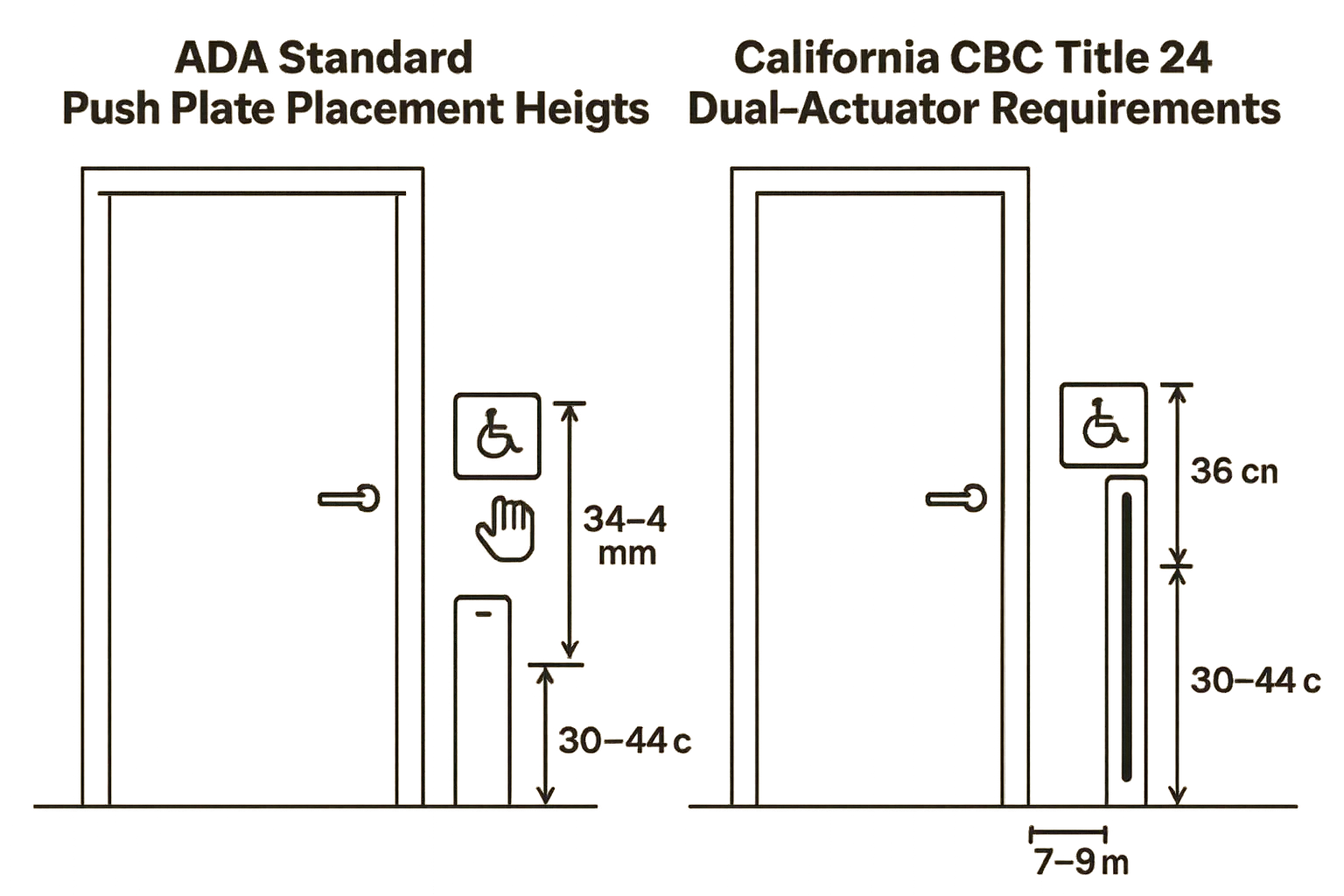
Side-by-side comparison of ADA standard and California Title 24 push plate placement rules, revealing the critical dual-actuator and vertical bar requirements unique to California. Understand correct installation heights visually to ensure compliance.
Whether you are managing a complex retrofit or a new handicap door installation, aligning your physical hardware layout with regional codes is non-negotiable.