(855) 676-0881

Troubleshooting Automatic Door Sensor Faults: The Facility Manager’s Guide to Safety Loop Diagnostics


Published: Sep 4, 2026

When an automatic commercial entryway freezes open or an overhead garage door reverses without warning, operations halt and building security is compromised. Most facility managers assume the motor or control board has failed. In reality, approximately 65% of commercial automatic door failures stem from a safety sensor system trapped in a fault loop [1].

Modern automatic doors are designed with safety as the absolute priority. If the safety system cannot verify that the path is clear, the door controller defaults to a safe, open state. Understanding the engineering logic behind these sensors helps you diagnose issues quickly and determine when you can resolve them yourself or when you need a certified professional.
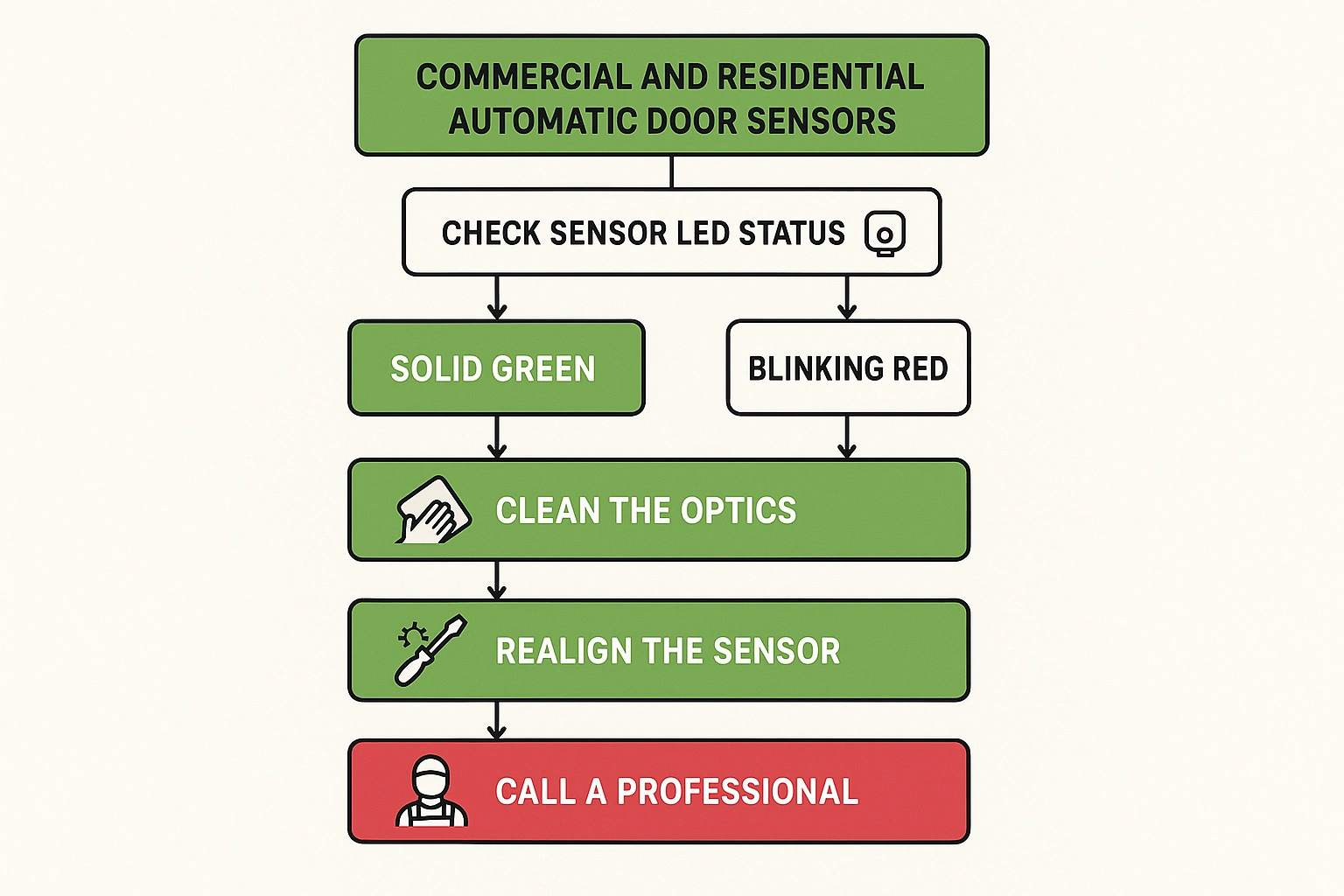
The Monitored Sensor Diagnostic Flowchart


To systematically isolate sensor issues, use this diagnostic sequence to identify physical blocks, alignment problems, or deeper electrical faults before calling for service.

A step-by-step troubleshooting flowchart for commercial and residential automatic door sensors, showing LED status checks (Solid Green, Blinking Red), cleaning optics, and sensor realignment steps.

Commercial Automatic Doors (ANSI A156.10 Focus)


Commercial pedestrian doors—including sliding, swing, and revolving systems—must meet the strict guidelines of ANSI/BHMA A156.10. Since the 2017 standard update, automatic door controllers must perform a software “handshake” to verify the safety sensors are operational before every closing cycle.

The control system distinguishes between Active Infrared (AIR) safety curtains (which detect presence directly in the door’s threshold) and Passive Infrared (PIR) or microwave motion sensors (which detect approach).

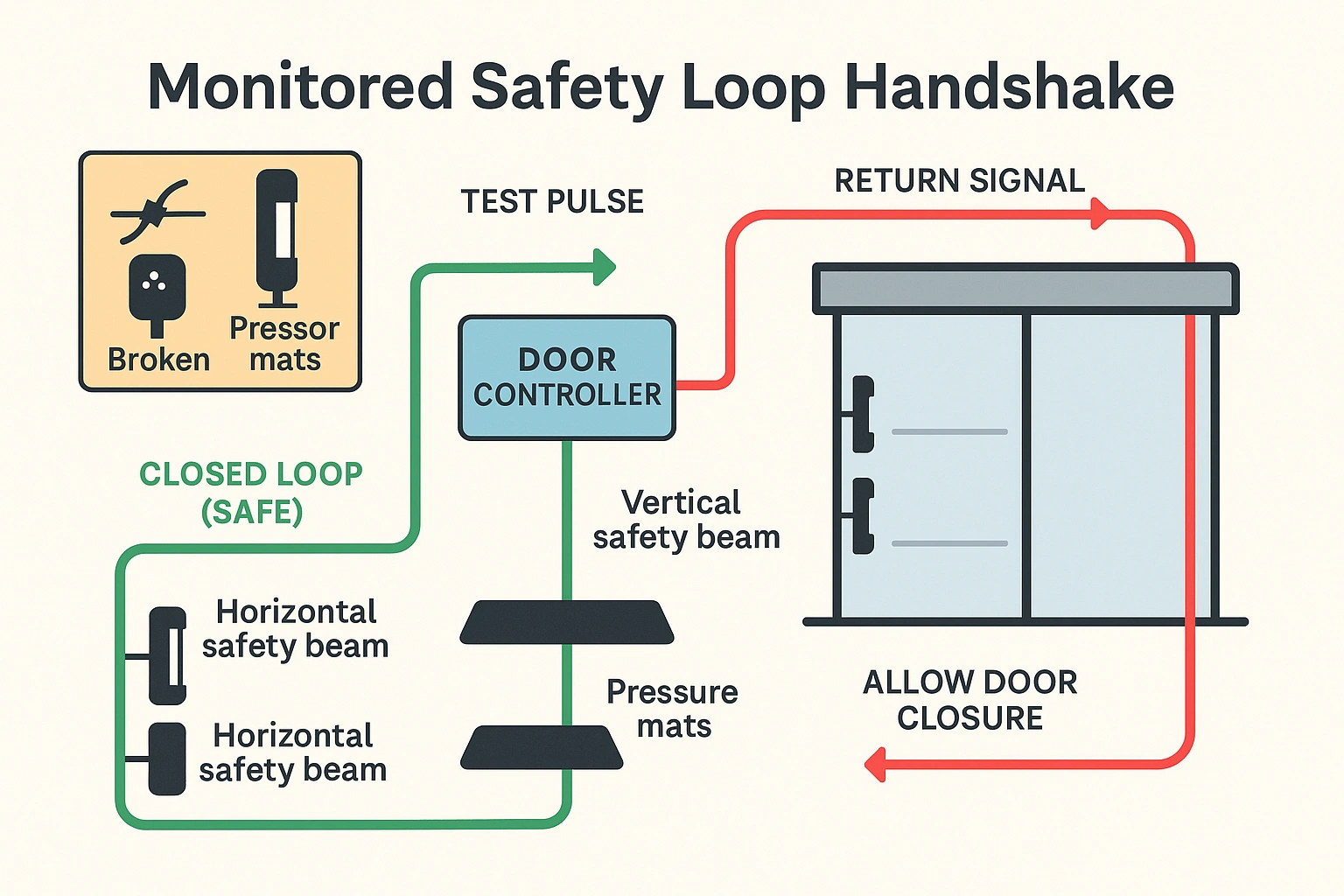
The Monitored Safety Loop Handshake is a critical safety check where the door controller sends a test signal to presence sensors before every closing cycle. If the sensor loop is intact and responds, the door can close safely. Any break (wiring fault, dirty optics) prevents closure, ensuring pedestrian safety.

If a wire is pinched, a lens is dirty, or an emitter is misaligned, the monitored safety loop fails. The controller registers a fault and holds the door open.

If your facility utilizes Tormax sliding door systems, you can clear transient sensor fault codes after cleaning your sensor lenses: locate the user interface or rotary programming switch and hold down selector button 5 for exactly 5 seconds to execute a software soft-reset [3].

Overhead & Garage Doors (UL 325 Focus)


Commercial and residential overhead doors fall under the federal UL 325 standard (16 CFR Part 1211). Since 1993, all automatic overhead doors must utilize secondary external entrapment protection, such as infrared safety beams or pressure-sensitive safety edges.

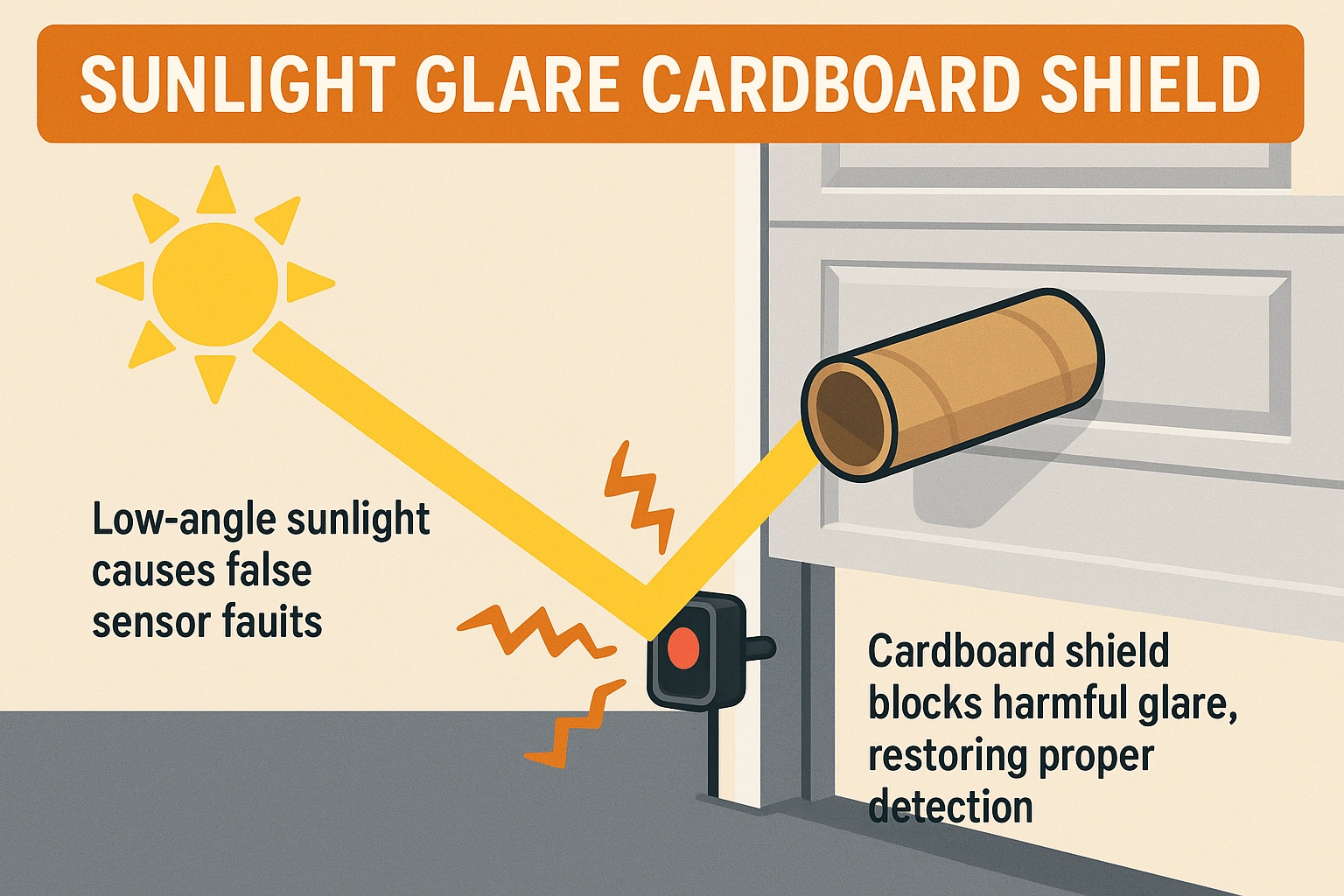
An instructional diagram explaining how sunlight glare causes false sensor faults and demonstrating how a cardboard shield blocks harmful rays to restore proper detection.

If you are dealing with garage door safety sensors not working, begin with physical measurements. UL 325 mandates that garage door photo-eyes must be mounted no higher than 6 inches (ideally 4 to 5 inches) above the finished floor to protect children and pets lying flat.

Next, check the indicator LEDs on your sender and receiver units (common on Chamberlain and LiftMaster models). A solid Amber LED on the sending unit and a solid Green LED on the receiving unit signal proper alignment. A flickering or dark green LED indicates the beam path is misaligned or obstructed.

If your overhead door closes completely, contacts the floor, and immediately reverses, the issue is typically not the safety sensor. Instead, the down-travel limit is set too low, causing the motor to detect excess force and trigger a safety reversal. Adjust the down-travel limit screw on the motor casing backward by 1/4 turn to resolve this.

Seasonal temperature shifts can also cause optical blinding. During sunrise or sunset, low-angle sunlight can overwhelm the infrared receiver, causing false safety reversals.


Safety Compliance, Insurance & Liability


It is tempting for maintenance teams to bypass a malfunctioning safety loop with a jumper wire to keep a building open. However, doing so introduces massive civil liability. Bypassing safety sensors is a direct violation of OSHA regulations, ADA standards, and local building codes.

Should a collision or entrapment injury occur while a safety system is bypassed, your commercial liability insurance coverage may be voided, exposing your business to catastrophic financial damages.

DIY vs. Certified Professional Repair


Knowing what tasks are safe for on-site staff and which require certified intervention protects both your system warranty and your facility’s occupants.

Keep DIY:

  • Wiping dust and dirt from optical sensor lenses.
  • Realigning physical mounting brackets for photo-eyes.
  • Trimming back foliage or removing trash blocking the beam.
  • Installing basic cardboard sunshields to combat sunlight glare.

Call a Professional:

  • Splicing, routing, or replacing damaged wiring harnesses.
  • Replacing damaged commercial mainboards or control units.
  • Replacing defective safety edges, light curtains, or pressure mats.
  • Rebalancing heavy commercial doors or handling high-tension springs.

Connecticut’s Trusted Door Specialists


With over 15 years of dedicated service, A1 Doors Services delivers professional door installation and repair solutions across Connecticut. Our fully licensed and trained technicians provide prompt, same-day services to resolve complex sensor loop faults, realignments, and compliance issues. Protect your property and ensure compliant operations by contacting A1 Doors Services today.

Frequently Asked Questions


Why does my automatic door reverse open right before closing?

This is typically caused by a slight misalignment in the safety sensors, track friction, or a down-travel limit set too low. Ensure the safety sensor lenses are clean and perfectly parallel to each other.

Can I bypass safety sensors temporarily to secure my building?

No. Bypassing safety sensors violates ANSI A156.10 and UL 325 standards. It creates immediate hazards and opens your business to substantial legal liability.

How often should automatic door sensors be tested?

Under AAADM recommendations, facility managers should conduct a brief daily safety check on all commercial automatic pedestrian doors to verify proper presence detection fields and smooth operation.