(855) 676-0881

Navigating the Triple Constraint: Your Guide to Automatic Door Modernization and Compliance


Published: Sep 3, 2026

As a commercial facility manager or property owner, balancing accessibility, fire safety, and building security is a high-stakes challenge. A single compliance misstep can expose your business to severe penalties. Under federal ADA regulations, the Department of Justice can impose civil penalties of up to $75,000 for a first-time violation and up to $150,000 for subsequent infractions, not including mandatory retrofit costs or private lawsuits.

True physical compliance is a balancing act. It requires navigating the “Triple Constraint”: ensuring your entryways are ADA-accessible, fire-safe, and secure. Securing your facility requires more than installing off-the-shelf hardware; it demands specialized expertise from licensed technicians who understand how these systems interact.
Executive Modernization Checklist


Before diving into complex integrations, you can assess your existing entrance systems with this baseline compliance checklist:

  • Clear Opening Width: Minimum of 32 inches when the door is opened to a 90-degree angle.
  • Opening Force: A maximum of 5 pounds of force required for manual interior operation.
  • Closing Speed: Must take at least 5 seconds to travel from a 90-degree open position to 12 degrees.
  • Bottom Kick Plate: A 10-inch smooth, uninterrupted surface on the push side to prevent wheel or crutch snags.
  • Push-Plate Activation: Positioned outside the door’s swing path, mounted between 34 and 48 inches above the finished floor.

The Core Technical Trade-Off: ANSI A156.10 vs. ANSI A156.19


Deciding between a low-energy operator and a full-power automatic door system is critical for both your project budget and code compliance.

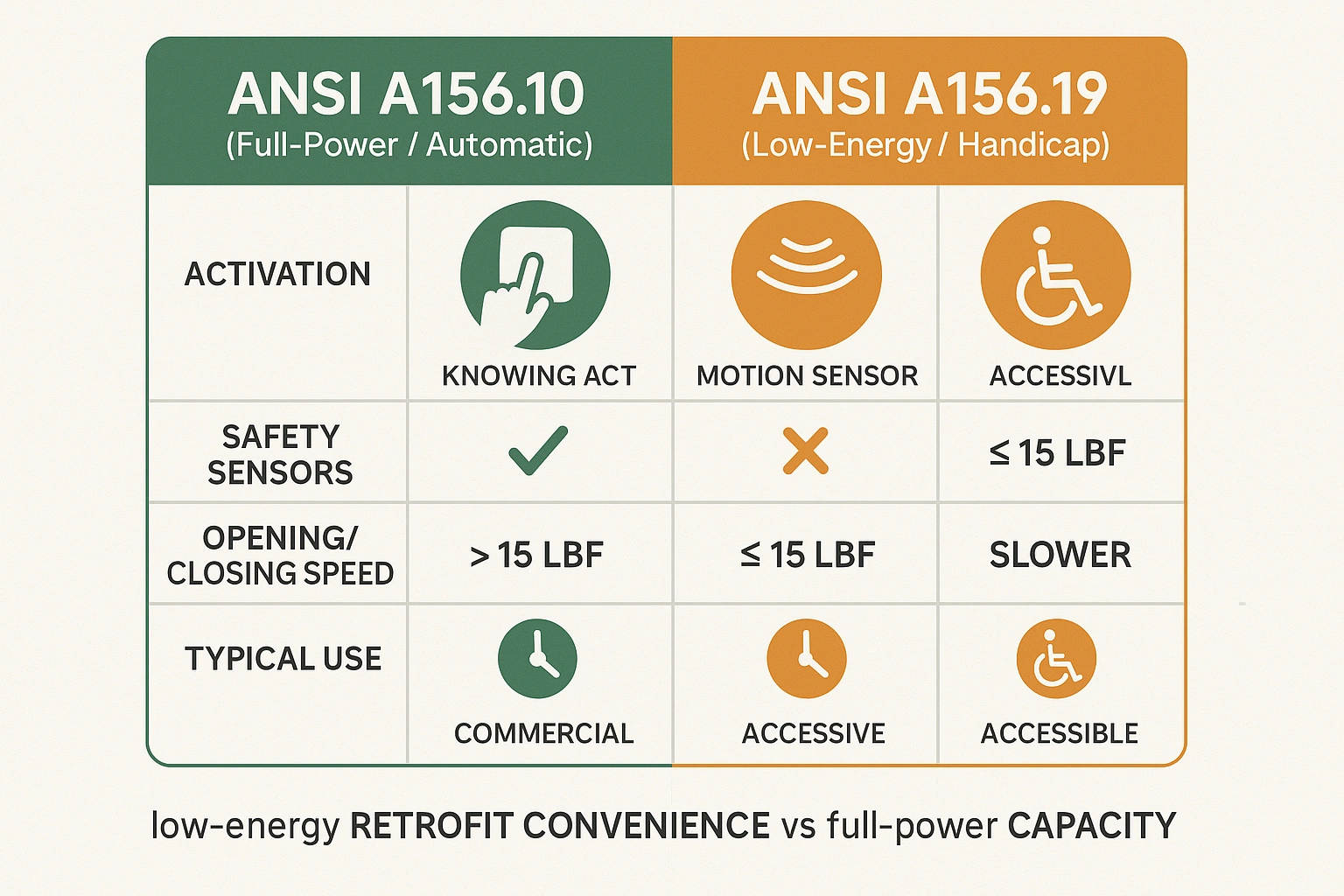
Requirement Parameter ANSI A156.19 (Low-Energy / Handicap) ANSI A156.10 (Full-Power / Automatic)
Typical Activation Knowing Act (Push plates, wave-to-open sensors) Automatic (Motion sensors, overhead detectors, pressure mats)
Safety Sensors Not required (if operating within slow speed/force limits) Mandatory presence sensors on swing/slide paths
Maximum Opening Force 15 lbf (67 N) to stop motion Varies, high force allowed; must instantly reverse on contact
Opening/Closing Speed Very slow (Min. 3s to open to 80°; Min. 4s to close) High speed allowed; depends on door weight
Primary Use Cases ADA-retrofitted office doors, restrooms, school entries Grocery stores, high-traffic hospitals, airport vestibules


ANSI A156.10 vs ANSI A156.19 ComparisonThis visual clarifies the fundamental differences between ANSI A156.10 full-power automatic doors and ANSI A156.19 low-energy handicap doors, helping facility managers quickly grasp which standard suits their modernization needs.


Fire-Rated Automatic Door Modernization (NFPA 80 & 101 Integration)


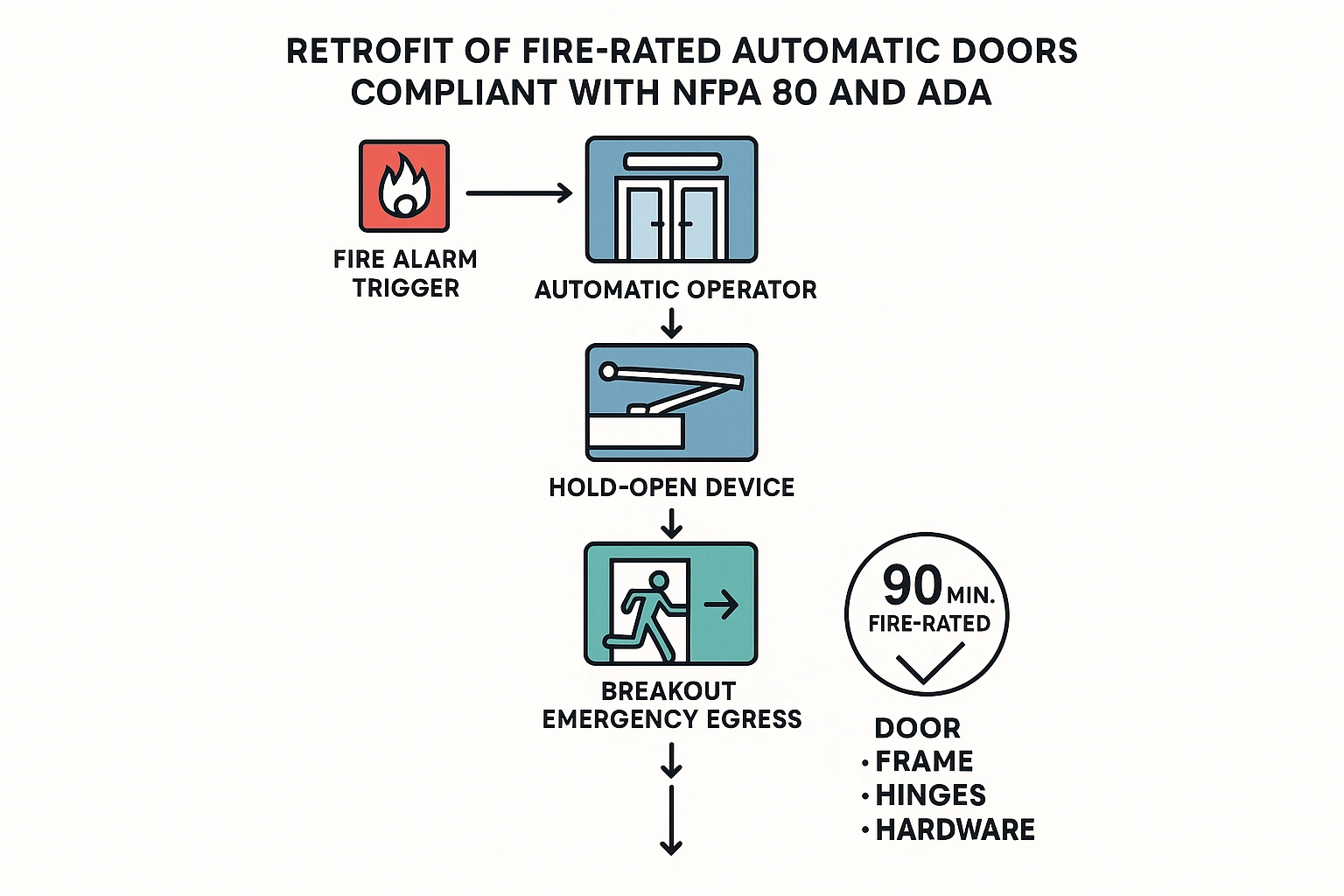
NFPA 80 & 101 Fire Sequence

Retrofitting automatic operators onto fire-rated doors introduces strict regulatory demands. Under NFPA 80 guidelines, if an automatic operator is installed on a fire-rated door, the operator, frame, hinges, latches, and sensors must all be certified to match the fire rating (typically 20, 45, 90, or 180 minutes). Mixing non-rated hardware onto a fire door instantly voids its certification.

The Auto-Close Fire Sequence

During a fire alarm event, a low-energy automatic operator must immediately deactivate its hold-open motor. This allows the mechanical closer spring to latch the door securely, maintaining the fire barrier.

Egress Breakout Requirements

Automatic sliding doors in emergency egress pathways must have a swing-out breakout mechanism. This mechanism must allow the door to be pushed open manually in the direction of travel, creating an immediate 32-inch clear opening.


Integrating Accessibility with Access Control


Modern entrances must combine accessibility with access control without compromising life safety codes.

  1. Sequencer Relay Setup: When a handicap push-button is pressed, the signal must route to a sequencer that unlocks the electric strike or magnetic lock before powering the operator motor. This delay prevents motor burnout and structural binding.
  2. Life-Safety Overrides: Card-access systems must cut power to electromagnetic locks during fire alarms (fail-safe operation) or power outages to prevent entrapment.

For these technical integrations, utilizing professional door services ensures your access systems operate safely and reliably.


Connecticut ADA & Automatic Door Upgrades


Connecticut enforcement introduces regional regulations that go beyond federal minimums.

  • Connecticut General Statutes § 29-270a: Mandates the installation of automatic doors for persons with physical disabilities in enclosed shopping malls or retail businesses exceeding 50,000 square feet of floor space.
  • 2022 Connecticut State Building Code (IBC Section 1105.1.1): Mandates that for high occupant loads (e.g., Group A assembly spaces > 300, Group M retail spaces > 500), at least 60% of required public entrances must be equipped with automatic doors.

Whether managing a retail footprint in Hartford or a corporate office in New Haven, partnering with a local specialist makes compliance straightforward. For professional updates in the capital region, choosing a dedicated provider for door installation hartford ct keeps your facility fully aligned with state mandates.


ADA-Compliant Signage & Testing Checklist


No modernization project is complete without compliant safety signage and routine testing.

  • “AUTOMATIC CAUTION DOOR” (yellow background, black lettering) is required for low-energy operators.
  • “ACTIVATE SWITCH TO OPERATE” labels must be visible on knowing-act push plates.

Daily Safety Check Routine:

  1. Inspect Activation: Test push-plates or sensors to ensure the door opens smoothly.
  2. Verify Safety Zones: Walk through the door swing path to confirm presence sensors prevent closure when a person is standing in the opening.
  3. Check Physical Condition: Verify all signage is securely attached and visible, and that the bottom kick plate remains free of obstructions.

Partner with Connecticut’s Compliance Experts


Navigating ADA, ANSI, and NFPA standards can be complex. Working with a1 door services ensures your modernization project is handled correctly from start to finish. Our team has over 15 years of experience delivering high-quality, reliable entrance solutions across Connecticut.

If you require expert commercial door repair near me or want to schedule a comprehensive AAADM compliance inspection, contact us today to secure and modernize your business entryways.

Frequently Asked Questions


Can we retrofit our existing manual commercial door into an automatic ADA-compliant door?

Yes. Most commercial wood, hollow metal, and aluminum storefront doors can be retrofitted with a low-energy operator (ANSI A156.19) and push-to-open switches. A technician will verify that the door frame, hinges, and structural mounting are sound enough to handle the automatic motion.

Does adding card reader security to our automatic doors violate fire safety codes?

Only if integrated incorrectly. When a fire alarm triggers, power to magnetic locks or electric strikes must disconnect automatically, allowing occupants to exit freely using simple manual force.

How often do automatic doors need to be inspected?

The Builders Hardware Manufacturers Association (BHMA) recommends annual inspections by an AAADM-certified technician. Daily visual checks should also be performed by your building maintenance team.