Selecting Commercial Automatic Doors for Facilities


Published: Aug 31, 2026

Choosing the right entryway is more than an aesthetic choice—it is a critical operational decision. For business owners, property managers, and developers, selecting the wrong entry configuration can lead to compliance violations, high energy bills, and costly construction bottlenecks, where project delays can average $1.6 million per day.

Whether you are designing a high-traffic retail storefront or researching the best automatic doors for hospitals, navigating the spatial limitations, local codes, and life-cycle durability ratings of different systems is essential to making an investment that lasts.

Hero Section & The Executive Decision Matrix


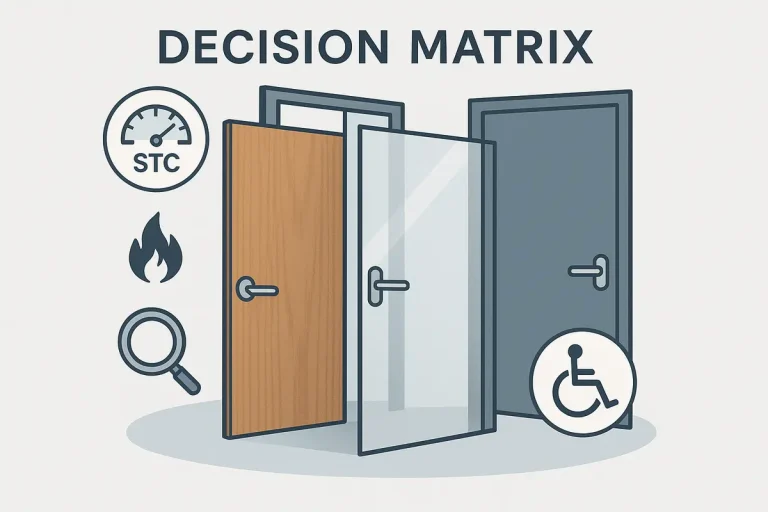
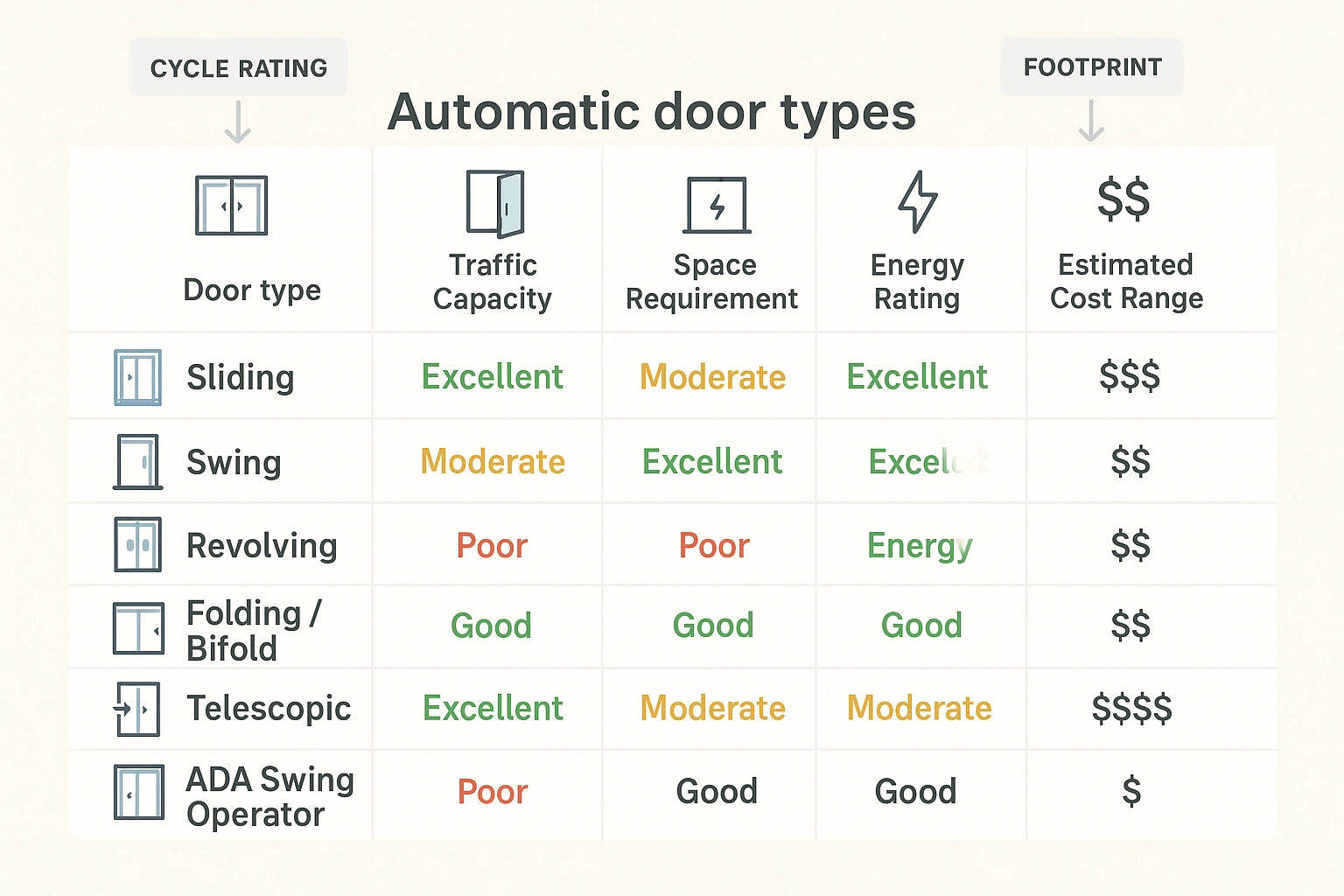
An at-a-glance comparison matrix of the six main automatic door types highlighting their traffic handling, spatial needs, energy efficiency, and typical costs to guide decision-making in commercial and residential contexts.

To make an informed choice, you must weigh multiple operational factors: foot traffic volume, physical space constraints, energy efficiency goals, and long-term capital expenditure .

Selecting the right system ensures your building operates seamlessly. If you need immediate assistance with an existing system, securing reliable commercial door service protects your investment from premature wear.


Types of Automatic Doors & Applications


Automatic Sliding Doors

The workhorse of commercial retail, sliding doors offer excellent bidirectional traffic flow. Available in single-slide or bi-parting configurations, these doors require adequate lateral wall space to receive the sliding panels. Commercial-grade automatic sliding systems are rated for 2,000,000+ open/close cycles, ensuring long-term reliability under heavy use. If your system begins to drag or fail, prompt automatic sliding door repair is vital to prevent building energy loss and maintain a smooth flow of customers.

Automatic Swing Doors

Ideal for directional corridors, executive offices, and narrow entryways, automatic swing doors require deep clearance to allow safe panel travel. These systems are frequently used to convert manual doors into accessible pathways.

Telescopic Automatic Doors

When lateral wall space is limited but high-volume traffic is expected, telescopic doors provide the ideal solution. By splitting sliding panels into multiple narrow interlocking leaves, they maximize the clear opening width in tight physical footprints.

Revolving Doors

For corporate headquarters and large public buildings, revolving doors serve as highly efficient airlocks. By preventing the “chimney effect” of wind tunnels, revolving doors maintain stable indoor pressure, saving up to 75,000 kilowatt-hours of energy annually and eliminating up to 14.6 tons of CO2 compared to standard double-swing doors.


Navigating Accessibility & Compliance: The ADA Framework


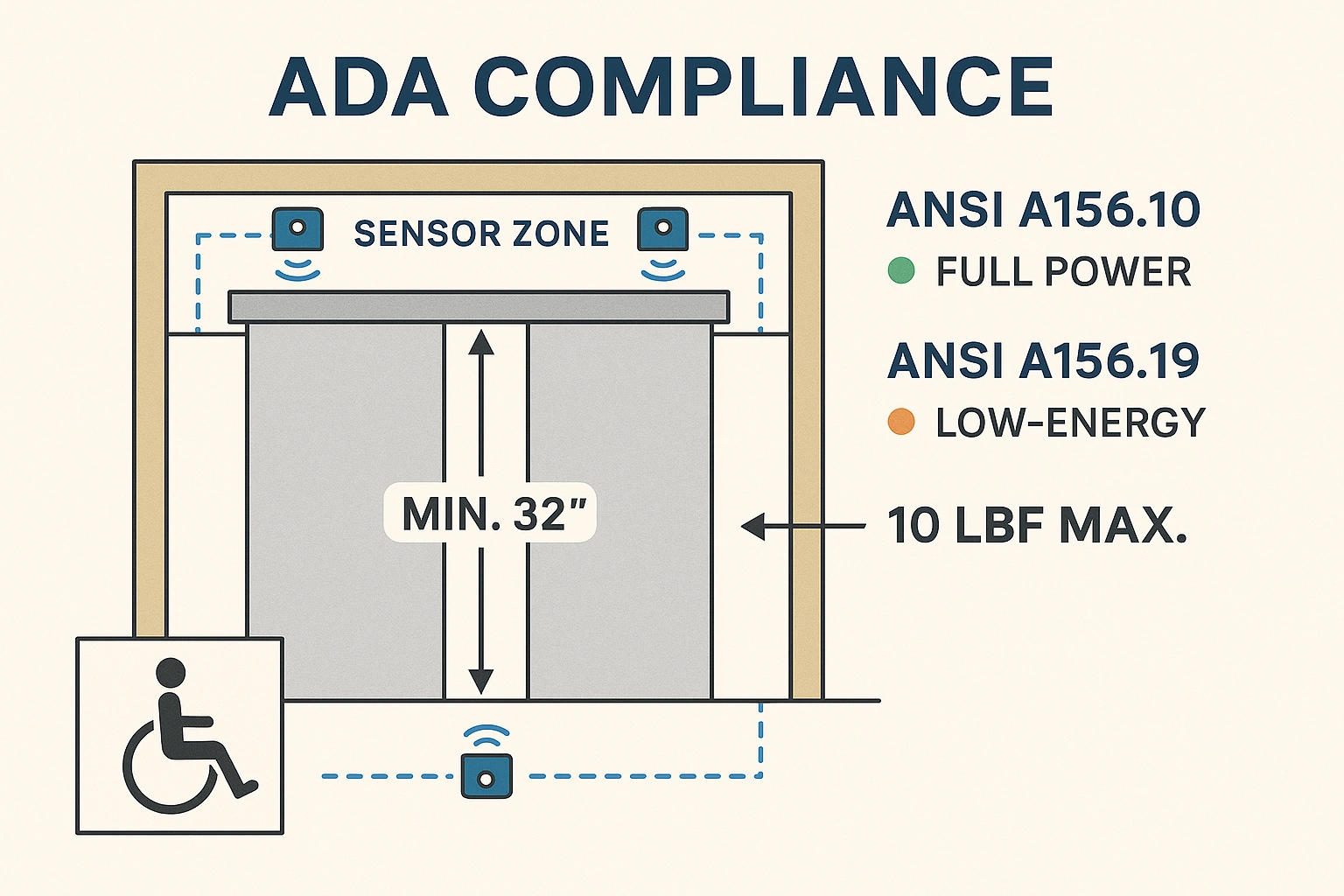
Visual guide to ADA standards for automatic doors, detailing minimum clearance widths, sensor zones, and force limits to ensure accessibility and regulatory compliance in commercial and public buildings.

Meeting accessibility standards is a key legal and operational priority for modern facilities. Commercial automatic doors must comply with specific American National Standards Institute (ANSI) guidelines:

  • ANSI A156.10 (Full Power): Applies to automatic doors triggered by sensors or mats, requiring comprehensive safety sensors to prevent contact with pedestrians.
  • ANSI A156.19 (Low Energy): Applies to power-assist doors activated by push-plates or wave sensors.

For commercial entrances, code requires a minimum clear opening width of 32 inches. Navigating these requirements demands precision. Partnering with professionals for ada door operator installation ensures your entryways meet these exact force tolerances and sensor zone guidelines.

These standards protect your business from liability while providing safe, barrier-free access for all visitors, including those seeking residential upgrades like handicap-accessible storm doors.


The Real Costs of Commercial Automatic Doors


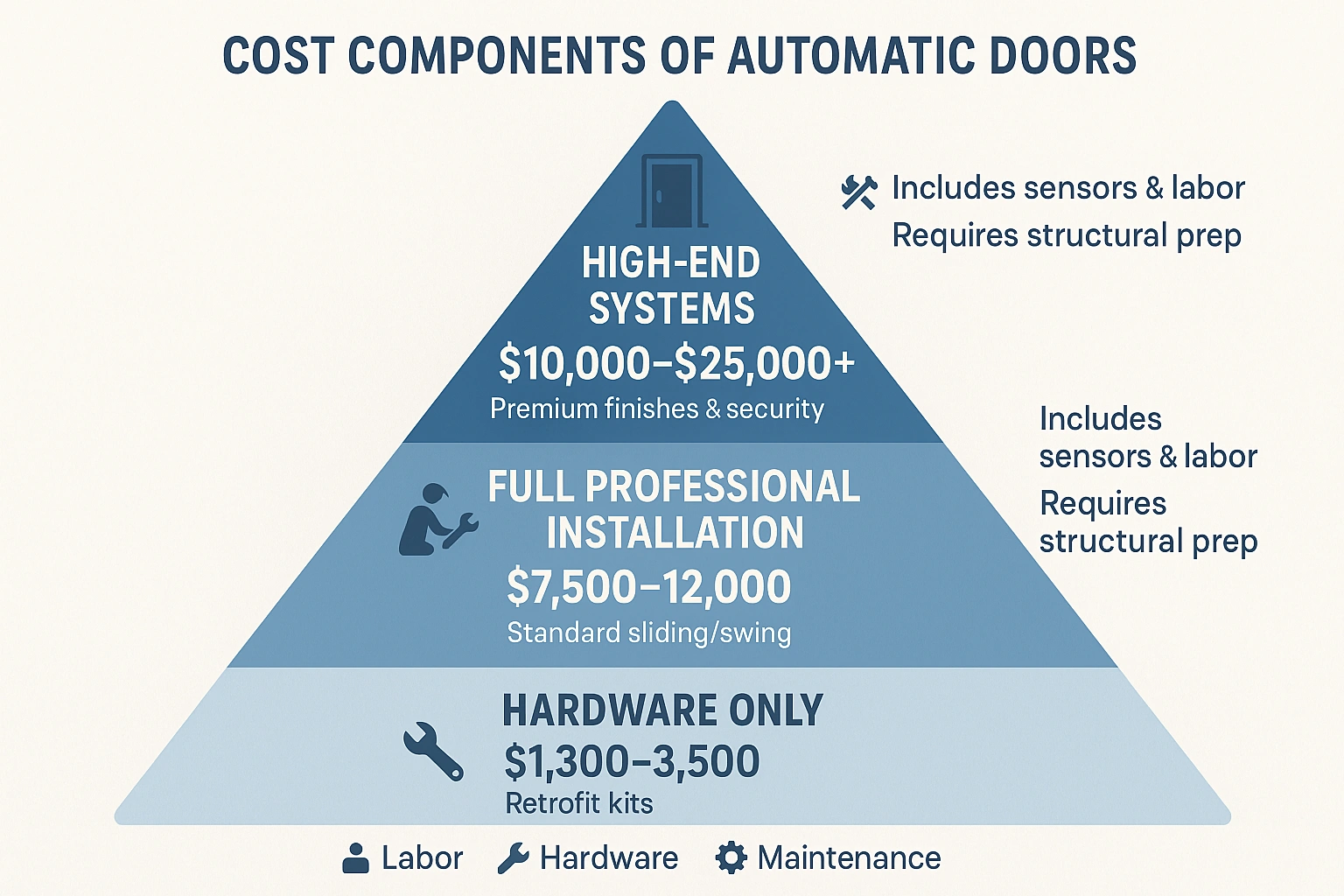
A layered cost breakdown infographic presenting transparent price ranges for automating existing doors, full installation services, and high-end commercial systems to demystify investment decisions.

Budgeting for an automatic door involves balancing initial capital hardware expenditures with professional installation and ongoing maintenance:

Retrofit vs. Full Installation

  • Retrofit Kits ($1,300 – $3,500): A budget-friendly option to automate an existing door frame using a low-energy operator.
  • ADA Swing Operator Hardware ($1,190.48 – $2,380.95): Hardware-only pricing for upgrading single door frames.
  • Full Professional Installation ($7,500 – $12,000): Covers new structural framing, glass sliding assemblies, sensors, and labor.

To keep these systems running efficiently, scheduling a periodic commercial door inspection helps prevent wear on safety sensors and drive motors. If a collision or alignment issue occurs, a rapid storefront door service keeps your entryway secure and operational.


Industry-Specific Selection Blueprints


  • Healthcare & Hospitals: Cleanliness and accessibility are paramount. Touchless wave-to-open sensors, wide breakaway clearances for ICU beds, and positive-pressure seals for sterile spaces make automatic sliding doors the gold standard here.
  • Retail & Grocery Storefronts: High-traffic sliding doors with heavy-duty safety sensors and cart-impact guards keep customer traffic moving smoothly.
  • Corporate & Hospitality: Grand revolving doors are the ideal choice to make a strong architectural impression while lowering HVAC costs.
  • Industrial Facilities: Heavy-duty, high-speed automated roll-up or sliding systems keep forklifts and materials moving safely.

Secure Your Entryway Investment with Local Experts


At A1 Doors Services, we believe every entrance should combine safety, convenience, and long-term durability. Serving commercial and residential clients across Connecticut for over 15 years, our family-owned business brings a highly personal approach, fair pricing, and fully licensed technicians to every project.

Whether you need a brand-new automatic door installation, a compliance upgrade, or rapid same-day repairs, our team is here to help. Contact us today for a professional consultation and secure your building’s entrance.

Frequently Asked Questions


Can I retrofit an existing manual door to make it automatic?

Yes. Using a low-energy operator kit, standard manual doors can be retrofitted to meet ADA compliance without replacing the entire frame.

How often do commercial automatic doors require maintenance?

To comply with ANSI standards, automatic doors should undergo professional safety inspections at least once a year by AAADM-certified technicians.

What is the lifespan of a commercial automatic door?

With routine preventive maintenance, a high-quality commercial automatic door system regularly lasts over 10 to 15 years, easily exceeding 2,000,000 opening cycles.