(855) 676-0881

Commercial Steel Door Repair: Frost and Condensation on Hollow Metal Doors


Published: Nov 17, 2026

When sub-zero winter temperatures hit, commercial facility managers often face a persistent and hazardous issue: sweating or frosted hollow metal doors. Moisture pooling at emergency exits creates immediate slip-and-fall liabilities, while perimeter ice can jam panic hardware, violate exit codes, and accelerate internal frame corrosion.

Resolving this requires moving past generic humidity advice and addressing the thermal dynamics of hollow metal assemblies.

The Physics of Sweating and Frosted Steel Doors


Structural carbon steel conducts heat rapidly at approximately 50 W/m·K—over 300 times faster than wood or polyurethane foam. Without internal thermal breaks, an exterior steel door face acts as a massive heat sink, transferring interior heat outward until the inside steel skin drops below the dew point temperature ($T_{dp}$).

At a standard interior room temperature of 70°F (21°C) and 40% relative humidity (RH), moisture condenses on any surface at or below 44.6°F (7°C). When outdoor temperatures plunge to 10°F (-12°C), uninsulated steel door faces easily drop below 32°F (0°C), causing accumulated moisture to freeze instantly into thick frost.
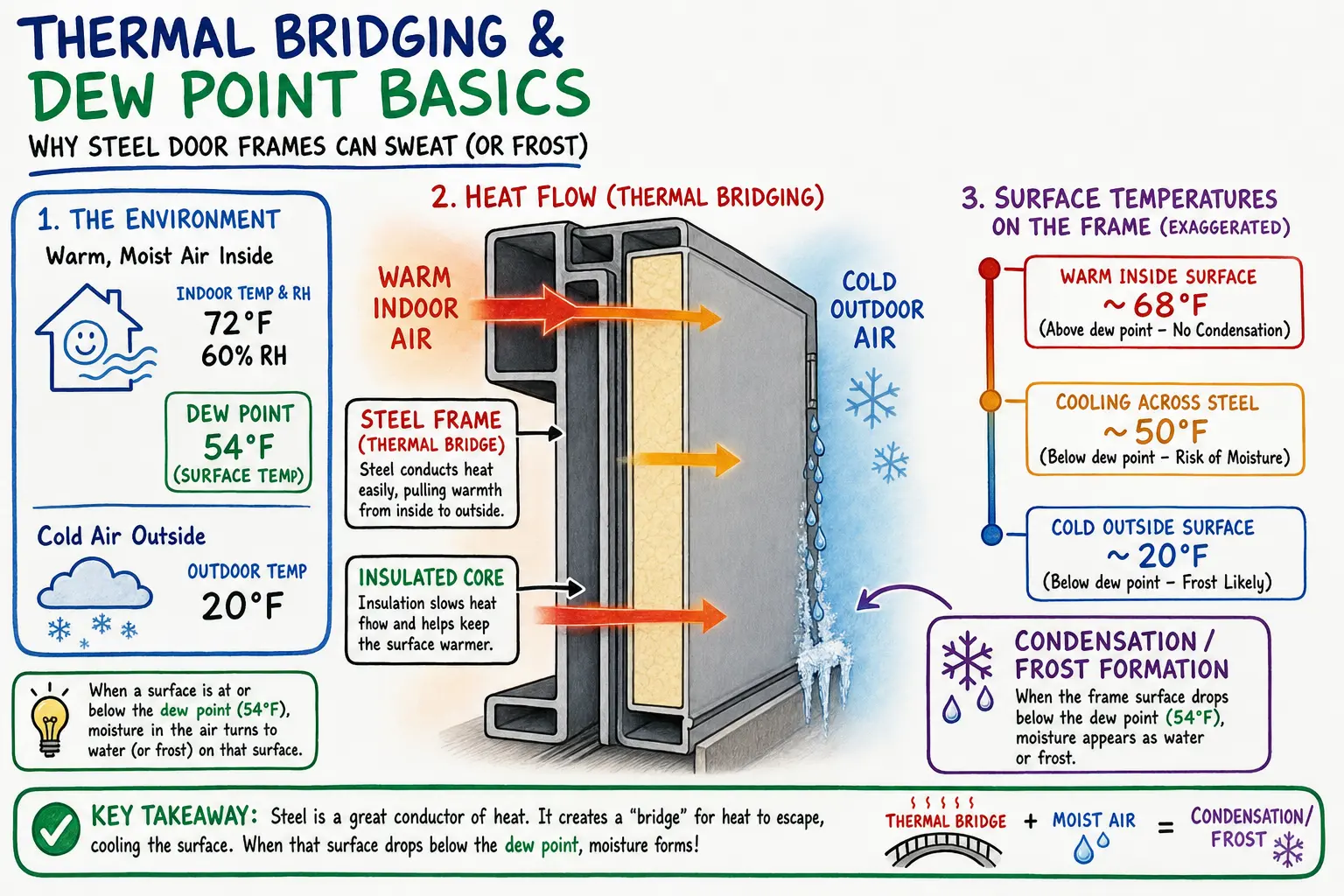
This visual demonstrates how steel's high thermal conductivity creates cold surfaces where condensation forms once indoor humidity meets or exceeds the dew point, leading to frost on hollow metal doors.

Thermal performance varies dramatically based on core insulation and frame construction:

  • Honeycomb Core (Uninsulated): R-1.0 to R-1.2 thermal resistance; U-factor 0.58–0.65.
  • Polystyrene (EPS) Core: R-3.8 to R-6.5 thermal resistance; U-factor 0.35–0.45.
  • Polyurethane (PUR) Core: R-9.0 to R-11.0 thermal resistance; U-factor 0.12–0.24.
  • Uninsulated Steel Frame: Adds a thermal bridge penalty of +0.20 to the overall assembly U-factor.

Additionally, negative building pressure pulls freezing outside air through microscopic frame gaps, instantly freezing localized moisture around locksets and jambs.

Need a Quick Fix?

Tell us what’s wrong with your door — we’ll get it sorted.

Step-by-Step Diagnostic Inspection Protocol


Before committing capital to door replacement, systematically diagnose where heat loss occurs across the assembly.

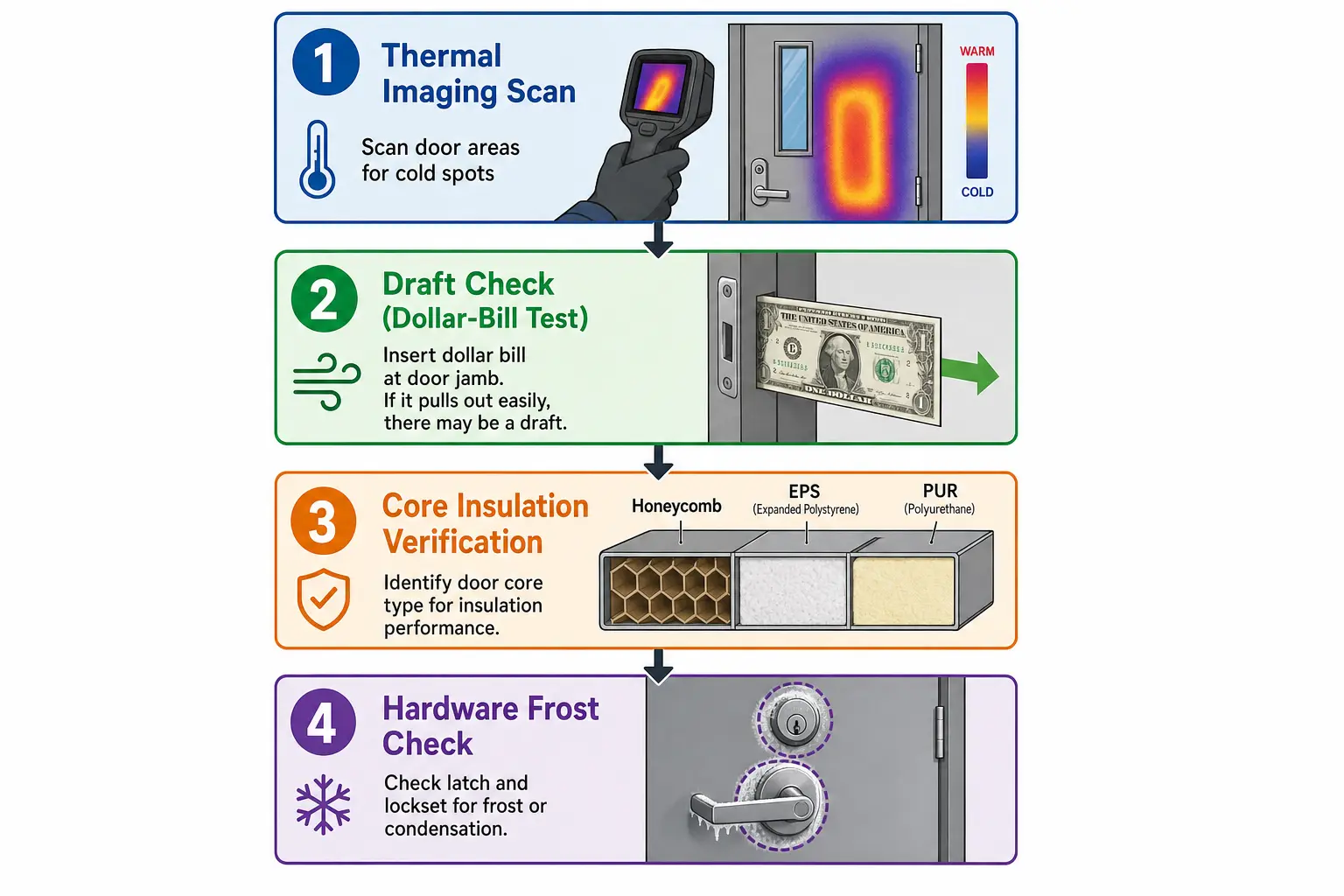
Follow this stepwise visual guide to systematically diagnose frost and condensation issues on commercial hollow metal doors, empowering precise problem identification before repair.

  1. Infrared Thermal Imaging: Scan the door leaf, frame, lockset, and threshold. Widespread frame cold spots indicate missing cavity insulation, while cold lines along perimeter edges highlight failing weather seals.
  2. Perimeter Air Leakage Test: Perform a clearance check along the head, jambs, and threshold using a thickness gauge or draft paper. Inspect swept perimeter seals for rubber hardening or alignment tears.
  3. Core & Pressure Audit: Check if interior RH exceeds 35–40% in vestibules and verify building pressure balance. When latches freeze shut overnight, emergency dispatch for 24 hour commercial door repair is required to maintain life safety.

Commercial Repair and Retrofit Playbook


If structural components remain sound, targeted retrofits often resolve thermal failure without full door replacement:

  • Frame Cavity Foam Injection: Drill low-profile ports in uninsulated steel jambs and inject low-expansion closed-cell polyurethane foam to eliminate internal thermal bridging.
  • Heavy-Duty Thermal Seals & Thresholds: Replace worn vinyl seals with commercial magnetic weatherstripping and install thermal-break thresholds featuring internal vinyl barriers.
  • Preventative Maintenance Compliance: Ensure door seals, latching hardware, and egress mechanisms pass annual facility audits per standard commercial door inspection requirements.

The MOFU Decision Framework: Repair vs. Retrofit vs. Replace


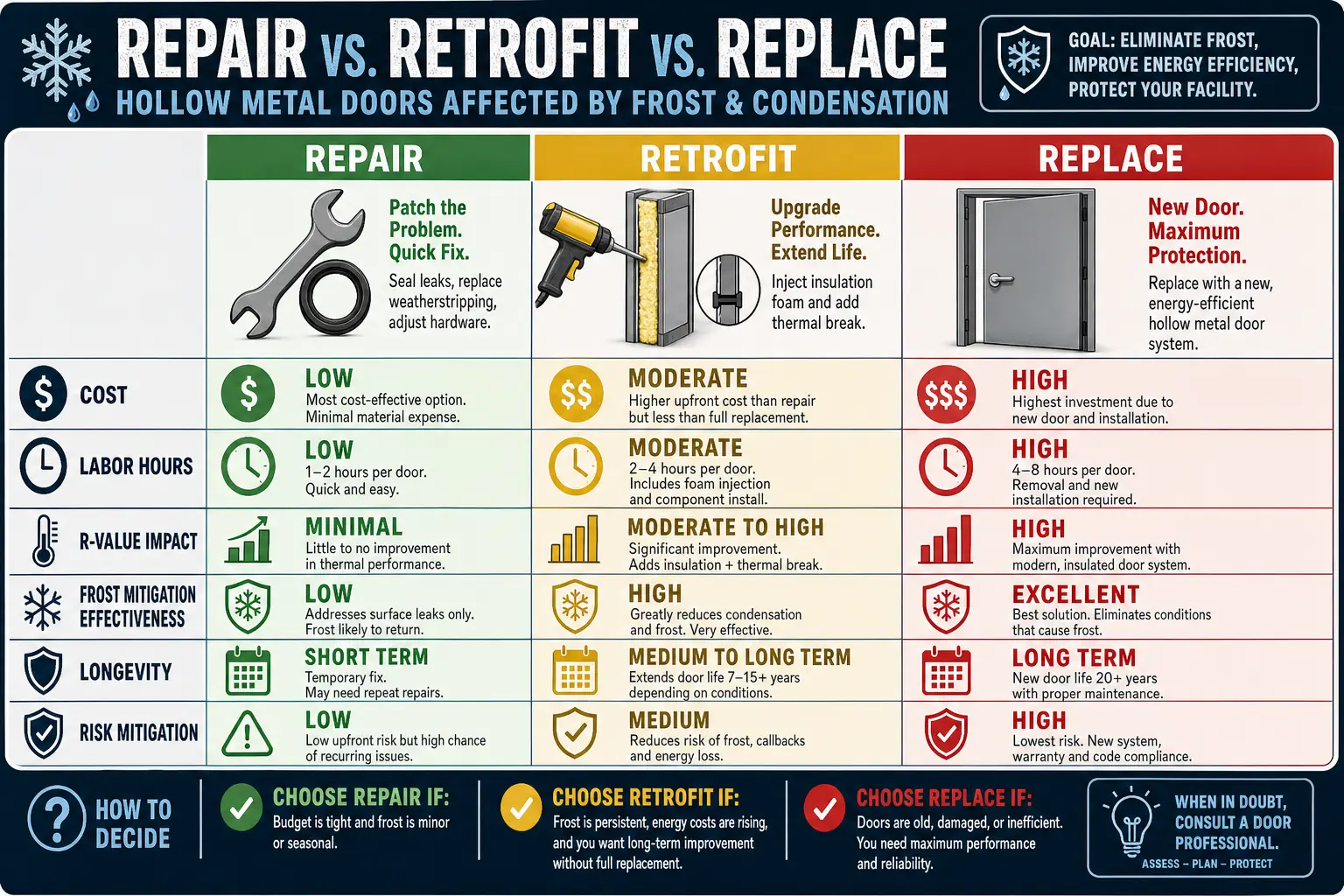
Determining whether to repair, thermally retrofit, or fully replace an assembly depends on structural integrity, R-value targets, and operating risks.

This matrix helps facility managers quickly compare and recall the trade-offs between repairing, retrofitting, or replacing frost-affected hollow metal doors based on cost, performance, and long-term risk management.

Evaluation Matrix

Metric / Criteria Option A: Repair (Seals & Hardware) Option B: Retrofit (Foam & Thermal Breaks) Option C: Full Replacement
Primary Use Case Worn perimeter seals, localized air leaks Uninsulated sound frame, sweating jambs Delaminated core, severe rust, uninsulated honeycomb
Thermal Gain Restores initial seal rating Increases frame thermal break ($R+4$ to $R+8$) Maximum thermal efficiency ($U < 0.24$, $CRF > 55$)
CapEx Impact Low Moderate High
Operational Lifespan 2–5 years 7–10 years 15–20+ years

When severe skin delamination or deep frame corrosion compromises structural integrity, full replacement using SDI-113 compliant, thermally broken assemblies is the only compliant path forward. Partnering with a licensed expert for commercial door repair near me ensures correct NFRC 102 thermal compliance and code-adherent installation.

Frequently Asked Questions


Why is frost accumulating only around the edge frame of our steel door?

Because structural steel conducts heat rapidly, uninsulated steel frame jambs act as a thermal bridge. Cold exterior temperatures transfer directly through the frame, dropping the interior surface temperature below 32°F and causing escaping humid interior air to freeze at the jamb edges.

Can expanding foam insulation be injected directly into existing hollow metal door frames?

Yes, provided technicians use low-expansion closed-cell polyurethane foam specifically formulated for commercial hollow metal frames. Standard high-expansion foam can bow or deform steel jambs, preventing proper door closure and latching.

How does building pressure affect commercial door condensation?

Negative pressure inside a building acts like a vacuum, pulling freezing outside air through perimeter door gaps. This micro-draft rapidly lowers nearby steel skin temperatures to the dew point, accelerating frost formation around locks and jambs.