Stop Paying for Emergency Repairs: A Cycle-Based Maintenance Schedule for Commercial Doors


Published: Aug 10, 2026

When a commercial door malfunctions, it is never just a mechanical issue. It is a sudden bottleneck in your daily operations, a security vulnerability, and a potential liability hazard. For facility managers and business owners, keeping entrances compliant and operational is a constant balancing act. Unplanned downtime can stall supply chains, while an overlooked code violation can result in immediate civil penalties ranging from $500 to $5,000 per violation under NFPA 80 standards.

Protecting your facility requires shifting from reactive repairs to an structured, data-driven preventative maintenance framework.

The Multi-Silo Preventative Maintenance Framework


A successful preventative maintenance strategy organizes tasks by operational frequency. Instead of treating commercial doors as static barriers, facility teams must monitor them as dynamic mechanical and electrical systems.

System Type Monthly Quarterly Annual
Storefront Doors Sweep speed test Pivot check Seal swap
Overhead Doors Balance test Roller lube Spring audit
Fire-Rated Doors Egress test Clearance audit Drop test*
Access Control Reader wipe-down Backup battery test Log audit


High-Traffic Storefront Doors: Glass, Aluminum, and ADA Compliance


Your storefront is your business’s first impression and its most frequent point of contact. To prevent costly commercial storefront door repair emergencies, you must monitor both structural integrity and strict ADA guidelines.

Meeting ADA Standards

Under ADA Section 404.2.9, interior doors must require no more than 5 pounds-force (lbf) to open. For exterior doors, typical municipal standards allow between 8.5 to 10 lbf. Additionally, ADA Section 404.2.8 dictates that a door closer must take at least 5 seconds to swing closed from a 90-degree open position to a 12-degree point.

Servicing Closer Hardware

When a closer fails, it often displays a slow closing cycle or leaks hydraulic fluid around the O-ring seals. A leaking closer cannot be refilled in the field; it represents an internal seal failure that demands professional door closer services to replace the unit entirely.

Protecting Aluminum Finishes

Protect storefront metal by cleaning anodized aluminum surfaces using a mild, pH-neutral soapy water solution. Avoid ammonia, acid-based cleaners, or abrasive steel wool, which strip away protective coatings and accelerate corrosion from road salt and moisture.


Overhead & Industrial Doors: Maximizing System Longevity


Industrial overhead doors handle immense physical stress. To ensure continuous operation, facilities need a trusted local garage door service near me to handle complex high-tension systems safely.

  • Understanding Torsion Springs: Standard commercial overhead springs are rated for 10,000 cycles. In a high-volume warehouse operating 20 cycles daily, these springs will snap in under 18 months. Upgrading to 25,000, 50,000, or 100,000 high-cycle springs drastically reduces downtime. Warning: Torsion springs hold extreme mechanical energy and should never be adjusted by in-house personnel.
  • The Emergency Release Balance Test: Safely disconnect the trolley operator and manually raise the door to a half-open state. It should remain stationary. If it falls or feels heavy, the springs are fatigued.
  • Auto-Reverse Security: Test photo-eye sensors and mechanical bottom-edges weekly. If a door fails to reverse immediately upon contact with an obstacle, take the system offline to avoid injury or vehicle damage.

For structural issues or complete retrofits, investing in professional commercial door repair keeps your logistics pathway clear.


Maintaining Fire-Rated Doors: Surviving the Annual NFPA 80 Inspection


A staggering 75% to 76% of inspected fire doors fail to meet regulatory standards. For new construction, the failure rate is still 40% due to poor installation and lack of maintenance.

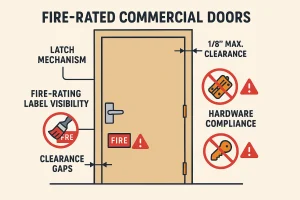
A clear visual decision framework for fire-rated doors To pass inspection, watch for these critical fire door failure points:
  1. Improper Clearances: NFPA 80 mandates clearances must not exceed 1/8″ for wood doors or 3/16″ for hollow metal doors.
  2. Unapproved Hardware Modifications: Painting over UL/FM fire-rating labels invalidates compliance instantly.
  3. Latching Failures: Fire doors must latch securely on every single swing. If your exits feature emergency egress hardware, professional panic bar installation and repair is required to ensure positive latching and swift evacuation during emergencies.

Commercial Access Control Integration: Routine Hardware & Electromechanical Checks


Modern security relies on physical doors integrated with digital networks. If the mechanical lock fails, the entire security system is compromised.

  • NFPA 101 Life Safety Compliance: Ensure electromechanical components like magnetic locks (maglocks) and electric strikes fail-safe (unlocking automatically) during fire alarm activation or power outages to allow unhindered egress.
  • Hardware and Battery Audits: Test backup batteries quarterly to avoid system lockouts during local power failures. Wipe down magnetic strike plates and readers to remove grime that hinders latching and card communication.

Repair vs. Replace Matrix (The Decision Framework)


Visual guide to the top three fire door failure points and NFPA 80 compliance criteria.

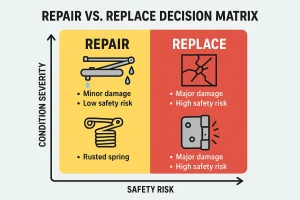
Deciding whether to patch a component or invest in replacement depends on safety, wear, and structural stability.

  • Repair: Minor alignment issues, surface rust, squeaking rollers, or doors requiring simple speed adjustments.
  • Replace: Structural frame sagging, deep stress cracks in storefront glass, leaking hydraulic fluid from closers, or fire doors with clearance gaps exceeding 3/16″.

Secure Your Business Continuity Today


Don’t wait for a door failure to disrupt your business operations, trigger a fine, or compromise security. Contact A1 Doors Services today to schedule a comprehensive, professional commercial door audit and build a reliable preventative maintenance plan for your facility.

Frequently Asked Questions


How often do commercial fire doors need inspections?

NFPA 80 mandates inspections at least once every 12 months. Any failed components must be addressed immediately to avoid code violation fines.

Can our in-house maintenance team adjust commercial overhead door springs?

No. Due to the extreme tension in commercial torsion systems, adjusting or replacing springs without specialized training and tools poses severe risks of serious injury. Always call a licensed technician.

Why is our storefront door slamming even after adjusting the closing speed?

If a door slams despite adjustments, the hydraulic fluid has likely leaked through failing internal O-rings. The entire closer unit must be replaced.