

Revolving Door Repair and Service
Revolving doors are the least common commercial entrance and the one fewest contractors will take on. A1 Door Services repairs, services, installs and replaces manual, automatic and security revolving doors across Texas, Connecticut and Alabama. They are also the entrance with the most safety-relevant moving parts. A revolving door has four separate sensor families, a speed limit tied to its diameter, and a breakout requirement that decides whether it counts toward the building's egress at all — none of which apply to any other door type.
 (855) 676-0881
Get in touch with us
Call us 24/7: (855) 676-0881
Or Let Us Call You
Revolving Door Types We Service
Manual revolving doors
Push-operated three- and four-wing doors, where speed control, wing seals, bearings and the collapsing mechanism are the service points.
Automatic revolving doors
Power-operated doors that turn on approach, with canopy or ring drives, speed regulation and a full sensor package covering the drum and the entry points.
Security revolving doors
Doors with anti-piggyback and anti-tailgating detection, usually integrated with the building’s access control and credential system.
Large-diameter and showcase doors
Monumental and two-storey doors, and showcase doors with a display in the centre shaft, where the drive and structure are heavier and the service interval shorter.
Drive and Mechanical Repair
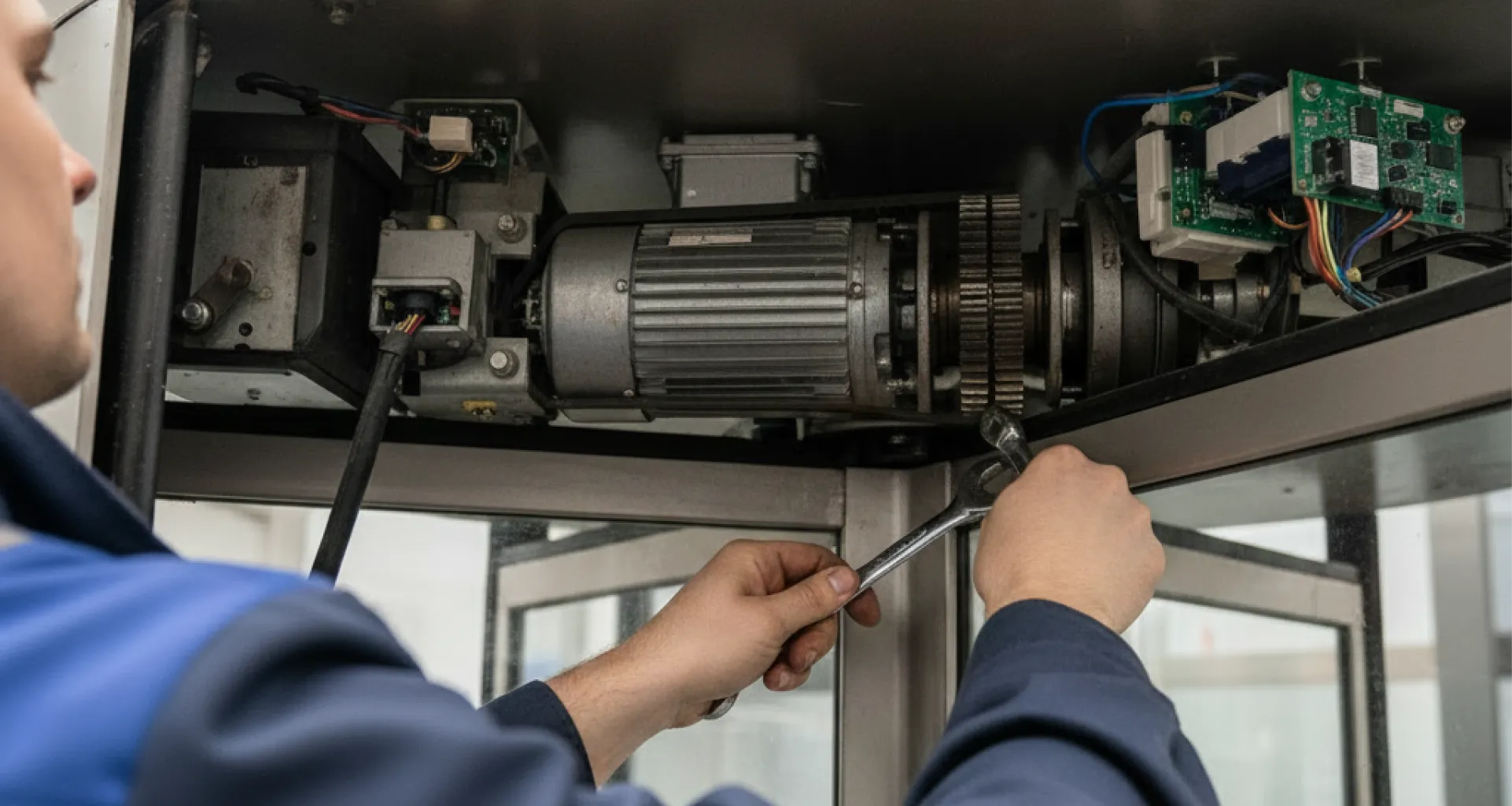
We service canopy and ring drives, motors and gearboxes, the centre shaft and bearings, speed control and the night lock. Noise, vibration, uneven rotation and a door that will not hold its set speed all come from this group of components.
Bearings and the drive ring take the whole weight of the assembly and wear silently until they do not. Where a door has developed a rumble or a stiff quadrant, that is usually where it is coming from.
Wing seals, sweeps, glass and the bottom rail are replaced during the same visit where they have worn or been damaged, because a revolving door with failed seals loses the wind and stack pressure control it was installed to provide.

Speed and Breakout Checks
Revolving doors have a maximum rotation speed tied to their diameter, and a breakout force that has to be met if the door forms part of the escape route. Both drift over time — the drive loses regulation and the breakout mechanism stiffens with age and dirt.
We verify rotation speed against the door’s diameter, test breakout force on each wing individually, and adjust the drive and the breakout mechanism back into range. The slow-speed control is tested at the same time, because that is the button someone who needs longer will actually press.
The Four Sensor Groups
A revolving door has four distinct sensor families, and a fault in any one of them stops the door or leaves it unsafe: wing sensors along the leading edge of each wing, end-wall sensors at the drum wall, bottom-rail guard sensors along the floor edge, and entry-point sensors that detect someone approaching or standing in the entrance.
Each group is tested and re-aimed separately. A revolving door that stops repeatedly for no visible reason almost always has one of these misaligned, contaminated or failing — and because the four groups look similar to anyone who is not servicing them regularly, the wrong one gets replaced surprisingly often.
Glass, Wing and Enclosure Repair
Revolving door glass is large, curved in the case of the drum, and heavy to handle. We replace wing glass and curved drum glass, repair and replace wing frames, rails and seals, and correct wings that have dropped or twisted out of alignment.
Enclosure work also covers the canopy trim, the ceiling assembly and the lighting inside the drum, which is usually the first thing anyone notices when it fails.

Revolving Door Installation and Replacement
New revolving entrances are installed complete — drum, wings, drive, controls and the full sensor package — and set to the speed and breakout figures their diameter and egress role require. Structural coordination happens early, because a revolving door carries load and needs a prepared opening.
Existing doors are replaced where the drive is obsolete or the enclosure is beyond repair, and older manual doors are converted to automatic operation where the building’s traffic has changed. Replacement is normally staged overnight, with the adjacent entrance carrying traffic in the meantime.

Scheduled Maintenance for Revolving Doors
Revolving doors reward a schedule more than most entrances, because their failures are gradual and their safety systems are invisible until they are tested. A quarterly or semi-annual interval is normal for a lobby door in continuous use.
Each visit covers rotation speed, breakout force on every wing, all four sensor groups, drive and bearing condition, seal compression, night lock function and the slow-speed control, plus the annual safety inspection folded into one visit each year.
Night Locking and Out-of-Hours Operation
Most revolving doors are locked or parked out of hours, and the night lock is one of the components most likely to be quietly failing. A door that will not lock at closing is a security problem; a door that will not release in the morning is a trading one.
We service and replace night locks, park positions and the controls that switch the door between day, night and slow-speed modes, and test the sequence in both directions rather than only the one the building uses most.
Revolving Doors in a Building's Wider Door Schedule
A revolving door is almost never the only entrance in a building. It sits alongside sliding entrances, swing operators, security doors and back-of-house openings, and it is usually the one nobody has a service arrangement for.
We cover the revolving door and everything around it on the same schedule and the same visit, which avoids the common situation where the lobby’s most complicated entrance is the only one that has never been inspected.

Common Revolving Door Complaints
Doors that stop repeatedly and restart on their own, which is almost always a sensor group rather than the drive. Doors that have become noisy or feel rough through one quadrant, which points to bearings, the drive ring or a dropped wing. Doors that have slowed, which is speed regulation.
Others are structural: wings that catch on the drum, seals that have hardened and are dragging, glass that has slipped in its frame, or a night lock that no longer engages cleanly. All of them are serviceable, and all of them get worse if the door is simply switched off and left.
Service Areas
Texas — Austin, Cedar Park, Cypress, Richardson, McKinney, Sherman, Paris. Connecticut — Hartford, New Haven, Danbury, Greenwich. Alabama — Birmingham.
Tell us the door diameter, type and what it is doing, and we will bring the right parts and the right test equipment.
Our Services

Frequently Asked Questions
How fast is a revolving door allowed to turn?
Maximum speed depends on the door’s diameter and whether it is manual or powered. We verify it against the diameter rather than setting it by feel.
Why does my revolving door keep stopping?
Almost always one of the four sensor groups — wing, end-wall, bottom-rail or entry-point — has drifted, been knocked or failed. Each is tested separately.
What is the slow-speed button for?
It reduces rotation speed for anyone who needs longer to pass through. It should work every time it is pressed, and it is checked at every service visit.
Can a revolving door be part of the accessible route?
No. An adjacent swing or sliding door provides accessible access, and it needs to be serviced alongside the revolving door.
Do you service revolving doors you did not install?
Yes, including manual, automatic and security doors from every major manufacturer and older systems no longer in production.
Can a manual revolving door be converted to automatic?
In many cases yes, depending on the drum, the shaft and the structure above it. The survey confirms whether the existing assembly can carry a drive.
How often should a revolving door be serviced?
A lobby door in continuous use is normally quarterly or semi-annual, with the annual safety inspection folded into one of those visits.