

Commercial Automatic Sliding Door Repair and Install
Automatic sliding doors carry more traffic than any other commercial entrance, and they wear accordingly. A1 Door Services repairs, replaces, installs and maintains sliding entrances across Texas, Connecticut and Alabama - every configuration, every major make, including systems that are no longer manufactured. Sliding systems fail in a small number of predictable ways, and most of them are inside the header. Getting the diagnosis right at the door is what keeps an automatic sliding door repair to a single visit instead of a sequence of return appointments.
 (855) 676-0881
Get in touch with us
Call us 24/7: (855) 676-0881
Or Let Us Call You
Sliding Door Configurations We Work On
Configuration decides almost everything about how a sliding entrance performs — how fast it clears, how wide the opening is, and how much wall it needs on either side.
Single-slide
One active panel sliding past a fixed sidelite. The standard fit for narrower openings and lower traffic, and the configuration most often outgrown when a building’s traffic increases.
Bi-parting
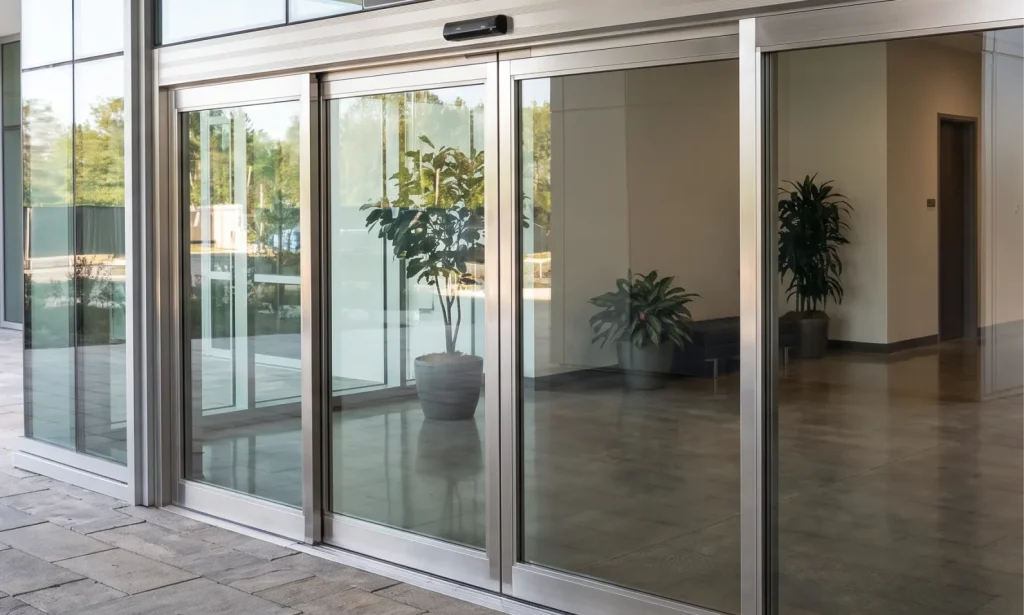
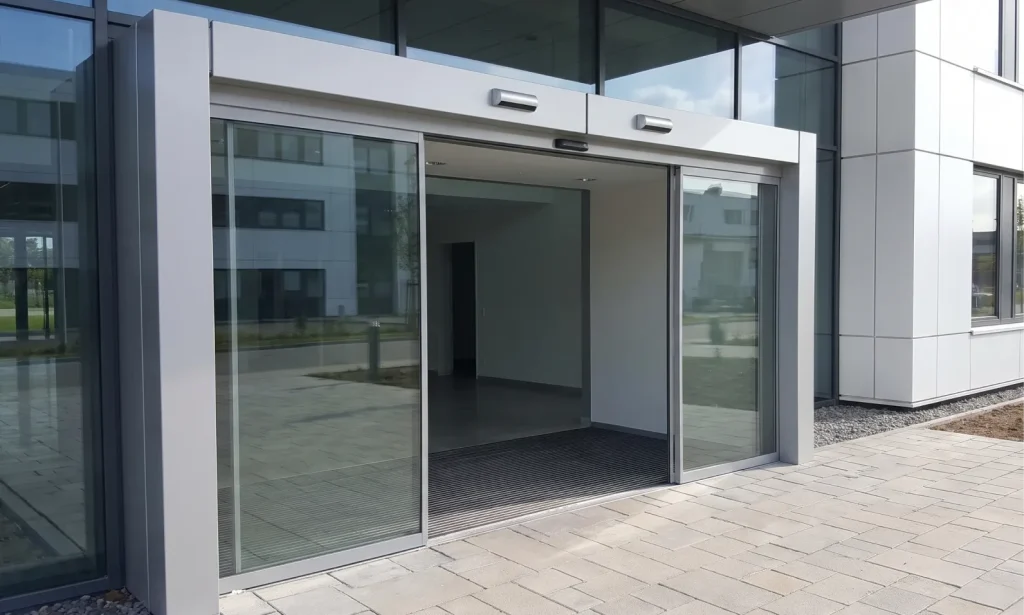
Two active panels opening from the centre. The most common configuration on retail, healthcare and office entrances, and the fastest way to clear a wide opening.
Telescopic
Two or three panels per side stacking behind each other. Used where the opening needs a wide clear width but the wall space for a standard bi-part is not available.
Breakout and non-breakout
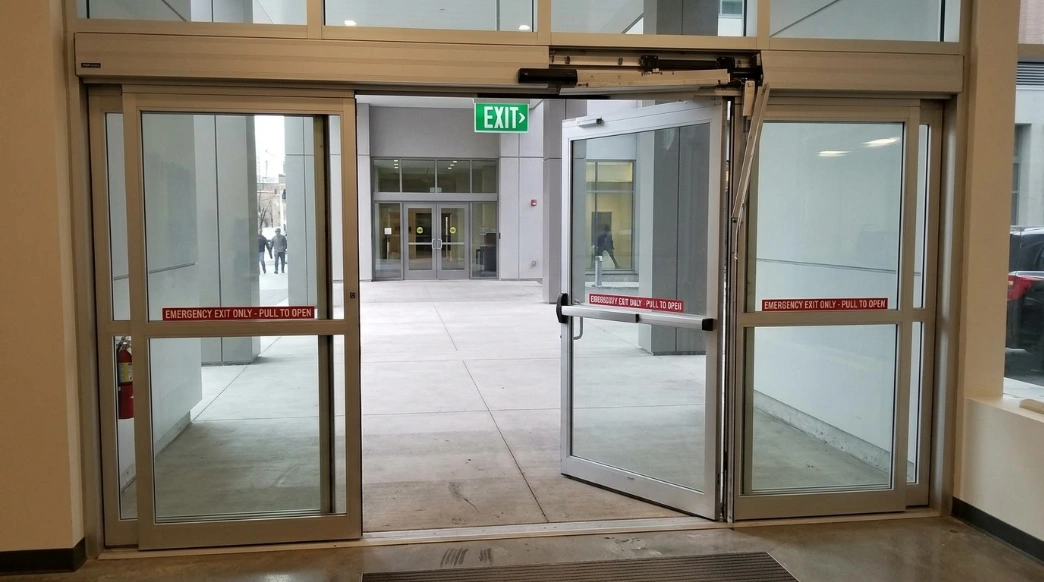
Breakout panels swing out of the opening under force to provide egress. Breakout force and operation are checked as part of any sliding door service, and restored where the mechanism has stiffened.
All-glass and specialty sliders
Frameless and all-glass systems, thermally broken and cold-climate entrances, hurricane and impact-rated sliders, and freezer and cooler doors.
Automatic Sliding Door Repair
Most sliding faults originate in the header. Drive belts stretch and slip, motors and gearboxes lose torque under load, carriers and hanger rollers flatten and seize, anti-riser rollers wear and let the panel lift, and the encoder or limits lose track of where the door is.
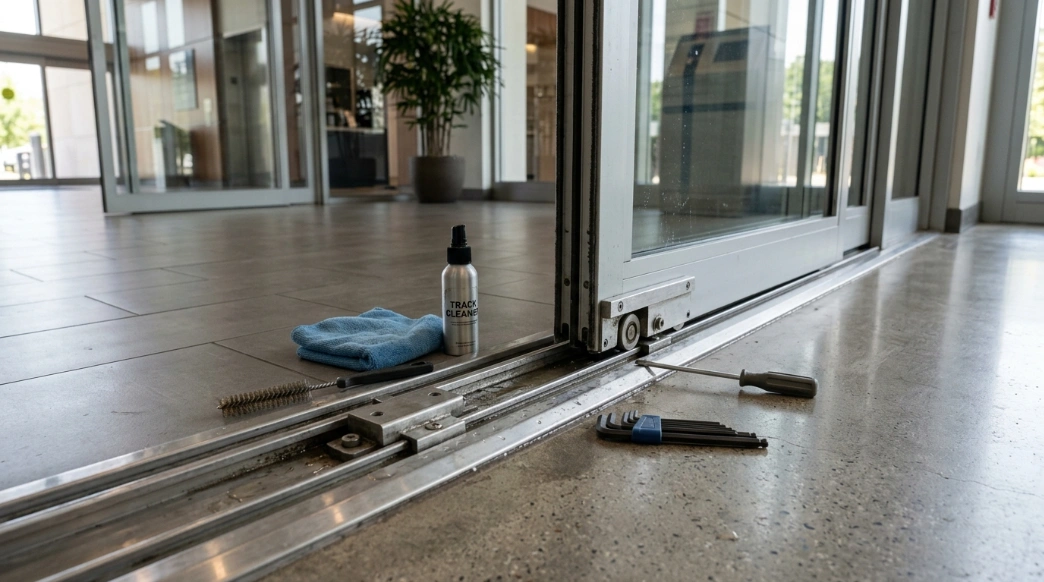
Below the header, bottom guides wear out of the track, the floor track fills with grit or gets knocked out of line, and the panel starts dragging. Left alone, a dragging panel takes the carriers with it and then the panel edge itself.
We replace the running gear, clean and realign the track, square the opening and reset the operator, rather than forcing a derailed panel back onto a track that caused the derailment in the first place.
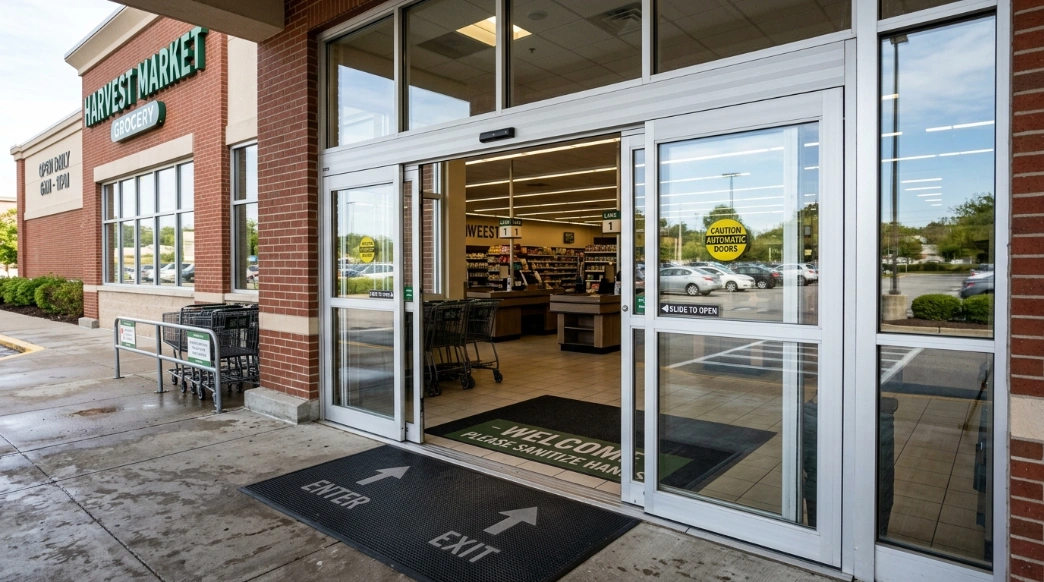
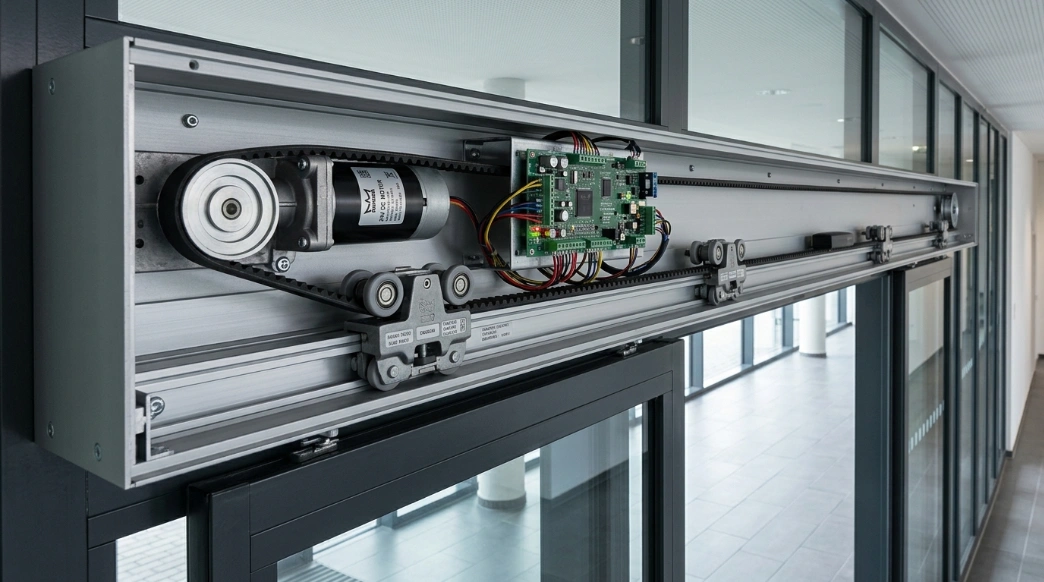
Header and Operator Repair
Inside the header we repair and replace drive belts and pulleys, motors and gearboxes, encoders and limit switches, control boards and power supplies. Where an operator has been undersized for the panel weight or the duty cycle it runs, we say so rather than replacing the same component a third time.
Header covers, end caps and structural support are checked at the same time — a sagging header puts the panels out of plumb and wears one side of the running gear faster than the other, which is the usual reason a door that was repaired six months ago is dragging again.
Track, Carrier and Bottom Guide Repair
Carriers, hanger rollers and anti-riser rollers are the components that wear fastest on any high-cycle sliding entrance. Replacing them is straightforward; identifying why they wore out early is the part that keeps the repair from repeating.
Bottom guides and floor tracks take grit, water, cart wheels and salt. We clean, realign and replace track sections, renew guides, and check that the panel is running plumb through the whole sweep rather than only at the closed position.
Sensor and Breakout Faults
A sliding entrance that stays open, closes on people or opens at nothing is almost always a sensor problem rather than a drive problem. Detection and safety zones drift, and a new display, a repositioned cart corral or a change in floor finish can put the door outside the behaviour it was set up for.
We replace and re-aim overhead motion and presence sensors, threshold sensors, photo eyes and safety beams, then re-test the door from every approach direction. Breakout switches and panel hinges are serviced at the same time so the egress path works when it is needed.
Common Automatic Sliding Door Problems
- Door stays open and will not close.
- Door opens part way, stalls or reverses mid-cycle.
- Door drags, grinds or scrapes along the floor track.
- Panel has come off track or is sitting low in the opening.
- Door will not break out, or breaks out under normal use.
- Door is noisy, jerky or noticeably slower than it used to be.
- Meeting stiles no longer close tight and the entrance leaks air and water.
- Door opens at nothing, or fails to detect someone approaching.
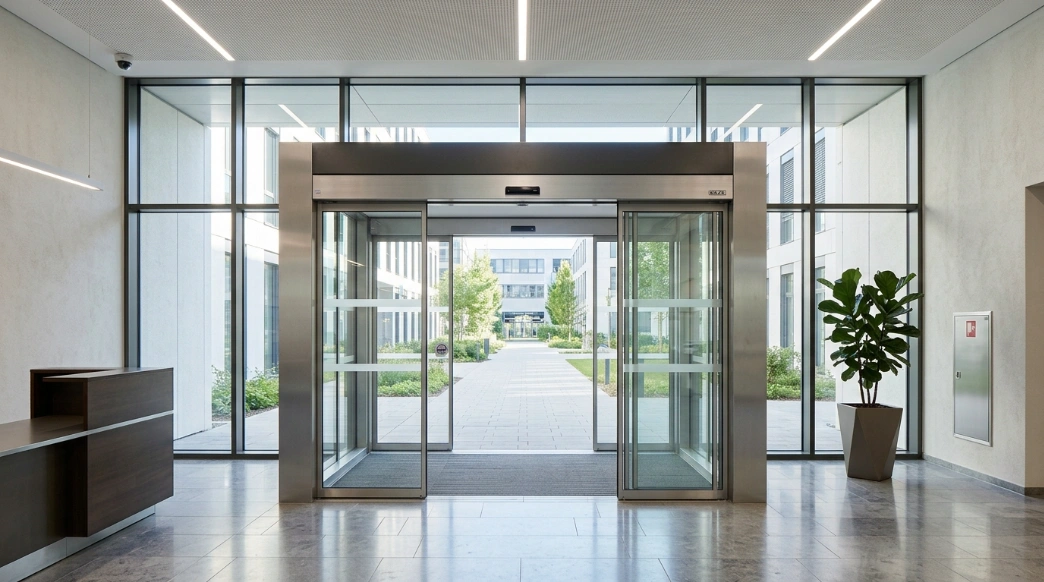
Automatic Sliding Door Replacement
Where the operator is obsolete or the header is damaged past repair, the sliding system is replaced. In most buildings the new header, drive and panels go into the frame that is already there, which keeps the work to a single visit and leaves the surrounding glazing untouched.
Where the opening has outgrown the door — more traffic, wider carts, a new layout — the replacement is the natural point to change configuration, most often from single-slide to bi-parting, or from bi-parting to telescopic for a wider clear opening in the same wall.
Automatic Sliding Door Installation
New sliding entrances are specified to the clear opening the building needs and the duty cycle they will run, then installed complete with header, drive, panels, sensors and activation devices, and tied into access control where the entrance requires it.
Which standard applies depends on how the door is activated: motion-activated full-energy sliders fall under ANSI/BHMA A156.10, while sliders activated by a knowing act such as a push plate fall under A156.38. That distinction changes the required sensor package and the speed settings, and it is regularly got wrong in the field — including on doors installed by other contractors that we are later called out to correct.
Keeping a Sliding Entrance Running
Sliding doors reward a schedule more than any other entrance type, because almost everything that fails on them wears gradually and visibly. Belt tension, carrier condition, track cleanliness, seal compression and sensor alignment all drift in ways that a technician can see months before the door stops.
High-cycle sliding entrances in retail and healthcare are usually maintained monthly or quarterly. Moderate-traffic entrances sit on a semi-annual interval, with the annual safety inspection folded into one of the visits.
Seals, Thresholds and Air Leakage
Meeting-stile seals, brush seals along the jambs, sweeps and the threshold are the cheapest components on a sliding entrance and the first ones people stop noticing. When they harden or wear, the door still opens and closes normally — it just stops sealing.
The result is conditioned air leaving the building, water and grit reaching the floor track, and a bottom guide that wears out faster than it should. Replacing seals and correcting the threshold is normally a short visit and it protects the running gear underneath.
Service Areas
Texas — Austin, Cedar Park, Cypress, Richardson, McKinney, Sherman, Paris. Connecticut — Hartford, New Haven, Danbury, Greenwich. Alabama — Birmingham.
Tell us the configuration and what the door is doing, and we will bring the parts that fault usually needs.
Our Services
Frequently Asked Questions
What is the difference between single-slide and bi-parting?
A single-slide has one moving panel; a bi-part has two opening from the centre. A bi-part clears a wide opening roughly twice as fast, which matters on high-traffic entrances.
When do I need a telescopic slider?
When the clear opening you need is wider than the wall space available for the panels to stack. A telescopic system stacks two or three panels per side instead of one.
What does breakout mean on a sliding door?
Breakout panels swing out of the opening under force so people can get out if the door loses power or jams. Breakout force and operation are checked whenever the door is serviced.
Why does my sliding door stay open?
Usually a presence sensor holding the door, a hold-open switch left engaged, or a failed limit or encoder. It is a quick diagnosis once a technician is at the door.
Why is my automatic sliding door dragging?
Worn carriers or hanger rollers, a contaminated or bent floor track, or a panel that has dropped. Forcing it makes the damage worse — the running gear needs replacing and the track realigning.
Can a manual sliding door be made automatic?
Yes. Retrofit operators are made for existing sliding doors, provided the frame and header can carry the unit and the panel weight is within range.
How often should an automatic sliding door be serviced?
High-cycle retail and healthcare entrances are usually monthly or quarterly. Moderate-traffic entrances semi-annually, with the annual safety inspection folded into one visit.