

Emergency Board-Up and Door Securement
When entrance glass goes, the building cannot be left as it is. A1 Door Services boards up and secures commercial openings across Texas, Connecticut and Alabama, then returns to fit the replacement panel or glass and put the entrance back into automatic operation. Board-up is the first half of the job, not the whole of it. The opening is measured while we are on site so the permanent repair is already moving before the plywood goes up.
 (855) 676-0881
Get in touch with us
Call us 24/7: (855) 676-0881
Or Let Us Call You
Emergency Securement and Board-Up
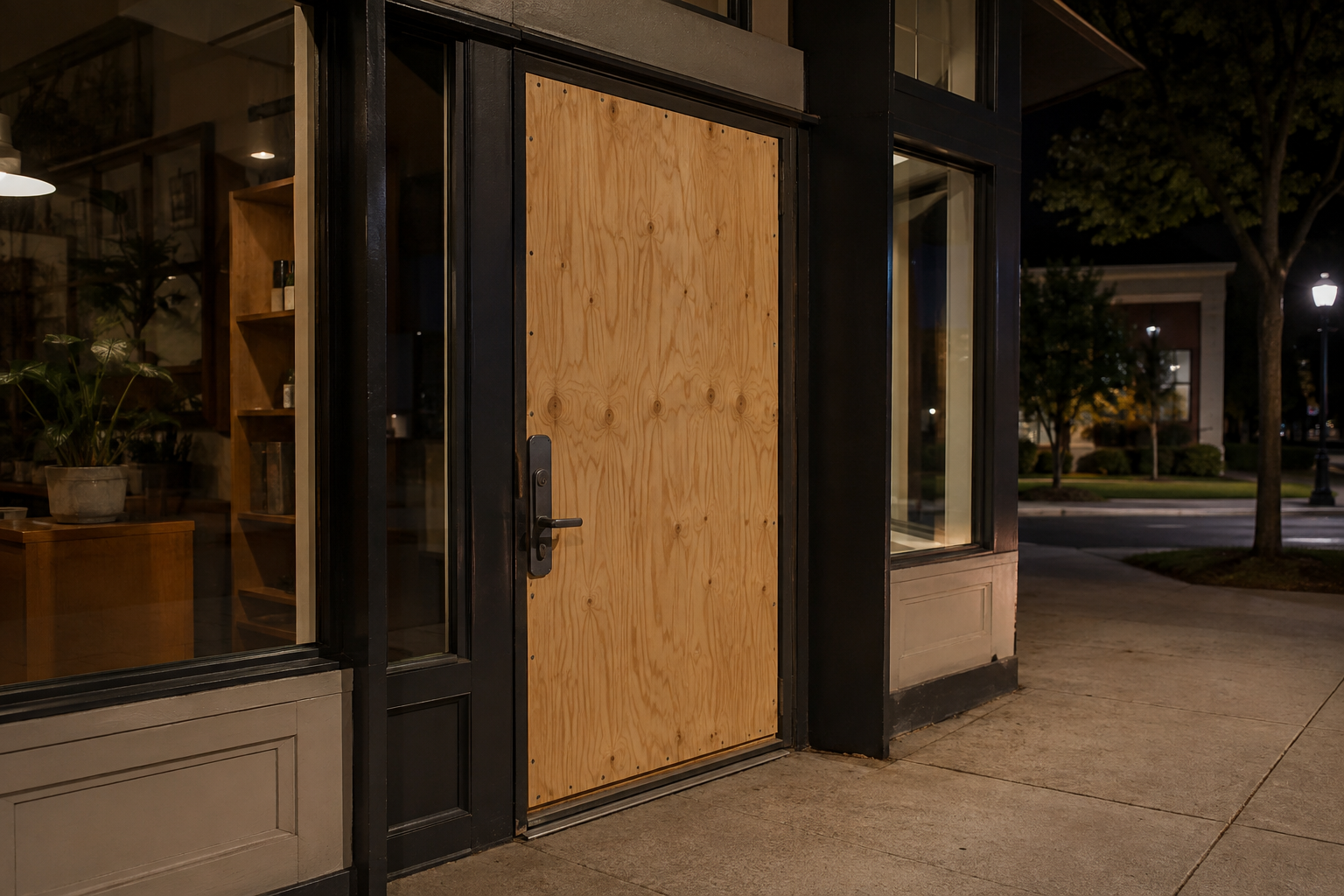
Broken or shattered entrance glass, a panel damaged past use, or a door that will no longer close and lock — the opening is secured so the building can be shut for the night and reopened safely in the morning.
Securement covers automatic entrance panels, sidelites, transoms, storefront glass, interior openings and service doors. Where the entrance has more than one leaf, we can often secure the damaged section and keep a route through the building open.
Where an automatic door has lost power or a panel, the operator is isolated so nothing tries to drive a damaged assembly.
Vehicle Impact Damage
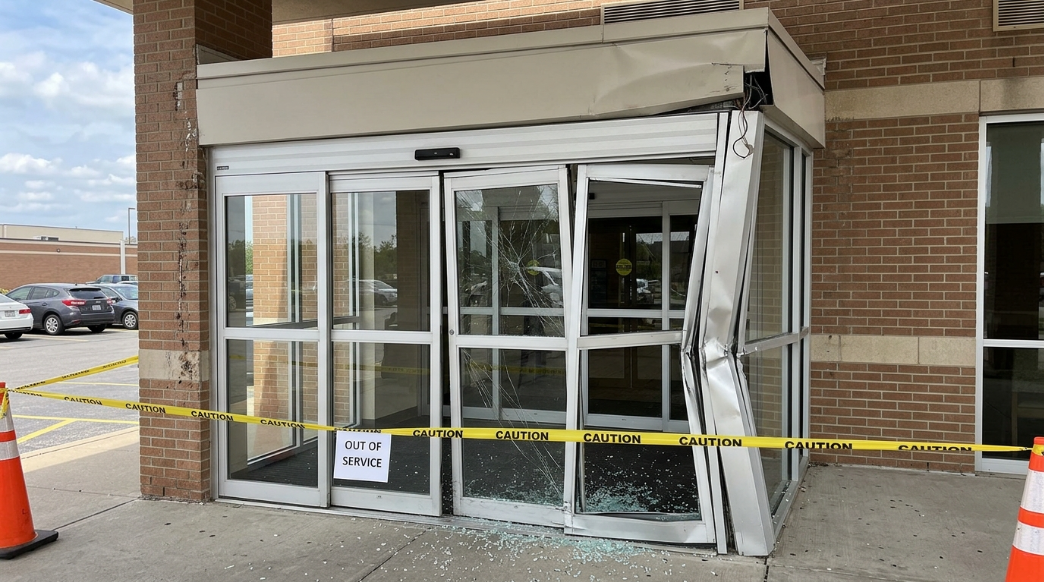
A vehicle into an entrance almost never damages only the glass. The header, frame, threshold, track and operator all take load, and the damage to the structure is often not visible until the panels are out.
We secure the opening first, then assess the header and frame for straightness and support, check the operator and running gear, and set out what has to be repaired and what has to be replaced. Bollards or guard posts are worth discussing at the same time — an entrance that has been struck once usually sits somewhere an entrance gets struck.
Break-In and Forced Entry
Forced doors, levered frames, damaged locks and broken glass after a break-in are secured in the same visit. Where a panel or frame has been levered out of shape, the opening is boarded and the frame is straightened or replaced as part of the follow-up repair.
Locking hardware, electric strikes and access control components damaged during the entry are checked and replaced with the glass rather than afterwards, so the entrance is genuinely secure once the board comes off.
Storm and Weather Damage
Wind-driven debris, water intrusion and pressure damage to entrances are secured and made watertight. Storm damage often shows up first as an entrance that will not seal or a threshold that has lifted, and only later as visible damage.
After the immediate securement we check the whole assembly — panels, header, threshold, drainage and seals — because water that has been through an entrance once will keep coming through the same path until it is closed properly.
Glass and Panel Replacement
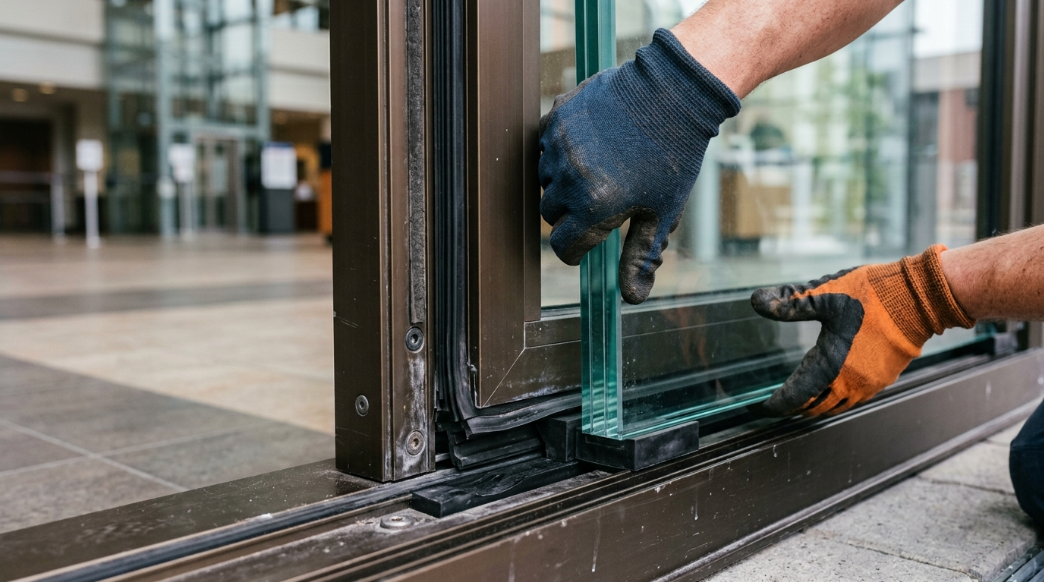
Tempered, laminated and insulated units for entrance panels, sidelites and transoms are measured on site and fitted when they arrive. Damaged stiles, rails, glazing gaskets and beads are replaced with them.
The board-up stays in place and the building stays secure until the permanent glass is in. On automatic entrances the panel is rehung, the running gear checked, and the door reset and tested before it goes back into automatic operation.
Frame, Header and Threshold Damage
The part of the repair most often skipped is the structure. A frame that has been struck or levered is rarely square afterwards, and an automatic door hung in an out-of-square opening will wear its carriers and lose its settings within months.
We check and correct frame square, header support and threshold seating before the new panel goes in, so the entrance runs the way it did before rather than becoming a recurring service call.
Restoring Automatic Operation
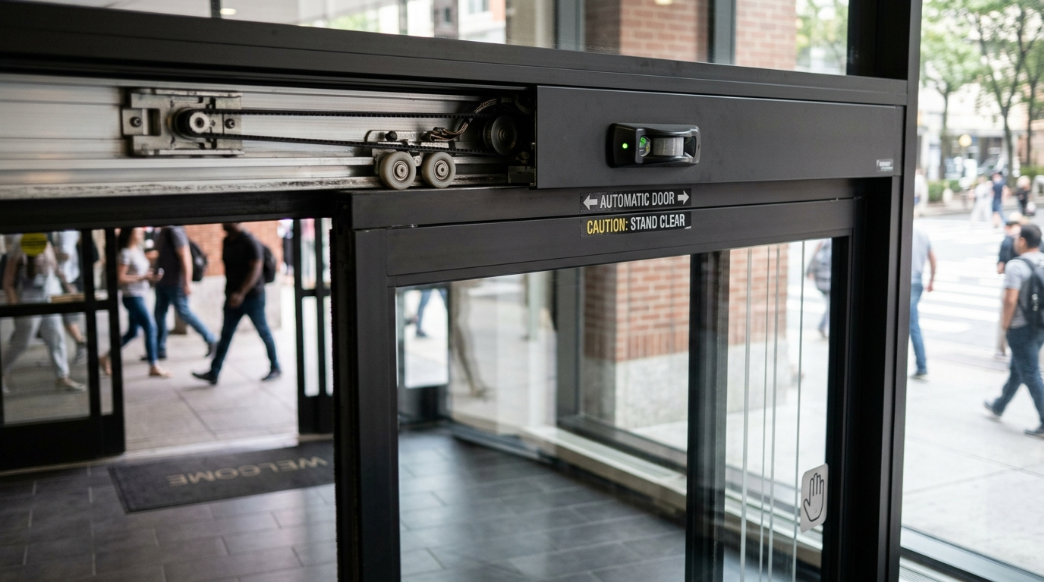
Once the glass and structure are back, the entrance is returned to full automatic operation: panels rehung and aligned, running gear replaced where it was damaged, sensors re-aimed to the rebuilt opening, and timing, force and breakout re-tested.
Damage is photographed throughout, which is what building owners normally need for their own records after an incident.
What We Secure
- Automatic entrance panels, sidelites and transoms.
- Commercial storefront glass and framed glass doors.
- Doors that will not close or lock after damage.
- Interior openings, suite doors and service entrances.
- Openings damaged by vehicle impact, forced entry, storm or vandalism.
Why Board-Up and Door Repair Belong Together
A general board-up contractor secures the hole. A door contractor secures the hole and understands what has happened to the entrance behind it — whether the header has taken load, whether the running gear is damaged, whether the operator can be run at all.
That matters because the second visit is where the money goes. An opening boarded without checking the frame and header usually needs the work doing twice: once for the glass, once again when the door will not run properly in a frame that was never straightened.
We secure the opening, assess the whole assembly while we are there, and come back once to finish the job rather than twice.
Interim Security While the Glass Is on Order
Replacement glass for a commercial entrance is made to order and rarely available the same day. The board-up has to hold for days rather than hours, and it has to leave the building usable.
Where the entrance has more than one leaf, we secure the damaged section and keep a route open. Where it does not, we can often restore a manual door in the opening so staff and customers still have a way in and out. Locking hardware is checked and made functional so the building can be secured properly at night rather than relying on the board alone.
After-Hours and Weekend Board-Up
Damage rarely happens at a convenient time. Board-up calls are answered at night, at weekends and on public holidays, because an unsecured entrance is not something that can wait until Monday.
Retail sites are usually secured before closing time is missed. Healthcare, hospitality and multi-tenant buildings are secured with the route through the building kept open, since those buildings do not close at all.
Damage That Is Not Obvious on the Night
Glass is the visible part of the damage and rarely the whole of it. A vehicle strike loads the header and can shear its fixings. A forced entry twists the frame and stretches the lock preparation. Storm damage lifts thresholds and drives water into the floor track where it sits for weeks.
We check the header, jambs, threshold, track and operator while the opening is boarded, so what comes back on the second visit is a full repair rather than a new panel in a damaged frame. Where the structure needs work, you know before the glass arrives rather than after.
Service Areas
Texas — Austin, Cedar Park, Cypress, Richardson, McKinney, Sherman, Paris. Connecticut — Hartford, New Haven, Danbury, Greenwich. Alabama — Birmingham.
Call as soon as the opening is unsafe — we secure it first and measure for the replacement while we are there.
Our Services
Frequently Asked Questions
How quickly can you board up an opening?
Board-up calls are treated as emergencies and answered around the clock, including nights, weekends and public holidays.
Do you replace the glass as well as board it up?
Yes. The opening is measured during the board-up so the replacement glass or panel is on order straight away.
Can you board up an automatic entrance and keep it usable?
Where the opening has more than one leaf, we can often secure the damaged section and keep a route through the building open. On a single entrance the opening is secured and an alternative door is used until the glass is fitted.
Do you handle vehicle impact damage to entrances?
Yes, including the header, frame, threshold and operator damage that usually comes with it, not just the glass.
Will you document the damage?
Yes. The condition of the entrance is photographed during the board-up and through the repair, which is what building owners normally need for their own records.
Will the automatic door work again after the repair?
Yes. Once the glass and structure are back, the panel is rehung and aligned, the running gear checked, the sensors re-aimed and the timing and breakout re-tested before the door returns to automatic operation.
Do you fix the frame or just the glass?
Both. A frame that has been struck or levered is rarely square afterwards, and an automatic door hung in an out-of-square opening will not hold its settings.